
2026-08-31 · Moni Happy Editorial Team
Live Commerce Reshapes Baby Products Retail in the Philippines and Indonesia
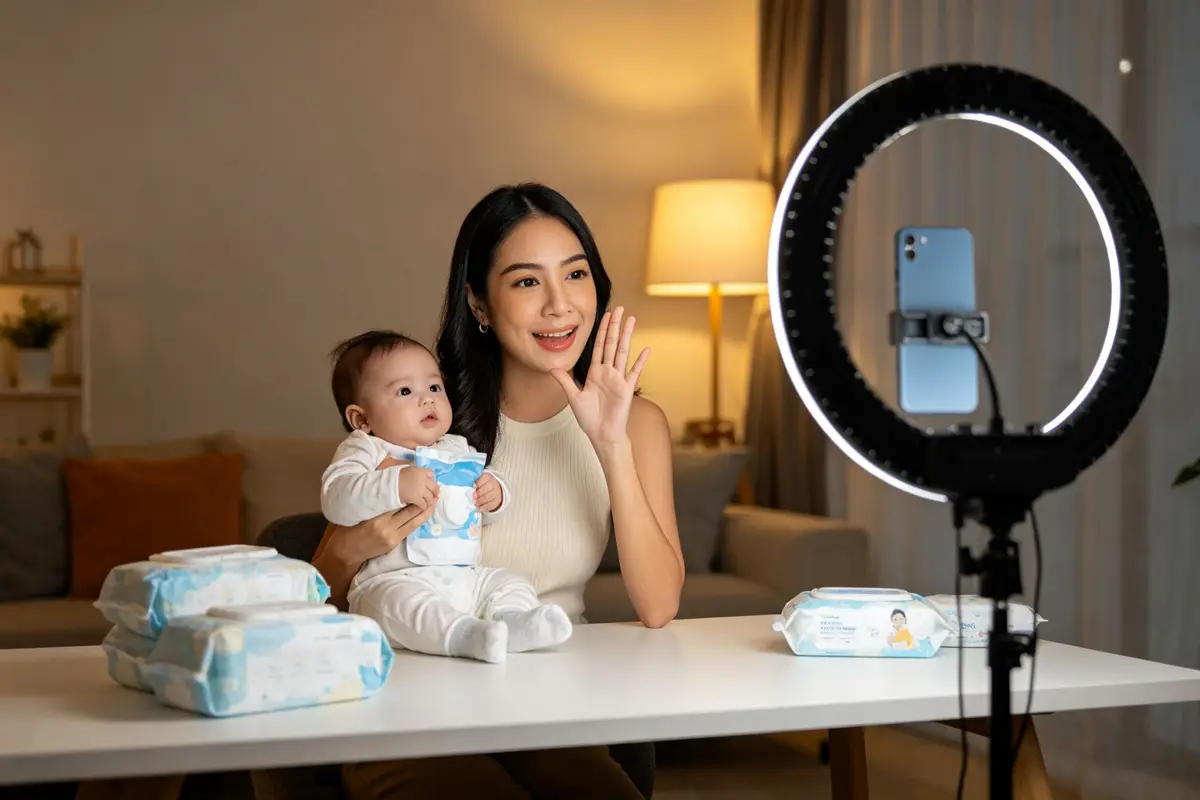
Key takeaway. Live commerce has become a real channel for baby products in the Philippines and Indonesia, and it behaves differently from everything else in the region: the transaction happens inside a livestream, the price moves during it, and the decision is made in minutes rather than days. For a brand or distributor deciding whether to invest in it, the useful question is not how large the market is reported to be but whether your product survives a live demonstration and a moving price.
Two things have made baby products a good fit for this channel, and they are structural rather than accidental.
The Live Commerce Explosion
Live commerce in the region grew out of social platforms rather than out of e-commerce marketplaces, which is why the format looks different from what most suppliers have seen in Europe or North America. The host is the storefront. There is no search, no category page, and no product comparison — the customer sees one product at a time, while it is being used, and can buy it while it is still on screen.
That has three consequences that matter commercially. The decision window is minutes, not days. The price is set for that session. And the relationship is with the host, not necessarily with the brand behind the product.
For a supplier, this means the same product behaves very differently here. Anything that depends on the customer comparing specifications before buying is disadvantaged. Anything that can be demonstrated in a few seconds is not.
Why Baby Products Are a Natural Fit for Live Commerce
Baby products have three properties that suit the format unusually well.
Demonstrable. Absorption, softness, stretch and thickness can all be shown on camera in seconds — a demonstration says more than a specification table, and a viewer who is holding a phone has time to watch it.
Repeat purchase is the base case. The host is not selling a one-off purchase. They are introducing a product that will be re-bought for months, which means the economics of the channel are not about a single transaction value.
Trust transfers from the host. For a new or unfamiliar brand, a credible host is a shortcut past the question "who is this and can I rely on them". That is the single most valuable thing this channel does for a brand that is not already established in the market.
It also has specific challenges that are worth naming honestly. Returns on a moving-price purchase can be significant, because a customer who did not intend to buy usually does not. Shelf-life pressure is real for anything with a use-by date. And the margin has to survive a promotional price that may not be repeatable.
Philippines: A Live Commerce Powerhouse
The Philippines is the most mature live commerce market in the region, and it is where the format was most aggressively built out. For a supplier, what matters is less the size of the audience than the structure: a set of established hosts with their own followings, high mobile penetration, and a consumer habit of buying through a broadcast rather than through search.
The practical implication is that a distributor entering the Philippines through live commerce is buying access to someone else's audience. That is worth paying for, and worth being clear about what you are paying for — you are buying a specific host's audience, not owning a customer relationship.
Indonesia: Scale and Opportunity
Indonesia is the larger population and the larger opportunity, with a correspondingly more dispersed set of platforms and hosts. The structural difference from the Philippines is not the format but the geography: distribution outside the major cities is a real logistics problem, and that shapes which products are practical to sell this way.
For a supplier, the question is whether your product survives a shipping network that reaches beyond the cities. Products that are heavy relative to their value, or that have a long shelf life requirement, travel very differently from a compact consumable.
Implications for Baby Care Brands
Three practical conclusions for a brand or distributor considering this channel.
Test the format with a product designed for it, not your best seller by default. A product that is easy to demonstrate and simple to explain will outperform a technically better product that takes a minute of camera time to convey. This is a packaging and communication decision as much as a product one.
Treat the host relationship as channel, not as advertising. The economics work when a host's audience converts repeatedly for you, which means the relationship has to be ongoing rather than a one-off session. Negotiate on repeat appearances, not on a single stream.
Decide what happens after the live session. A customer who bought during a promotion and cannot find the product at a normal price next time does not stay a customer. Make sure the product is available through your ordinary channels at a price that does not punish the buyer for watching a livestream.
Whichever channel you build it on, the economics start with the same four figures — landed cost, price, freight responsibility and payment terms — and those are what we work through market by market rather than publishing generically. See the Moni Happy partner program for how we approach it, and the baby diaper and baby wipes lines for the product detail that suits this format.
The Future of Live Commerce in Baby Care
The direction is difficult to predict and easy to overstate, so we will keep to what is observable: it is established in the Philippines, expanding in Indonesia, and still uneven elsewhere in the region. What is also observable is that it rewards products that are demonstrable and repeatable rather than products that are merely differentiated.
For most suppliers the sensible position is to treat it as one channel among several, test it with a limited range and a fixed budget, and judge it on repeat purchase rather than on the size of a single session.