
2026-10-09 · Moni Happy Editorial Team
How Do I Calculate the Landing Cost of Imported Baby Diapers?
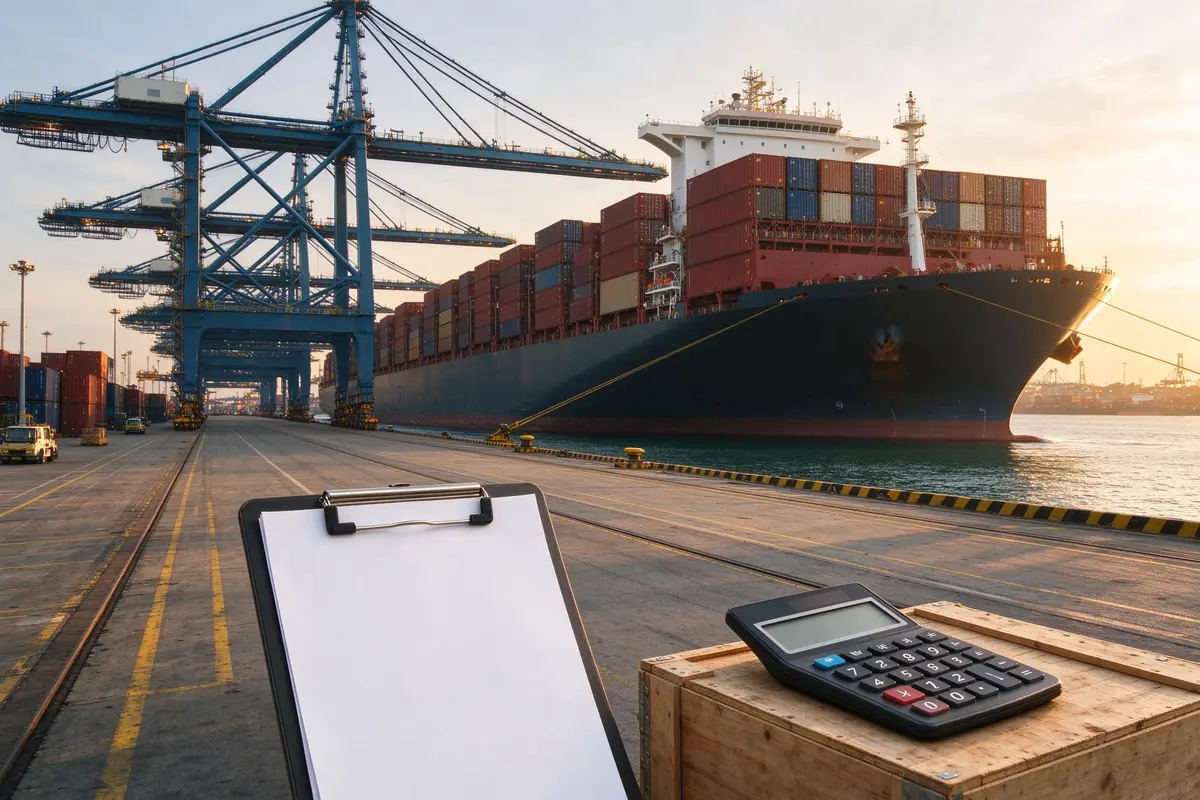
Landed cost per pack equals FOB goods cost plus origin and destination port charges, sea freight, insurance, import duty, VAT/GST, customs clearance and inland delivery, divided by the number of packs received. In a worked example below, one container shows landed unit cost landing above FOB once freight, duty and clearance are added. Treat the ratio as an illustration of the method, not a market rate. Baby diapers ship under HS code 9619, and ASEAN free-trade certificates of origin (Form E for China, AJCEP for Japan) can cut import duty to 0–5%.
Most new importers lose money not because the FOB price is wrong but because they quote customers before adding the six layers of cost that sit between the factory and their warehouse. This guide gives the formula, indicative Southeast Asian rates and a fully worked example. For what margin to add on top, see the diaper wholesale price and margin guide.
What is included in landed cost?
- FOB goods value — the factory price loaded on board at the origin port.
- Origin port/local charges — documentation, booking and terminal handling at export.
- Sea freight — the container rate from origin to your destination port.
- Insurance — commonly about 0.3–0.5% of CIF value.
- Import duty — set by HS code and origin; check for FTA reductions.
- VAT or GST — generally recoverable for tax-registered businesses.
- Destination port, customs clearance and inland delivery to your warehouse.
What is the difference between FOB, CIF and DDP?
- FOB: you arrange and pay freight, insurance and import costs.
- CIF: the seller covers Cost, Insurance and Freight to your port; you handle duty, clearance and on-carriage.
- DDP: the seller delivers duty-paid to your door — convenient but usually the most expensive and least transparent.
How much are freight, insurance and port charges?
Indicative ranges for planning (rates move with fuel and peak season):
- Sea freight for one 20GP from East Asia to major Southeast Asian ports: ask your forwarder for a current quote. Rates move with fuel, season and capacity.
- Marine insurance: about 0.3–0.5% of CIF value.
- Terminal handling, documentation and clearance: charged by the port and destination — obtain it from the port authority or your clearing agent.
- Inland delivery to your warehouse: depends on distance and road access — price it with your haulier for the actual address.
How much duty and VAT apply to diapers in Southeast Asia?
Diapers and similar hygiene products are classified under HS 9619. Applied Most-Favoured-Nation duty varies by country (often in a broad 0–25% range), but goods with a valid certificate of origin can qualify for much lower ASEAN FTA rates, commonly 0–5%. Standard indirect-tax rates are approximately:
| Market | Standard VAT / GST (indicative) |
|---|---|
| Singapore | 9% GST |
| Thailand | 7% VAT |
| Vietnam | 10% VAT |
| Indonesia | 11% VAT |
| Philippines | 12% VAT |
| Malaysia | SST (verify applicable rate) |
These rates change, and diaper-specific duty and exemptions differ by market — always confirm HS 9619 duty and current VAT with a licensed customs broker before ordering. For registered, VAT-compliant businesses, import VAT is generally an input credit, not a true cost.
Worked landed-cost example
Illustrative only, with clearly assumed inputs for one 20GP of about 3,000 mixed-size packs:
| Line item | Amount (US$) |
|---|---|
| FOB goods (3,000 packs × US$5.00) | 15,000 |
| Sea freight (20GP) | 1,500 |
| Insurance | 180 |
| CIF value | 16,680 |
| Import duty @ 5% with FTA certificate | 834 |
| VAT @ 10% on (CIF + duty) — usually recoverable | 1,751 |
| Port, clearance and inland delivery | 1,400 |
| Landed cost incl. VAT | 20,665 |
| Landed cost excl. recoverable VAT | 18,914 |
| Landed per pack (excl. recoverable VAT) | ≈ US$6.30 |
Without the FTA certificate at, say, a 15% MFN duty, duty would be US$2,502 instead of US$834 — a US$1,668 difference on one container. That is why origin paperwork is worth more than aggressive price haggling.
How can I legally lower landed cost?
- Obtain Form E (China) or AJCEP (Japan) certificate of origin for every shipment.
- Confirm the correct HS code (9619) and any category exemptions.
- Fill the container to its volume limit — fixed freight is spread across more packs; use compact wipes and tissue to fill gaps.
- Ship outside peak surcharge windows where possible.
- Register for VAT so import VAT becomes a recoverable input credit.
- Ask the brand whether CIF or FOB gives the better all-in rate; compare on landed per piece only.
For an exact landed quotation to your nearest port, including certification and packing documentation, contact the Moni Happy partner program. For route-to-market after clearance, see the Southeast Asia distribution channel guide.
Frequently asked questions
What is the HS code for imported baby diapers?
Baby diapers and similar hygiene articles are generally classified under HS code 9619; confirm the exact subheading with your customs broker.
How much is import duty on diapers in Southeast Asia?
MFN duty varies widely (often 0–25%), but a valid ASEAN certificate of origin commonly reduces it to 0–5%.
Is import VAT a real cost?
For tax-registered, VAT-compliant businesses, import VAT is usually a recoverable input credit rather than a true cost.
How much does sea freight add per diaper container?
A 20GP from East Asia to Southeast Asia is priced by your forwarder against the actual route, port and season — a published range will be stale by the time you book.
Bottom line: Never price from FOB alone. Build the full landed unit cost — freight, insurance, duty, VAT, clearance and inland delivery — and secure Form E or AJCEP origin paperwork, which on a single container can save well over a thousand US dollars versus MFN duty. Use a licensed broker for current rates, register for VAT recovery, and fill every container to spread fixed freight across the maximum number of packs.
Frequently Asked Questions
What is the HS code for imported baby diapers?
Baby diapers and similar hygiene articles are generally classified under HS code 9619; confirm the exact subheading with a customs broker.
How much is import duty on diapers in Southeast Asia?
MFN duty varies, often around 0–25%, but a valid ASEAN certificate of origin (Form E or AJCEP) commonly reduces it to 0–5%.
Is import VAT a real cost for distributors?
For tax-registered, VAT-compliant businesses, import VAT is usually a recoverable input credit rather than a true cost.
How much does sea freight add per diaper container?
A 20GP from China or Japan to Southeast Asia typically costs about US$800–2,500, depending on route, port and season.