
2026-11-03 · Moni Happy
Why do wet wipes wholesale packs fail at the seal rather than the wipe?
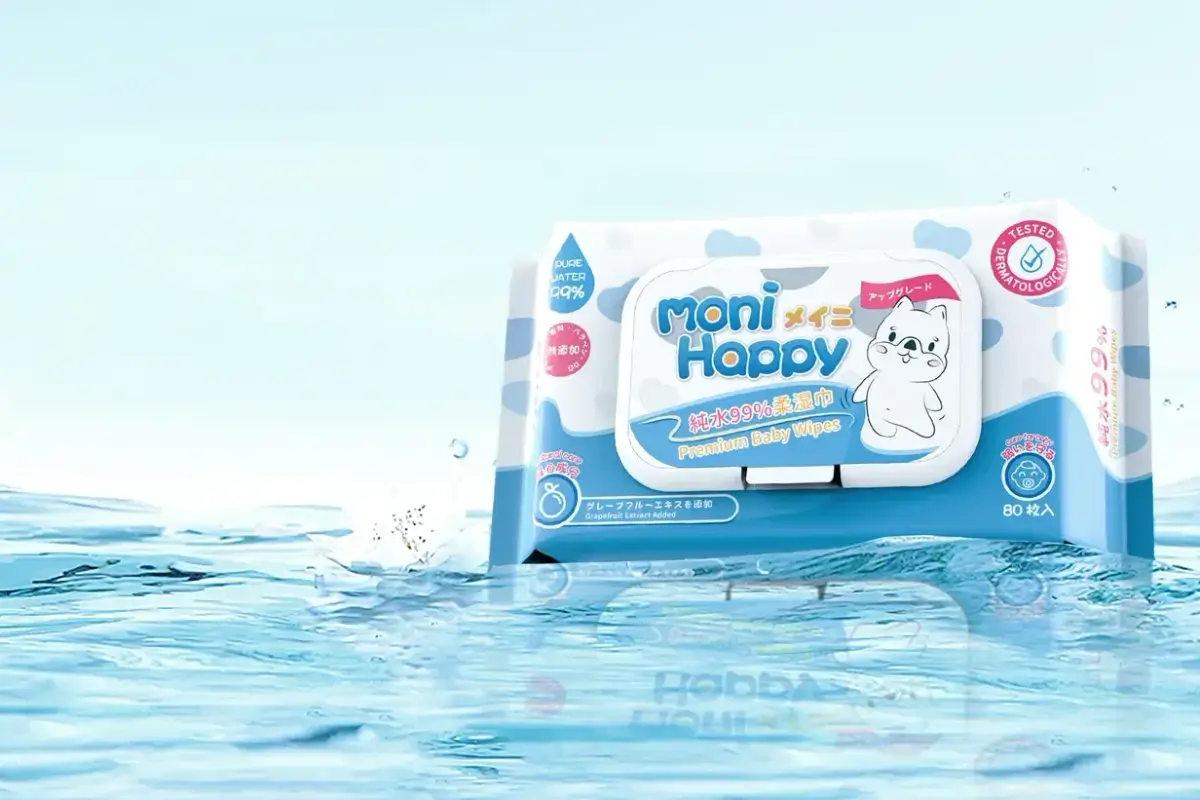
Because the seal goes first. A wet wipes wholesale pack fails at the lid adhesive, the film seal or the fold long before the wipe itself deteriorates, and all three failures arrive as a complaint about the product rather than the packaging. Three checks catch them: whether the lid still seals after 30 openings, how much moisture the pack loses over its shelf life, and whether one pull lifts exactly one sheet.
Most buyers spend their audit time on the wipe: substrate weight, water purity, preservative system. Those matter, but they are fixed at the production stage and hard to change after the first order. Seal and dispensing are decided by the film, the lid and the fold, and they are the two variables that behave differently in a tropical warehouse than they do on a European spec sheet.
Why does pack seal matter more than the wipe itself in a tropical warehouse?
Because heat and humidity attack the adhesive, not the substrate. A pack that holds its seal in a climate-controlled laboratory can lose adhesion on a 38°C loading dock, and the first sheets to dry are the ones a parent touches first. The complaint is always the same: the wipes on top are dry. Nobody reports a seal failure, so the defect hides inside a quality complaint about the product.
For a wipes wholesale buyer, that matters commercially. Dry top sheets drive returns in modern trade and destroy repeat purchase in independent stores, where the store owner absorbs the complaint personally and stops reordering.
How do you test a resealable lid before you place a wipes wholesale order?
Three tests, all of which can be run in an afternoon with a sample carton and a stopwatch.
- Lid cycle test. Open and reseal the lid thirty times, pressing it down as a user would. Then invert the pack and hold it for one minute. Any lift at the corner is a fail.
- Drop test. Drop a sealed pack from waist height onto a hard floor, on each face, twice. Check for film rupture at the seal and for lid separation.
- Peel check. After the cycle test, peel the lid back slowly and look at the adhesive transfer. Adhesive that has migrated onto the film, or a lid that curls at the edge, will not reseal in a shop.
Run all three on packs that have spent at least a week in a warm room, not straight out of an air-conditioned sample box. Packaging that passes cold frequently fails warm, and warm is where your stock will live.
What moisture loss should you accept over the shelf life?
Weigh a sealed pack at day zero on a kitchen scale accurate to a gram, then at day thirty and day ninety, storing the pack at ambient warehouse temperature and out of direct sun. Express the loss as a share of the original wet weight and compare it against the figure the supplier declares.
Two practical notes. First, weigh the whole pack including film, and record the dry pack weight from an empty pack of the same format so the wet weight is real. Second, keep one pack unopened as a control and one pack opened and resealed daily, because the realistic use case sits between the two. A pack that holds moisture sealed but fails the daily-open test has a lid problem, not a film problem.
How do you measure sheet dispensing and the double-pull problem?
Pull thirty sheets in sequence from a fresh pack at normal speed and count how many pulls returned more than one sheet. One or two double pulls in thirty is normal; five or more means the fold pattern, the perforation or the sheet tension is wrong for the pack format.
The cause is usually mechanical rather than material. A perforation that is too strong holds the next sheet; a sheet that is too wide for the film aperture drags its neighbour out; a stack that is packed too tightly creates suction. Ask the supplier which fold they use, how the stack is compressed, and whether the aperture size was set for that sheet dimension. A supplier who cannot answer in specifics has not tested it.
What do pack format choices do to pack seal and sheet dispensing?
Tubs are rigid, so seal risk sits in the lid hinge and the foil beneath it, and the failure mode is a hinge that cracks rather than a film that leaks. Soft packs put the whole burden on the film and the label reseal, and they are far more sensitive to how the carton is stacked in a container. Flow-wrap single sachets remove the reseal question entirely but change the cost per wipe and the shelf presence.
Neither format removes the need to test: a tub that survives a hinge test can still fail a pack seal check if the foil beneath the lid is under-specified. Match the format to the channel rather than to the price list. A pharmacy counter sells small soft packs because the purchase is immediate and the pack travels in a bag; a supermarket sells tubs because the pack lives on a shelf at home. Testing a tub's hinge life tells you nothing about whether a soft pack will survive your container.
How should the purchase order document these tests?
Write the acceptance criteria into the order, not into an email. Specify lid cycle count, drop height and faces, maximum moisture loss at ninety days, and the maximum number of multi-sheet pulls per thirty. Add an AQL sampling level for seal inspection and state that retained samples from the production run are kept for twelve months.
Retained samples are the cheapest insurance in the category. When a retailer complains in month seven, the retained pack from the same lot tells you within an hour whether the fault is in the goods or in the storage.
Frequently asked questions
What is the most common failure in a wet wipes pack?
The resealable lid losing adhesion after repeated opening in heat, letting the top sheets dry out. It appears as a complaint about dry wipes, not as a leak.
How do I measure moisture loss?
Weigh a sealed pack at day zero, day thirty and day ninety at ambient temperature, and express the difference as a share of the original wet weight.
What is a double pull, and how do I test it?
One pull lifting two or more sheets. Pull thirty sheets in sequence from a fresh pack and count how many pulls returned more than one.
Should I test tubs and soft packs the same way?
No. Tubs are judged on hinge life and stack strength; soft packs on film seal quality and the fold pattern that controls dispensing.
Bottom line. Seal and dispensing are the two wet wipes wholesale variables that behave differently in your warehouse than in the supplier's sample room, and both can be tested with a carton, a scale and thirty pulls. Put lid cycles, drop height, moisture loss and double-pull limits into the purchase order, keep retained samples, and you convert a category of complaints into a specification. Packaging specifications and pack formats are subject to formal quotation per order.
Distributors evaluating a wet wipes range can review the wipes product line and request free samples through the partner programme. If you are opening a new market and want the packaging specification sheet alongside pricing, start with the distributor application.
Sources and further reading
- EDANA, nonwovens industry guidance on flushability and wipes testing, 2024 — edana.org
- ASTM International, standards for packaging seal strength and distribution testing — astm.org
- International Organization for Standardization, catalogue of packaging and nonwoven test standards — iso.org/standards
Test methods should be agreed with the supplier and, where a retailer imposes its own packaging specification, with the retailer's quality team.
Frequently Asked Questions
What is the most common failure in a wet wipes pack?
The resealable lid losing adhesion after repeated opening in heat, which lets the top sheets dry out. It shows up as a complaint about dry wipes long before it shows up as a leak.
How do I measure moisture loss in a wet wipes pack?
Weigh a sealed pack at day zero, then again at day thirty and day ninety while storing it at ambient warehouse temperature. Express the difference as a share of the original wet weight.
What is a double pull, and how do I test for it?
A double pull is when one pull lifts two or more sheets. Pull thirty sheets in sequence from a fresh pack at normal speed and count how many pulls returned more than one sheet.
Should I test tubs and soft packs the same way?
No. Tubs are rigid and are judged on lid hinge life and stack strength; soft packs are judged on film seal quality and the fold pattern that controls dispensing.
Distributor resources
If you are evaluating suppliers for your market, these are the pages that answer the commercial questions — in the order buyers usually need them.