
2026-11-01 · Moni Happy
What does a wet wipes wholesale buyer check about the water used?
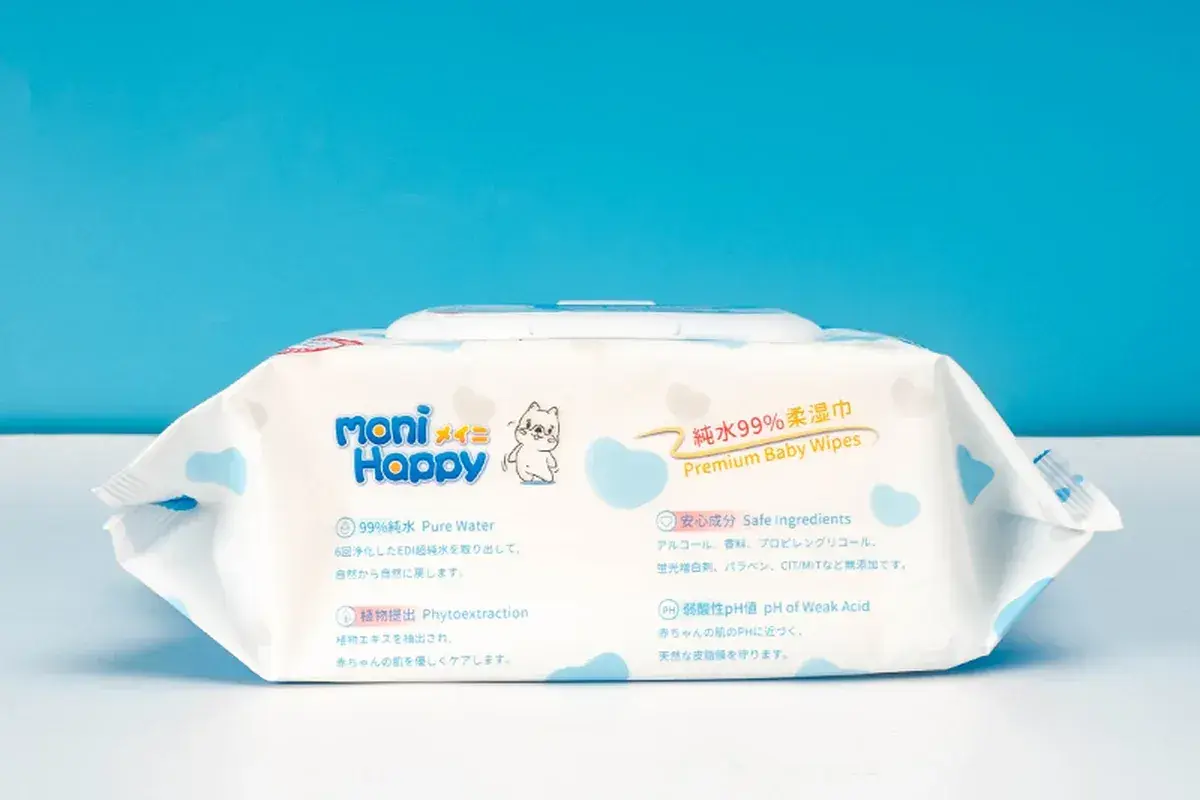
Check the water first, because water is the product. In a high-water-content baby wipe the liquid phase is the overwhelming majority of what leaves the factory, so the purity of that water sets the ceiling on how short the additive list can be. Before price, a wet wipes wholesale buyer should ask for four documents: the water treatment method, a current water test report, the full ingredient declaration, and the substrate specification. Wholesale terms and minimum order quantities are then quoted against a specification you can actually compare.
This matters commercially rather than academically. Retail buyers in Southeast Asia increasingly merchandise wipes on the additive exclusion list printed on the front of the pack — alcohol-free, fragrance-free, paraben-free. You cannot make that claim credibly on the back of impure water, because impure water forces preservatives into the formula to keep the pack stable.
Why does the water source decide the rest of the specification?
Because the cleaner the water, the less the formula needs to compensate. Water carrying residual chlorine, heavy metal ions or microbial load has to be held stable with preservatives and masked with chelating agents; water treated to ultra-pure grade removes that pressure and lets the ingredient list stay short.
The technology name to look for is EDI — electrodeionization — which is used in pharmaceutical and semiconductor production before the water is passed through a multi-stage filtration train. What a buyer should ask is not "do you use EDI" but "what is the conductivity of the water at the filling head, and who tests it, and how often". The answer separates a marketing claim from a controlled process.
Which water numbers should appear in a supplier's test report?
Three: conductivity or resistivity, total microbial count, and the absence of detectable residual chlorine. Ask for the report with a date and the sampling point named — at the filling head, not at the plant inlet.
- Conductivity in microsiemens per centimetre, taken at the point of use. It is the fastest proxy for dissolved ions.
- Microbial limits for total aerobic count, with the specification limit the plant holds itself to stated explicitly.
- Residual chlorine and hardness, which indicate whether the filtration train is being maintained rather than merely installed.
- Filtration stages, with the media named at each stage, so you can see what is being removed and in what order.
A supplier who can produce this on request is running a process. A supplier who can only produce a brochure is running a claim.
What should the ingredient declaration tell you about preservatives?
It tells you what the water purity is not doing. Preservatives exist in a wet wipe to hold a microbiological specification across shelf life; the more robust the water and the cleaner the filling environment, the less preservative load is needed. Ask for the full declaration, in descending order, and ask specifically which preservative system is used and at what level.
This is not an argument against preservatives — a wipe with no preservative system and no control over water quality is a microbiological risk, not a purer product. It is an argument for reading the two together. Compare any two wet wipes on offer and the pair of answers — water specification plus preservative system — tells you more about the product than either answer alone.
Why does the substrate matter as much as the liquid?
Because the sheet controls how the liquid is released onto skin. Spunlace nonwoven, where fibres are interlocked by high-pressure water jets rather than glue, gives a cotton-soft hand feel with enough tensile strength to resist tearing and linting during wiping. A weaker substrate sheds fibres onto skin, which defeats the purpose of a pure-water formula.
Ask for the substrate specification in numbers: fibre composition, grammage in grams per square metre, sheet dimensions, and the wet tensile strength the plant holds to. Then ask for a sample and do the test a buyer can do in five minutes — hold a sheet by opposite corners wet and pull. If it tears before it stretches, the sheet is under-specified for a premium pack.
How do you check the filling environment without an audit?
Ask for the cleanroom classification of the filling hall and the automation level of the line. A high-speed line that unwinds, doses, folds, cuts and seals inside a classified cleanroom, with the finished packs case-packed and palletised automatically, removes the main contamination route: people touching product.
For a wet wipes wholesale programme this is the answer that supports a premium shelf position, because it gives the retailer something concrete to say about why the pack costs more. Retail buyers respond better to a process description than to an adjective such as "gentle".
What else should be in the pack specification before you compare prices?
Pack count, sheet dimensions, closure type, film structure and carton configuration — the five variables that decide what the consumer actually experiences and what your shelf space costs.
- Pack count — wipes per pack, stated with a tolerance.
- Sheet size — millimetres, because a larger sheet at the same count is a different value proposition.
- Closure — resealable label or hard lid, and how many open-close cycles the adhesive is rated for.
- Film structure — thickness and barrier layer, which control moisture loss over shelf life.
- Carton — packs per carton, carton board grade, and whether the carton is shelf-ready.
Convert every quotation to cost per hundred wipes at a stated sheet size and the comparison becomes honest. Most price differences in this category dissolve into sheet size and pack count once normalised.
How should a buyer verify claims before the first container?
Three steps: request documents, request samples from the production batch that will ship, and inspect before shipment. Documents tell you what the plant says it does; samples tell you what the line actually produced; the inspection ties the two together.
Keep the approved sample sealed and dated. When the second container arrives and the sheet feels different, that sealed pack is the reference that makes the conversation short. If your supplier cannot supply a pre-shipment inspection report, arrange your own — for a first order in this category it is a small cost against a container of stock you cannot sell.
Where does the pure water claim fit in a retail pitch?
It fits where the retailer needs a reason to give you shelf space rather than a price cut. A wipe positioned on water purity and a short additive list sells into the sensitive-skin segment, which is the segment that pays for a premium facings position. That is a merchandising argument, not a chemical one, and it is the argument a wet wipes distributor should be able to make in two sentences.
Build the pitch around the four documents. Buyers at pharmacy chains and modern trade in the region are used to being shown a brochure; being shown a dated water test report changes the conversation. If you are still deciding which accounts to approach first, the channel guide maps how wipes move through pharmacy, grocery and e-commerce in the region, and the onboarding guide sets out the sequence from sample to first purchase order.
Frequently asked questions
Is 99 percent water the same as pure water?
No. The percentage describes how much of the formula is water; "pure" describes how that water was treated and tested. A pack can be almost all water and still be built on poorly controlled water.
Do I need a laboratory to check a wipe before buying?
Not for a first screen. Conductivity, sheet tensile and pack seal can be checked without a lab; reserve third-party testing for the batch you actually intend to ship.
Can a wet wipes wholesale programme start below a full container?
Sometimes, at a higher unit cost and with a narrower pack range. Minimum order quantities are set per market and per pack, so treat any figure you read as indicative and confirm it in a formal quotation.
How long is shelf life, and what shortens it?
Shelf life is set by the formula and the film barrier together, and heat shortens both. Ask for the declared shelf life at your storage temperature, not the supplier's ambient assumption.
Sources and further reading
- European Union, Regulation (EC) No 1223/2009 on cosmetic products — the ingredient and labelling framework many Asian markets benchmark against for wipes.
- EDANA, edana.org — nonwoven industry test methods and terminology for spunlace substrates.
- International Organization for Standardization, ISO 9001 quality management — the baseline a filling plant should be certified against.
Bottom line: water is the specification, not a marketing line. Ask for the treatment method, a dated water test report, the full ingredient list and the substrate numbers — then compare quotations per hundred wipes at a stated sheet size. A supplier who can answer all four is worth a longer conversation than one who cannot.
Moni Happy produces high-water-content baby wipes on an EDI ultra-pure water line with eight-stage filtration, filled in a Class 100,000 cleanroom. Distributors in Malaysia, Singapore, Thailand, Vietnam and Laos can request samples and an indicative quotation, or review the wipes range before shortlisting pack formats. Specifications and pricing are confirmed per market, subject to formal quotation.
Frequently Asked Questions
Is 99 percent water the same as pure water?
No. The percentage describes how much of the formula is water; pure describes how that water was treated and tested. A pack can be almost entirely water and still be built on poorly controlled water.
Do I need a laboratory to check a wipe before buying?
Not for a first screen. Conductivity, wet tensile strength and pack seal can be checked without a lab; reserve third-party testing for the batch you intend to ship.
Can a wet wipes wholesale programme start below a full container?
Sometimes, at a higher unit cost and with a narrower pack range. Minimum order quantities are set per market and per pack, so confirm them in a formal quotation rather than relying on a general figure.
How long is shelf life, and what shortens it?
Shelf life is set by the formula and the film barrier together, and heat shortens both. Ask for the declared shelf life at your actual storage temperature, not the supplier's ambient assumption.
Distributor resources
If you are evaluating suppliers for your market, these are the pages that answer the commercial questions — in the order buyers usually need them.
