2026-11-04 · Moni Happy
What is actually inside baby wipes, and how do you explain it at the shelf?
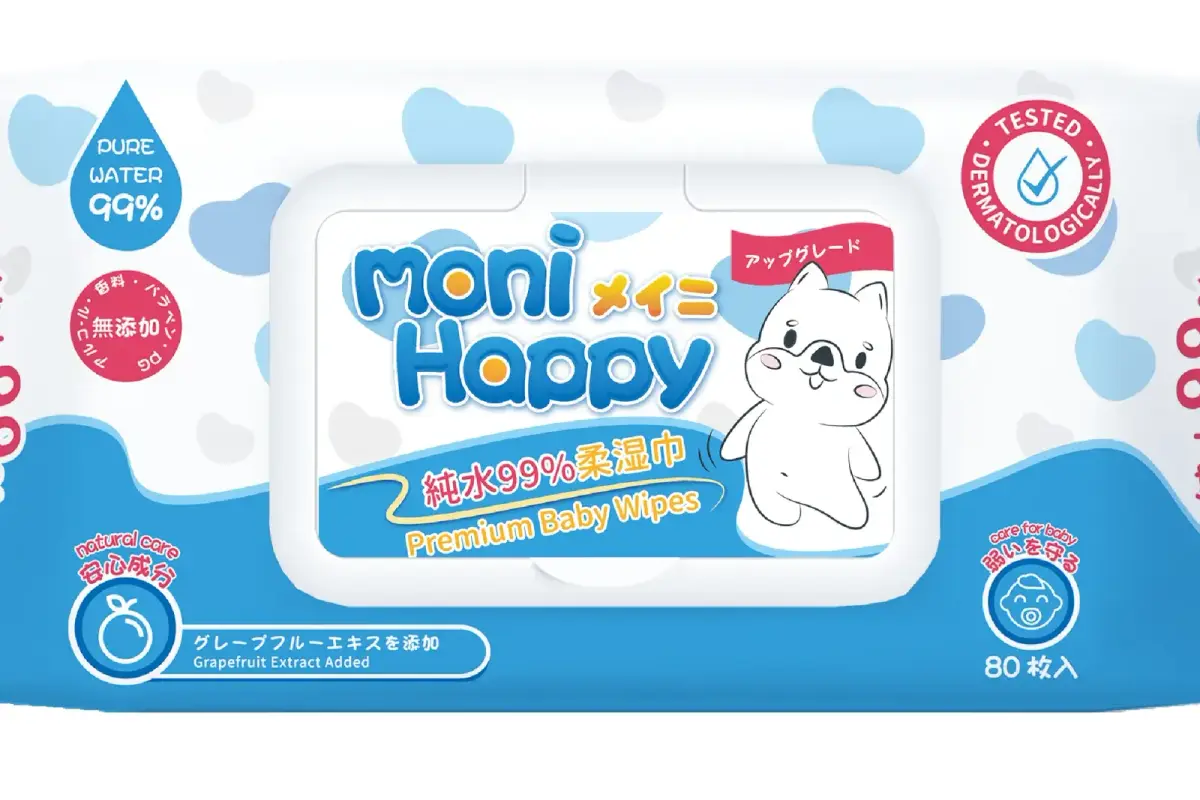
A baby wipes pack is four things: a nonwoven fabric, water, a small amount of mild surfactant, and a preservative system that keeps the pack safe after it is opened. Staff who can explain those four parts answer most parent questions at the shelf without guessing — and guessing is what loses the sale.
The questions are predictable. What is in it, why is there a preservative, is the fragrance a problem, and why is this pack more expensive. Each has a short, honest answer that a retailer can train in ten minutes, which is the whole point of a repeatable shelf explanation.
What is actually inside a baby wipe?
Fabric, water, surfactant, buffer and preservative. Everything else is optional.
- Nonwoven fabric — usually a spunlace blend. Its weight and texture decide how the wipe feels and whether it stretches in use.
- Water — the largest component by far. In a high-purity pack the water is filtered and treated before it ever meets the fabric.
- Mild surfactant — small quantities, present to lift residue rather than to create lather.
- pH buffer — keeps the liquid in a range compatible with skin.
- Preservative system — protects the pack once the resealable label has been opened and closed many times.
In practice a baby wipes pack is mostly water by weight, which is why the fabric and the water treatment decide most of what a parent experiences. Optional: fragrance, skin-conditioning agents, and extracts. These are the parts a parent is most likely to ask about, and the parts a retailer can most easily describe wrongly.
Why does the water quality matter more than the length of the ingredient list?
Because water is most of the product. A pack that is 99% water is defined by the quality of that water far more than by the last few ingredients on the label.
Water in a wipe is treated to remove microbial load and impurities before the fabric is saturated, and the production environment around it is controlled so the pack does not pick up contamination between filling and sealing. That is a manufacturing discipline rather than an ingredient, which is why it never appears on the pack. For staff, the practical phrasing is short: the water is filtered and treated, the pack is filled in a controlled line, and the preservative covers what happens after the customer opens it. Parents understand that chain immediately because it mirrors what they already know about sterilising bottles. The American Academy of Pediatrics parent guidance on nappy changing is a useful neutral reference to point to.
What do preservatives do in a wet wipe, and why can't they simply be removed?
They keep the pack safe after it is opened. An open pack is warm, wet and handled with unwashed hands — exactly the conditions microbes need.
This is the question where staff most often over-promise. Saying "no preservative" sounds reassuring and is usually either inaccurate or a description of a different preservation strategy. The honest answer is that a wet wipe needs a documented control for microbial growth, whether that is a preservative system or another validated approach, and that the choice is a formulation decision made with safety testing rather than a marketing one. If a parent is worried about irritation rather than microbes, redirect to what actually answers the concern: whether the finished product was tested on sensitive skin. That is a question with evidence behind it, and a retailer can ask a supplier for the report.
How do you explain free-from claims without overclaiming?
Describe what the claim covers and what it does not. A free-from statement lists absences; it is not a performance result.
Two packs can both say free from alcohol and behave completely differently on skin, because the claim says nothing about the surfactant, the pH or the fabric. Staff should treat free-from as a starting point for the conversation, not the conclusion. The stronger statement is the one backed by finished-product testing on sensitive skin, with a report the supplier can produce on request. If a customer asks which is better, the defensible answer is: this one has been tested on sensitive skin and here is what the pack says about it — rather than a comparison of which label lists fewer words.
What should staff say about fragrance and sensitive skin?
That fragrance is optional, that fragrance-free is a real and meaningful choice, and that sensitive skin is the reason that choice exists.
Fragrance is added for the parent's nose, not for the baby's skin. A fragrance-free pack removes one variable, which is why it is the version to recommend when a customer describes a baby who reacts to products generally. Note the distinction between fragrance-free and unscented, which are not the same claim in every market — if the pack does not say fragrance-free, do not describe it as such. For the wider conversation about skin sensitivity in nappies, our baby wipes range sets out which formats are fragrance-free, and the nappy rash talk track covers the change-frequency advice that usually matters more than the wipe itself.
How do you compare two packs at the same price?
Four things, in this order: sheet size, sheet count, fabric weight, and pack seal. Price per pack is the least useful comparison.
- Sheet size — a larger sheet often means fewer wipes per change, which changes the real cost per use.
- Sheet count — multiply by sheet size to compare total usable area, not pack price.
- Fabric weight — a heavier nonwoven resists stretching and does not tear mid-change.
- Pack seal — a pack whose label stops resealing dries out, and a dried pack is a returned pack.
A shelf explanation built on those four is honest, checkable and repeatable by any staff member. It also gives the retailer a reason to stock the higher-value pack instead of defaulting to the cheapest one on the fixture.
What should staff never say?
Never promise a medical outcome, never claim a product is sterile after opening, and never invent an ingredient comparison.
Never describe baby wipes as something that treats skin. They clean; they do not treat. A claim that a wipe prevents or cures a skin condition is a regulated claim in most markets and is not something a shop assistant should make. Equally, never assert what a competitor's pack contains — describe your own specification and let the customer compare. If a question goes beyond the pack, the correct answer is to point to the label and the manufacturer's published information, and to offer to check with the supplier. That answer protects the customer, the retailer and the brand at the same time, and it keeps the shelf explanation inside what the pack can actually support.
Frequently asked questions
Are water wipes the same as baby wipes?
They are a subset. A high-water-content wipe carries mostly treated water with minimal added ingredients, but it still needs a preservation strategy and a controlled filling environment.
Should staff recommend wipes for newborn skin?
Follow the pack's stated age guidance and the local health guidance. Cotton wool and water remains a common first-weeks recommendation in many markets, and staff should not contradict it.
Does a thicker wipe always clean better?
It handles better and tears less, which reduces the number of wipes used per change. Cleaning performance depends on the liquid and the mechanical action as much as on the fabric.
Sources and further reading
- American Academy of Pediatrics, HealthyChildren.org — baby care — parent-facing guidance on nappy changing and newborn skin care.
- EDANA, absorbent hygiene and nonwovens — industry guidance on nonwoven materials and hygiene product performance.
- Euromonitor International, retail data — category structure and pack-format trends in Southeast Asian retail.
Bottom line
A baby wipe is fabric, water, a mild surfactant, a buffer and a preservative — and the shelf conversation is won by explaining those five honestly rather than by listing what the pack does not contain. Train staff on water quality, the reason preservatives exist, what free-from actually means, and the four-way comparison of sheet size, count, fabric weight and seal. That is enough to answer nearly every question a parent asks.
Frequently Asked Questions
What are baby wipes actually made of?
A nonwoven fabric carrying a liquid made mostly of water, with a mild surfactant for cleaning, a pH buffer, and a preservative system that keeps the pack stable after opening. Fragrance and skin-conditioning agents are optional additions.
Why do wet wipes contain preservatives?
Because an opened pack is a warm, wet environment. Without a preservative system, microbial growth becomes a real risk once the seal is broken. A pack claiming no preservative needs another documented control, so staff should not promise it casually.
Does free from mean the wipe is safer?
Not automatically. Free-from claims describe what is absent, not what is present or how the product performed in testing. The more useful question is what testing the finished product passed on sensitive skin.
How should staff compare two packs at the same price?
Compare sheet size and count, fabric weight, water content and pack seal. Those four decide how the pack performs in use, and they are visible on the pack or in the specification.