
2026-11-01 · Moni Happy
What should store staff tell parents about facial tissue for babies?
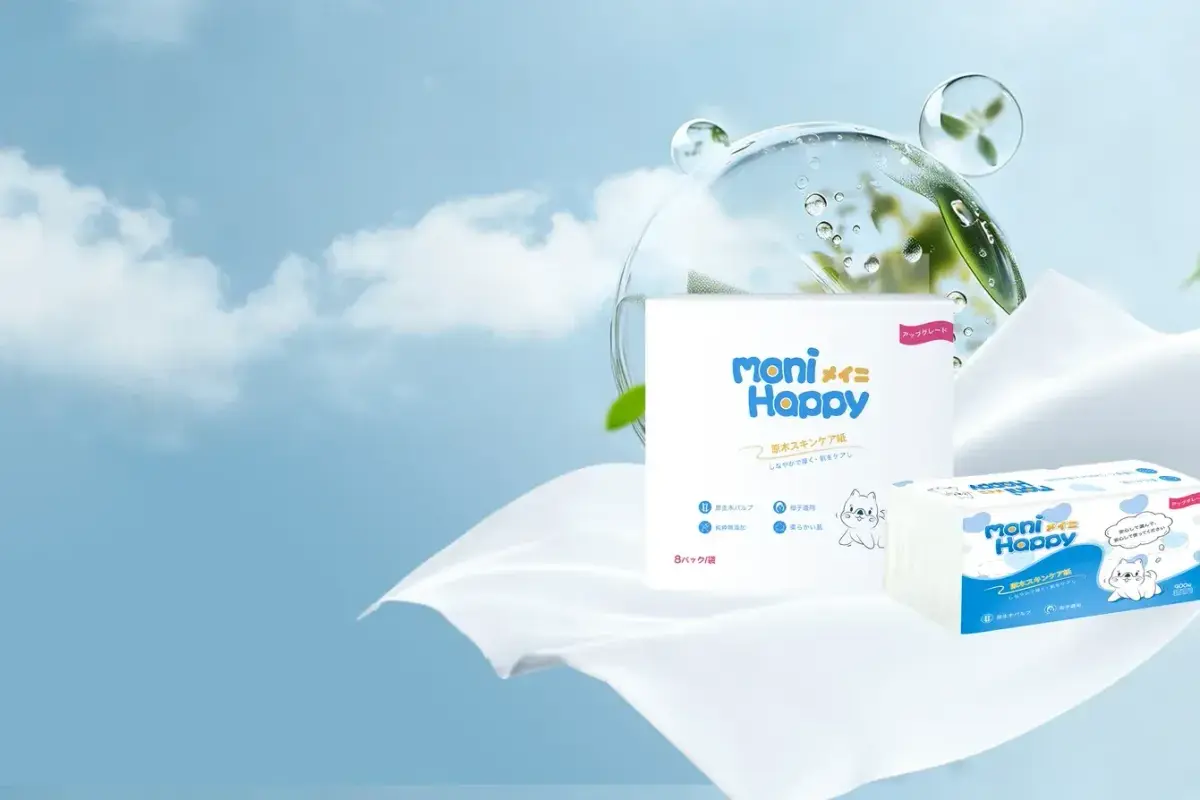
Give staff three facts and one rule. The facts are ply count, pulp grade and wet strength; the rule is when to use facial tissue instead of a wet wipe. Parents standing in the tissue aisle are usually deciding between two packs that look identical, and the difference between them is almost always those three facts.
This is not a chemistry lesson for the shop floor. It is a short script that lets an assistant answer a real question in one sentence and move the parent to the pack that suits them — which is how a tissue fixture earns its space, and how a store earns the next visit.
What should staff say first about ply count?
Say what ply means in use, not in manufacturing. Two-ply means two sheets bonded together, so the tissue holds together when it is folded and used; three-ply is softer and thicker again, and is usually chosen for faces rather than for general use.
A one-line script that works: "Two-ply is the everyday choice and holds up when folded; three-ply is softer and better for faces, but you use it up faster." That single sentence resolves most of the aisle hesitation, because it converts a number into a use case.
How do you explain pulp grade without sounding technical?
Talk about how it feels and how much lint it leaves. Virgin pulp gives a cleaner sheet with less lint and a more consistent feel; recycled furnish is a legitimate choice for utility use but varies more between packs.
For a baby, lint matters. A tissue that sheds fibres leaves them on skin and around the eyes, which is exactly the complaint a parent brings back to the store. Staff can say: "For a baby's face, the virgin pulp sheet leaves less lint — that is what you are paying the difference for."
Why does wet strength change which pack a parent should buy?
Because most of what a parent does with tissue involves moisture. A sheet with good wet strength holds together when used with a little water or when wiping a messy face; a sheet without it pills and tears, and the parent ends up using two or three sheets where one would do.
- Dry use — noses, faces, general wiping. Standard wet strength is fine.
- Damp use — wiping a face or hands with a splash of water. Ask for a sheet with stated wet strength.
- Heavy mess — this is a wet wipe job, not a tissue job, and staff should say so.
When should staff recommend a wet wipe instead?
Whenever the task involves cleaning rather than drying. Nappy changes, hands after eating and any situation with a sticky residue belong to baby wipes; drying a face, a nose or a bottom after washing belongs to tissue.
This distinction is worth training because parents reach for baby wipes and facial tissue interchangeably and only one of them cleans. A parent who buys tissue for nappy changes comes back annoyed; a parent who is told plainly which product does which job comes back for both. On a baby-care fixture baby wipes and tissue paper support each other — the basket that contains diapers, wipes and tissue is the one that repeats.
How should staff handle the sensitive skin question?
Answer it factually and stop. If a pack is fragrance-free and made from virgin pulp, say that. If it is not, say that too, and point to the pack that is. Anything stronger than that invites a sensitive skin claim the store cannot support.
What staff should not do is imply that a tissue treats or prevents a skin condition. Parents of babies with persistent redness need a clinician, and a shop assistant who promises a cure is creating a problem for the store. The safe formulation is: "This one has no fragrance and less lint, which is why parents with sensitive babies tend to take it."
Which pack size should staff suggest?
Match the pack to where it will live. A box for the living room, a soft pack for the changing bag, and a larger multi-pack for the car or the nursery — three placements, three formats, one basket.
- Soft pack — the changing bag and the car. Suggest two, because one always runs out at the wrong moment.
- Box — the living room or the nursery shelf, where it is used on a face rather than a mess.
- Multi-pack — the household that has already decided, and the highest-value line on the fixture.
Tissue paper is a low-involvement purchase, so the assistant's job is not to persuade but to remove doubt, and most doubt in the tissue paper aisle is about skin. Removing doubt is what increases units per basket.
How does a store train this in fifteen minutes?
One sheet of paper per assistant, three products in hand, and a role-play of the two questions parents actually ask. Anything longer does not happen on a busy shop floor.
Put the ply, the pulp grade and the wet strength on a card beside the tissue paper fixture so the answer is on the shelf, not in someone's memory. Then check once a month that the card still matches the packs — a stale card is worse than no card, because staff will repeat it confidently and be wrong. Stores that build this habit usually find that facial tissue stops being a price-led line and starts being a basket-builder next to diapers and wipes. Distributors who want the fixture-level version of this training for their retail accounts can ask about the retailer support programme, and the pack size guide by retail channel covers the same logic for diapers.
Frequently asked questions
Is three-ply always better for a baby?
Not always. Three-ply is softer, but it is also used up faster and costs more per use. For noses and faces two-ply is usually enough; three-ply earns its price on comfort.
Can facial tissue be used for nappy changes?
Only for drying. Cleaning belongs to a wet wipe, which is designed to lift residue without tearing. Staff should make that distinction rather than let a parent discover it at home.
Does fragrance-free mean the same as sensitive?
No. Fragrance-free describes what has been left out; sensitive describes how the product behaves on reactive skin. Both matter, and neither substitutes for the other.
How should tissue be stored at home?
Dry, off the floor and away from a bathroom shower. Moisture is what turns a good sheet into a limp one, and a damp pack is the most common reason a parent switches brand.
Sources and further reading
- EDANA, edana.org — nonwoven and hygiene product terminology, useful for the tissue and wipe distinction.
- International Organization for Standardization, ISO catalogue — including the ISO 12625 series on tissue paper and tissue products.
- European Union, Regulation (EC) No 1223/2009 — the ingredient and labelling framework behind fragrance-free and preservative claims.
Bottom line: three facts and one rule. Ply, pulp grade and wet strength explain the price difference; the tissue-versus-wipe rule protects the sale. Put them on a card by the fixture and check the card monthly — that is the whole training programme.
Moni Happy supplies facial tissue, wet wipes, cotton towels and diapers to distributors and retail accounts across Malaysia, Singapore, Thailand, Vietnam and Laos, with point-of-sale and staff training material available to appointed partners. See the distributor programme or apply for a territory, and review the facial tissue range before shortlisting formats. Pricing and minimum order quantities are confirmed per market, subject to formal quotation.
Frequently Asked Questions
Is three-ply always better for a baby?
Not always. Three-ply is softer, but it is also used up faster and costs more per use. For noses and faces two-ply is usually enough; three-ply earns its price on comfort.
Can facial tissue be used for nappy changes?
Only for drying. Cleaning belongs to a wet wipe, which is designed to lift residue without tearing. Staff should make that distinction rather than let a parent discover it at home.
Does fragrance-free mean the same as sensitive?
No. Fragrance-free describes what has been left out; sensitive describes how the product behaves on reactive skin. Both matter, and neither substitutes for the other.
How should tissue be stored at home?
Dry, off the floor and away from a bathroom shower. Moisture is what turns a good sheet into a limp one, and a damp pack is the most common reason a parent switches brand.
