
2026-11-14 · Moni Happy
Which diapers Singapore pharmacy planograms drop at the annual reset?
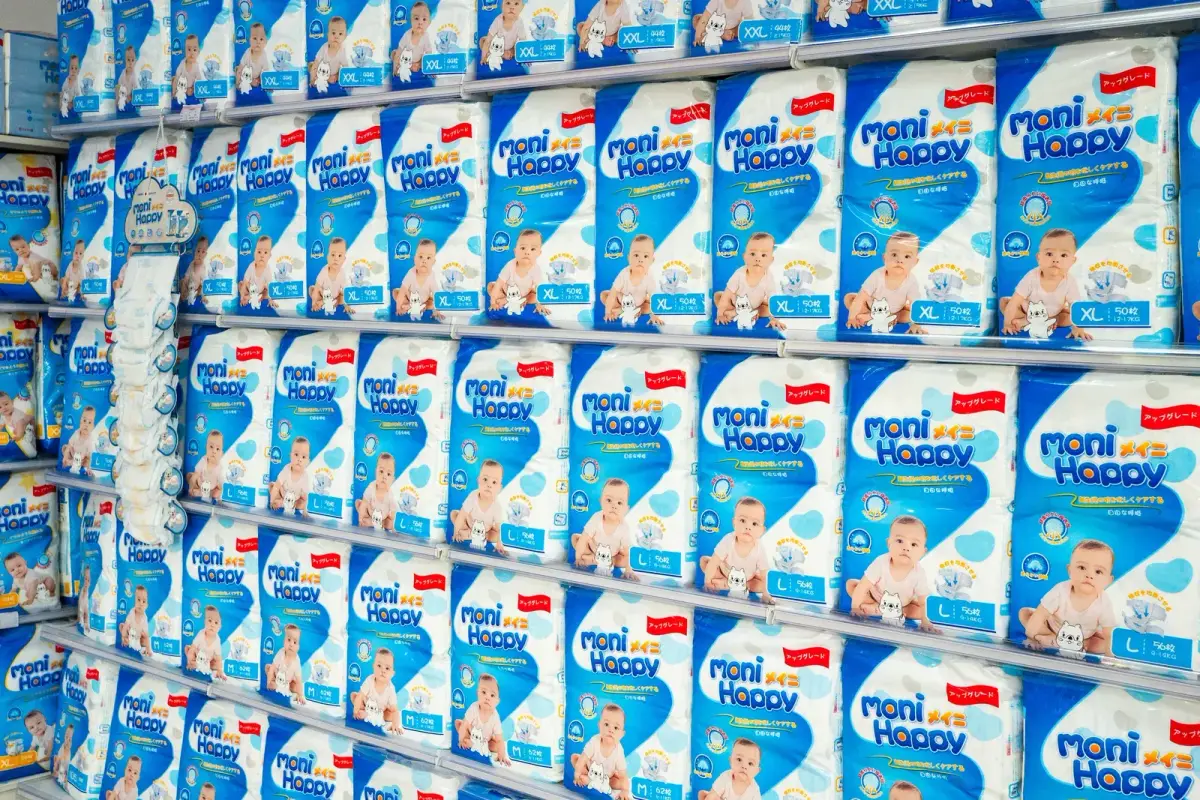
The reset drops the line with the lowest sales per facing per week and the worst expiry exposure. Brand size does not save a line, and neither does a low unit price. In a Singapore pharmacy a diaper range typically runs three to four brands with three to five facings each, concentrated on sizes M and L in packs of 20 to 34 pieces, so there is very little room for a line that cannot earn its width.
The annual reset is not a negotiation about whether the range changes. It is a negotiation about which article numbers survive it, and the distributor who arrives with the buyer's own metrics rather than a brand story is the one who keeps a facing.
Which diapers Singapore planograms drop at the annual reset?
Four types go first: the line below the shelf's sales per facing average, the line with two or more missed deliveries, the single-size range, and the large pack count that only sells on promotion.
Work through them in the order a buyer works through them. Sales per facing per week is the first screen, because a pharmacy measures productivity by shelf width and not by total sales. A brand block in this channel is typically 40 to 60 centimetres of shelf width on a gondola with 350 to 450 millimetres of depth, so the arithmetic is done in centimetres. A brand selling 60 packs a week across six facings is less productive than a brand selling 30 packs across two, and the second brand is the one that gets the space when the planogram is redrawn.
The second screen is gross margin return on inventory. Diapers are bulky, slow against cosmetics, and carry a date code. A line that earns a lower return per square metre than the shampoo next to it has to justify itself on traffic, and few diaper lines can.
The third screen is operational, and it is where distributors are most often surprised. Two missed deliveries in a quarter, a carton that arrives with the wrong date code, or stock that arrives with nine months of shelf life left instead of eighteen will cut a line that scores well on the first two screens.
When does the reset happen, and who signs it off?
Planograms are usually redrawn twice a year and formally reviewed once, with the category review cycle set by the chain's financial year. Most Singapore retailers close that year in December or March, which puts the working deadline for a submission in September or December. The category buyer drafts, the merchandising team checks the fixture capacity, and a commercial manager signs.
Three people matter and they want different things. The category buyer wants sales per facing and margin return. Merchandising wants the planogram to be physically buildable on the existing fixture, which is a constraint on pack dimensions rather than on brand. The commercial manager wants the category's total contribution and the supplier income attached to it.
A submission that only addresses the first person fails at the second or third. A diapers Singapore listing is built inside the chain's existing fixture, so pack dimensions that do not fit the shelf depth, or a pack that cannot stand upright on a shelf without a tray, will be dropped in merchandising even with the best sales rate in the category. Ask for the fixture depth and shelf height before you design the pack, not after.
Which numbers decide a delisting?
Sales per facing per week, gross margin return on inventory, and weeks of cover against the date code. Those three, in that order, and the first two are computed from the chain's own scan data.
The distributor rarely sees the scan data before the review, which is the structural disadvantage of the channel. You can rebuild most of it from your own delivery data: units delivered per store per week, divided by the facings you know you hold, gives a usable proxy. A diapers Singapore distributor who does that monthly knows the rank before the buyer does.
The date code number is the one distributors can control completely and most often neglect. A pharmacy will not accept a product with an 18 month shelf life and only 9 months remaining unless it is bought on promotion, and a line that keeps arriving short-dated gets flagged as a slow mover even when it is not. Ship the freshest stock to the pharmacy channel and the older stock to general trade, where the buyer cares about price rather than date.
Why do large pack counts lose to small ones in a pharmacy?
Because the trip is different. A pharmacy visit is a top-up made on the way home, and a 60 pack at SGD 24 competes with a 24 pack at SGD 11 for the same decision.
Two mechanics sit behind that. The first is basket size: a shopper who came in for toothpaste will add a small pack and will not add a large one. The second is shelf economics: a large pack occupies 40 percent more width for the same unit sale, so its sales per facing is lower by construction. A chain measuring productivity per facing will always prefer the smaller pack unless the larger one carries a materially better margin.
The exception is the shopper buying for a newborn, who does want volume and who is often in the store with a prescription. That is why a two-pack architecture works in this channel: a 24 pack on the shelf as the volume line and a 48 or 60 pack as a second facing for the newborn shopper, rather than one large pack trying to serve both.

How many facings does a new line get, and what earns a second?
One facing to start, in size M or L, and a second facing only after two consecutive periods at or above the category average for sales per facing.
The first facing is a test, and it is usually placed at the bottom of the shelf block or at the end of the brand's run, which suppresses its measured productivity. That placement is the reason new lines rarely earn a second facing in the first review. Counter it by asking for a position inside the brand block rather than at the edge, and by putting the promotional support into the first two periods rather than spreading it across the year.
The second facing is worth roughly double the first in revenue terms and considerably more in review terms, because two facings let the brand hold two sizes. Two sizes is the minimum for a shopper to find their weight band without walking to a competitor's block.
What gets a line cut regardless of sales?
Missed deliveries, short shelf life, and pack dimensions that do not fit the fixture. None of the three shows up in a sales report, and all three end a listing.
- Missed deliveries. Two in a quarter is the usual threshold. The chain's own service metric, not yours, is what counts.
- Short shelf life. Arriving with under twelve months remaining on an eighteen month product triggers a markdown conversation and a flag on the line.
- Fixture fit. A pack that will not stand on the shelf, or that overhangs the shelf depth, gets dropped in merchandising regardless of sales.
- No promotional support. A line that never funds a leaflet or a gondola end is a line the buyer has to defend without evidence, and buyers stop defending.
What should a distributor do 90 days before the reset?
Build the buyer's three numbers from your own delivery data, book the review meeting, and bring a plan for the facing you want rather than a defence of the ones you have.
The numbers first. Units per store per week, divided by facings held, ranked against the category. If you do not know the category average, estimate it from the total shelf width and the store count. An estimate with a stated method beats a claim without one.
Then the plan. A one-page submission with the current numbers, the two sizes you want to hold, the promotional calendar for the next two quarters, and the service record for the last twelve months. Buyers read one page. The appendix exists to answer questions, not to be read first.
Then the fixture question, asked in the same meeting. Shelf depth, shelf height, and whether the planogram allows a tray. Getting those wrong undoes a good commercial case, and they are free to ask.
If you are entering this channel for the first time, the Singapore partner page sets out territory and support terms, and the distribution channels guide covers how pharmacy compares with supermarket and general trade on cost to serve.
Frequently asked questions
Does a pharmacy chain in Singapore buy diapers through the brand or a distributor?
Mostly through a local distributor holding the import licence and the stock, because a chain will not fund the working capital for a slow category. A few large chains import the top two sizes directly and take the rest through distribution.
How long before a reset should a distributor make its case?
Ninety days. The buyer needs the numbers before the planogram is drafted, and by signature the space is allocated. A submission three weeks out is filed rather than read.
Is a listing fee normal for a pharmacy category in Singapore?
Yes. Treat it as a fixed cost per store per year, model it across the store count before signing, and check whether it includes a promotional slot or only the shelf position.
What pack size sells best in a Singapore pharmacy?
Twenty to thirty-four pieces in size M or L, at a price the shopper decides without comparing. Large packs belong in a supermarket where the trip is planned; the pharmacy purchase is usually a top-up.
Sources and further reading
- Health Sciences Authority (Singapore, current): product classification and labelling requirements that determine how baby care articles may be described and sold.
- Enterprise Singapore (current): weights and measures and consumer goods labelling rules applying to pre-packaged products on Singapore shelves.
- Competition and Consumer Commission of Singapore (current): fair trading and supplier practices guidance relevant to listing terms and shelf allocation.
Bottom line
A Singapore pharmacy reset ranks lines by sales per facing and margin return on inventory, then cuts on service and date code. Large packs and single-size ranges go first because they cannot earn their shelf width. Build the buyer's three numbers from your own delivery data, ask about fixture dimensions before designing the pack, and make the case 90 days out with one page.
Frequently Asked Questions
Does a pharmacy chain in Singapore buy diapers through the brand or a distributor?
Mostly through a local distributor who holds the import licence and the stock, because a chain will not carry the working capital for a slow category. A few large chains import directly on the top two sizes and take the rest through distribution, which means the distributor's range is the tail rather than the head.
How long before a reset should a distributor make its case?
Ninety days. The buyer needs the numbers before the planogram is drafted, and by the time the reset is signed the space is allocated. A submission that arrives three weeks before the reset is filed, not read.
Is a listing fee normal for a pharmacy category in Singapore?
Yes, and it should be treated as a fixed cost per store per year rather than as a one-off. Model it across the store count before signing, and check whether the fee includes a promotional slot or only the shelf position.
What pack size sells best in a Singapore pharmacy?
Twenty to thirty-four pieces, in size M or L, at a price the shopper can decide on without comparing. Larger packs belong in a supermarket where the trip is planned. In a pharmacy the purchase is usually a top-up made on the way home.
