
2026-09-02 · Moni Happy Editorial Team
Baby Language Development: Milestones & How to Encourage Speech from Birth
Baby Language Development: Milestones & How to Encourage Speech from Birth
When my first baby said "mama" for the first time, I cried. It was around 8 months, and I had been talking to her constantly since the day she was born—narrating everything I did, making silly faces, reading board books, and responding to every coo and babble as if it were the most profound conversation. With my second and third babies, I knew what to expect, but I still marveled at how language unfolds—from those first newborn cries to coos, babbles, first words, and eventually full sentences. As a mom of three and a former early childhood educator, here's everything I've learned about baby language development: the milestones to expect at each age, how to encourage speech and language skills, and when to seek help if you're concerned.
Understanding Baby Language Development
Language development is one of the most fascinating aspects of early childhood development. It begins long before your baby says their first word—actually, it begins before birth. Research shows that babies can hear and recognize sounds from the third trimester of pregnancy, and they're born with a preference for their mother's voice and the language they heard in the womb.
Language development involves two key components:
- Receptive language: This is the ability to understand and comprehend language—what your baby hears and processes. Receptive language develops before expressive language; babies can understand much more than they can say. For example, a 9-month-old may not be able to say "ball," but they can look at or point to a ball when you ask "where's the ball?"
- Expressive language: This is the ability to produce and use language—what your baby says and communicates. Expressive language includes crying, cooing, babbling, gestures (pointing, waving), first words, and eventually sentences.
Both receptive and expressive language develop gradually, and every baby develops at their own pace. There's a wide range of normal, and some babies may be early talkers while others are late bloomers. What matters most is that your baby is making progress and moving forward in their language development, not that they hit every milestone at exactly the "right" age.
It's also important to note that language development is closely linked to other areas of development, including hearing, cognitive development, social-emotional development, and motor skills. If there are concerns in any of these areas, it can affect language development, which is why regular well-baby checkups are so important—your pediatrician will monitor all areas of development and catch any concerns early.
Language Milestones by Age
Here's a general overview of language development milestones from birth to 2 years. Remember, these are general guidelines—every baby is different, and there's a wide range of normal. If your baby is premature, use their adjusted age (corrected for prematurity) when assessing milestones.
Birth to 3 Months
In the first three months, your baby is learning to communicate through sound and body language:
- Crying: Crying is your newborn's primary way of communicating. Different cries can mean different things—hunger, pain, tiredness, overstimulation, or just needing to be held. Over time, you'll learn to distinguish your baby's different cries.
- Cooing and gurgling: Around 6-8 weeks, babies start making cooing sounds (soft "ooh" and "aah" sounds) and gurgling. These are their first attempts at making speech-like sounds, and they often do this when they're content and alert.
- Responding to sound: Newborns will startle at loud sounds (Moro reflex) and quiet down at the sound of a familiar voice. By 2-3 months, they'll turn their head toward sounds and look at your face when you talk.
- Eye contact and smiling: Around 6-8 weeks, babies start making eye contact and smiling socially. This is an important pre-language skill—they're learning to engage with you and take turns in "conversation."
- Differentiating sounds: By 3 months, babies can distinguish between different speech sounds and can recognize familiar words (like their name, though they may not respond consistently yet).
4 to 6 Months
During this period, your baby's communication skills expand significantly:
- Babbling: Around 4-6 months, babies start babbling—making repetitive consonant-vowel sounds like "ba-ba-ba," "ma-ma-ma," and "da-da-da." At first, these sounds are random and not associated with meaning, but they're practicing the sounds of language. By 6 months, many babies will babble with different consonant sounds and may even string different sounds together ("ba-da-ga").
- Responding to their name: Around 5-6 months, many babies will turn their head or look at you when you say their name. This is an important receptive language milestone.
- Responding to "no": Around 6 months, some babies will pause or stop what they're doing when you say "no," though they may not consistently obey it yet.
- Vocalizing emotions: Babies this age will use different sounds to express different emotions—happy squeals, frustrated grunts, excited coos. They're learning that their voice can communicate how they feel.
- Using gestures: Around 6 months, babies may start using simple gestures like reaching to be picked up, raising their arms, or pushing away things they don't want.
- Interest in books: Many babies this age will enjoy looking at high-contrast board books and listening to you read, even if they just want to chew on the book!
7 to 9 Months
This is an exciting period for language development as babbling becomes more sophisticated and babies start understanding more:
- Canonical babbling: Babbling becomes more consistent and varied, with babies producing long strings of sounds ("ba-ba-ba-ba-da-da"). They may also start using different "tones" of babbling—like asking a question with a rising intonation or making a statement with a falling intonation.
- First words (possibly): Some babies say their first words around 8-9 months, though many don't until 12 months or later. Early words are often "mama," "dada," "bye-bye," or the name of a favorite person or pet. At this age, "mama" and "dada" may still be just babbling rather than true words with meaning—true words are used consistently and intentionally to refer to a specific person, object, or action.
- Understanding simple words and phrases: By 9 months, many babies understand simple words like "no," "bye-bye," "up," and "milk." They may look at the right object when you name it, or perform an action when you ask (like waving when you say "bye-bye").
- Gestures: Babies this age use more gestures to communicate, including pointing (at things they want or find interesting), waving bye-bye, clapping, and shaking their head "no." Gestures are an important precursor to words and show that baby understands communication.
- Joint attention: Around 9 months, babies develop joint attention—the ability to share attention with another person on an object or event. They'll look at an object, look back at you, and look at the object again, as if to say "look at this!" This is a critical social-communication skill that supports language development.
- Imitating sounds: Babies this age love to imitate sounds, actions, and facial expressions. They may imitate your cough, your laugh, or sounds you make. Imitation is a key way babies learn language.
10 to 12 Months
By their first birthday, most babies have made significant progress in language:
- First words: By 12 months, most babies say at least 1-3 words with meaning (though some say more, and some say fewer—that's normal). True first words are used consistently to refer to a specific person, object, or action. Common first words include "mama," "dada," "dog," "cat," "ball," "more," "bye-bye," and "no."
- Jargon: Many babies this age produce "jargon"—long strings of babbling that sound like they're talking in sentences, with real intonation and rhythm, but without real words. It sounds like they're having a conversation in a language only they understand! Jargon is a normal part of language development and shows that baby understands the structure of conversation.
- Understanding more: By 12 months, babies understand many words and simple phrases, like "give me," "come here," "where's daddy?" and "don't touch." They can follow simple one-step instructions (like "give me the toy") with gestures or context.
- Gestures: Gestures become more sophisticated and are often combined with sounds or words. Baby may point at something and say "da!" (meaning "what's that?" or "I want that"), or wave and say "bye-bye."
- Turn-taking: Babies this age understand the turn-taking nature of conversation—they'll "talk" (babble) and then pause, waiting for you to respond, then "talk" again. They love back-and-forth "conversations" with you.
12 to 18 Months
In the second year, language really takes off:
- Vocabulary explosion: Between 12 and 18 months, most babies learn new words rapidly. By 18 months, most babies have a vocabulary of 10-50 words (though the range is wide—some have more, some have fewer). They learn words for familiar people, objects, actions, and favorite things.
- Holophrases: Babies this age often use single words to express whole ideas (called holophrases). For example, "milk" might mean "I want milk," "I spilled my milk," or "there's milk on the floor," depending on the context and their intonation.
- Understanding: Receptive language continues to develop rapidly. By 18 months, most babies understand 50+ words and can follow simple one-step commands without gestures (like "put the toy in the box"). They understand simple questions like "where's your nose?" and can point to body parts.
- Gestures and words combined: Babies often combine gestures with words to communicate more complex ideas—pointing at a ball and saying "more" (meaning "I want more ball"), or pointing at a dog and saying "woof" (meaning "that's a dog and it says woof").
- Echolalia: Some babies this age repeat words or phrases they hear (echolalia), like repeating the last word you say or a phrase from a favorite show. This is a normal way of practicing and learning language.
18 to 24 Months
By 2 years old, language has developed significantly:
- Two-word phrases: Between 18 and 24 months, most babies start combining words into two-word phrases, like "more milk," "daddy go," "my toy," and "all done." These phrases follow basic grammar rules (e.g., adjective + noun, subject + verb) and show that baby is learning how language works.
- Vocabulary: By 24 months, most babies have a vocabulary of 50-200+ words. They learn new words every day, often after hearing them just a few times (fast mapping). They can name many common objects, body parts, family members, and animals.
- Understanding: By 24 months, most babies understand 200+ words and can follow two-step commands (like "get your shoes and put them by the door"). They understand simple concepts like "in," "on," "under," "big," and "little."
- Pronouns: Some toddlers start using pronouns like "I," "me," "my," and "you," though they may confuse them at first (e.g., saying "you" when they mean "I"). This is normal and improves with time.
- Questions: Toddlers this age love to ask "what's that?" and "why?" (though "why" questions usually come closer to 2-3 years). They're curious about the world and use language to learn.
How to Encourage Baby Language Development
As a parent, you are your baby's first and most important language teacher. The good news is that you don't need any special tools or programs—everyday interactions are the best way to encourage language development. Here are the strategies that worked for my kids and that speech-language pathologists recommend:
1. Talk, Talk, Talk (Narrate Everything)
From the day your baby is born, talk to them constantly. Narrate what you're doing as you go about your day: "I'm changing your diaper now. First I'll wipe you, then put on a clean diaper. There we go, all clean!" "I'm making lunch. I'm cutting up some carrots. Mmm, carrots are crunchy." At first, it may feel silly to talk to a baby who doesn't understand you, but every word you say is building their receptive language and exposing them to the sounds, rhythm, and structure of language. Research shows that children whose parents talk to them frequently in the first three years have larger vocabularies and better language skills later on.
When talking to your baby, use "parentese" (also called "motherese" or "baby talk")—a slower, higher-pitched, more exaggerated way of speaking with simple words and short sentences. Babies are naturally attracted to parentese, and it helps them distinguish speech sounds and learn words. Avoid using actual "baby talk" with made-up words (like "wawa" for water)—it's fine to use it occasionally, but consistently using real words helps baby learn the correct vocabulary. You can say "water" in a parentese tone without calling it "wawa."
2. Read Together Every Day
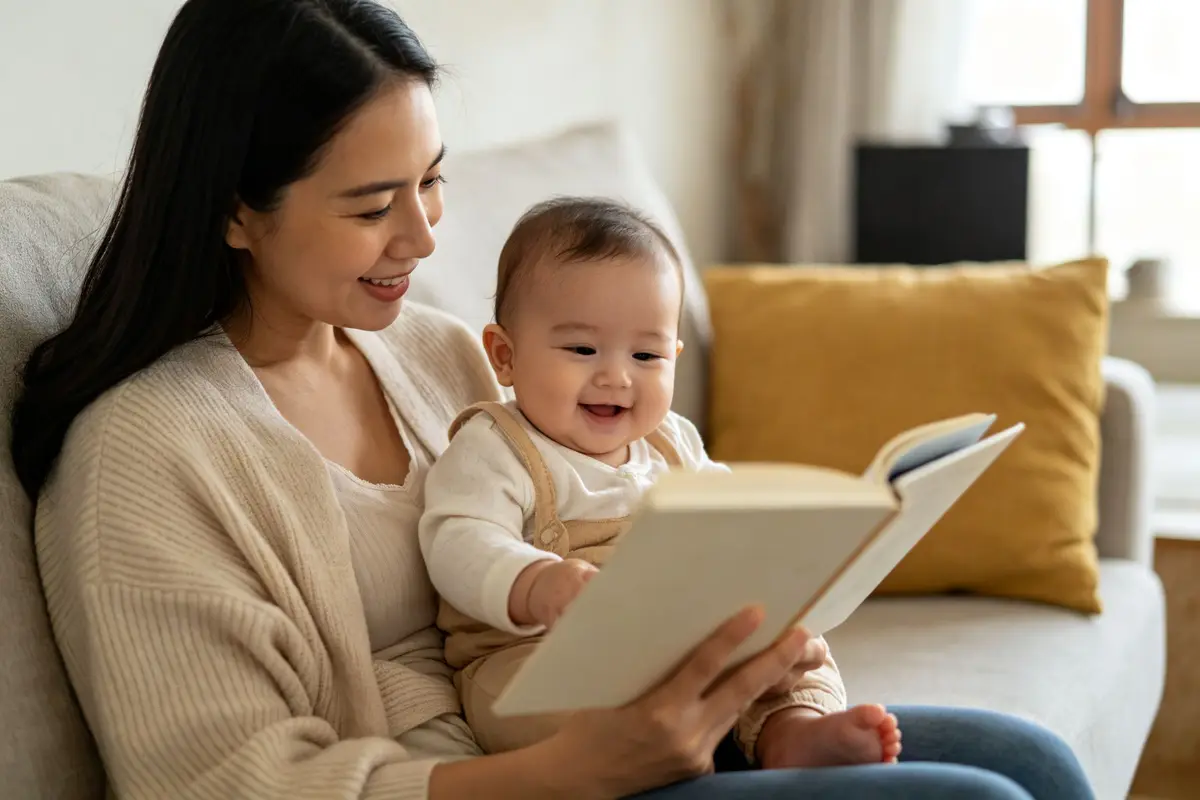
Reading to your baby is one of the best things you can do for their language development. Start from birth—even newborns benefit from hearing your voice and looking at high-contrast images. For young babies, use board books with simple pictures, high contrast, and textures. As baby grows, introduce books with more words, simple stories, and interactive elements (lift-the-flap, touch-and-feel). Make reading a part of your daily routine—before naps, before bed, or anytime you have a few quiet minutes.
When reading, don't just read the words—engage with your baby. Point to pictures and name them: "Look, a dog! The dog says woof woof." Ask questions: "Where's the cat? Can you point to the cat?" Make animal sounds, use different voices for different characters, and let baby turn the pages (even if they want to turn back or skip pages). The goal is to make reading fun and interactive, not to get through the whole book. Even 5-10 minutes of reading a day makes a big difference.
3. Respond to Your Baby's Sounds and Gestures
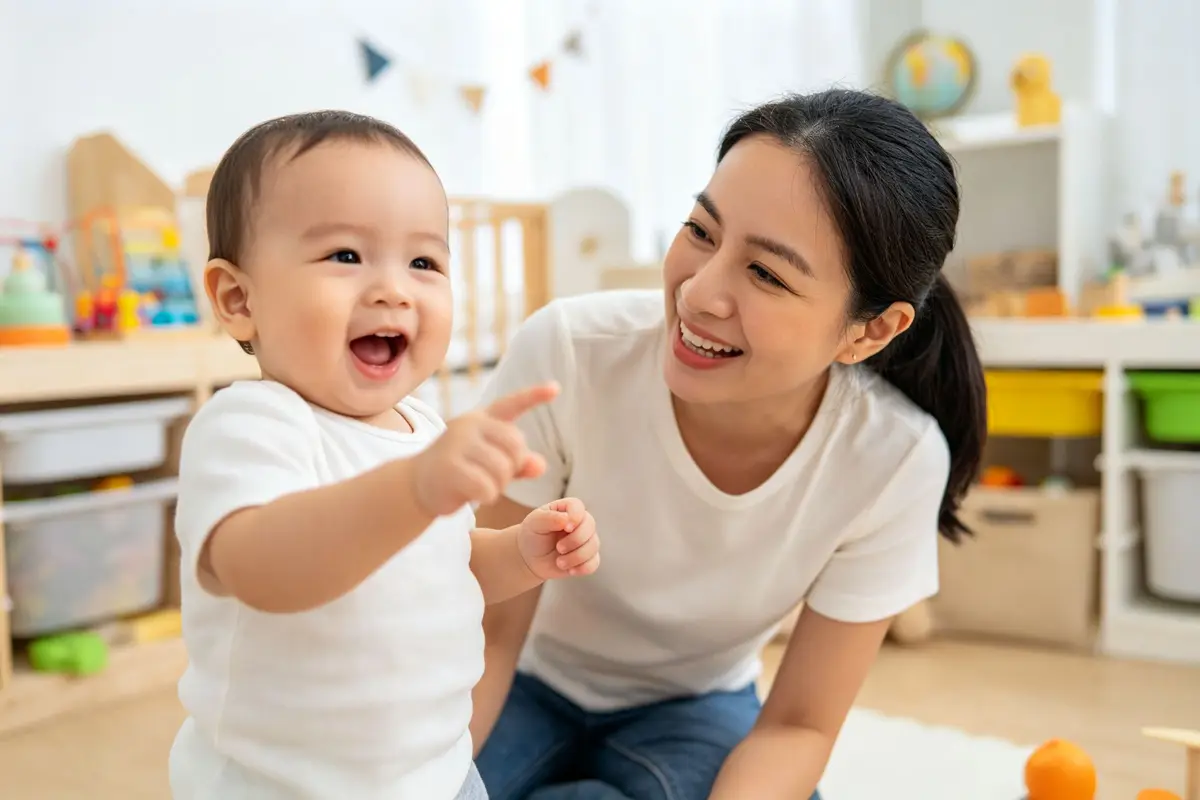
When your baby coos, babbles, points, or makes any sound or gesture, respond to them as if they're having a conversation with you. If they coo at you, coo back and make eye contact. If they babble "ba-ba-ba," say "ba-ba! You're saying ba-ba! Can you say ma-ma?" If they point at a bird, follow their point and say "You see a bird! The bird is flying. Tweet tweet!" Responding to your baby's communication attempts teaches them that communication is powerful—their sounds and gestures get a response from you. This motivates them to keep communicating and eventually use words.
Also, wait for your baby to respond. When you ask a question or make a comment, pause and give them time to process and respond (even if their response is just a look, a sound, or a gesture). This teaches them the turn-taking nature of conversation. Don't rush to fill every silence—give them space to communicate.
4. Use Gestures and Sign Language
Gestures are an important precursor to words, and using them with your baby can help them communicate before they can talk. You can use simple baby signs (like "more," "all done," "milk," "eat," "sleep," "please," "thank you") to help your baby communicate their needs before they can say the words. Research shows that babies who learn sign language often develop spoken language earlier and have larger vocabularies, because they understand that symbols (whether gestures or words) represent meaning.
You don't need to learn a full sign language—just a few simple signs for common words. Use the sign consistently while saying the word, and eventually your baby will start using the sign too. When they use the sign, respond to their request and say the word: "You signed 'more'! You want more crackers? Here you go, more crackers." This reinforces the connection between the sign, the word, and the meaning.
Also, use natural gestures when you talk—point to things, wave, shrug, use your hands. Babies learn by watching you, and gestures help convey meaning and make language more engaging.
5. Sing Songs and Nursery Rhymes
Singing songs and nursery rhymes is a fun and effective way to encourage language development. Songs expose babies to the rhythm, rhyme, and melody of language, and the repetition helps them learn words and sounds. Babies love music, and they'll often respond by moving, cooing, or trying to sing along. Even if you think you have a terrible voice, your baby loves hearing you sing!
Sing simple songs like "Twinkle Twinkle Little Star," "Itsy Bitsy Spider," "Wheels on the Bus," "Old MacDonald," and "Head, Shoulders, Knees, and Toes." Use actions and gestures to make the songs more interactive. Pause before a familiar word in a song and wait for baby to fill it in (e.g., "Twinkle twinkle little... [pause] ...star!"). This encourages them to anticipate and participate.
6. Limit Screen Time
The American Academy of Pediatrics recommends no screen time (other than video chatting with family) for babies under 18 months, and limited, high-quality screen time (no more than 1 hour per day) for children 18-24 months. Research shows that excessive screen time can interfere with language development, because screens don't provide the interactive, back-and-forth communication that babies need to learn language. A baby may hear many words on a screen, but they don't get the responsive interaction that makes those words meaningful.
If you do use screens with your baby (after 18 months), choose high-quality, educational content and watch it with them, talking about what you see and asking questions. Co-viewing makes screen time more interactive and educational. But remember: no screen can replace the value of real, human interaction for language development.
7. Expand on What Your Baby Says
When your baby says a word or makes a sound, expand on it to model more complex language. If your baby says "ball," you can say "Yes, that's a big red ball! You're rolling the ball. The ball is bouncy!" If they say "more milk," you can say "You want more milk? Here's your milk. Yummy milk!" Expanding on your baby's utterances models longer sentences and new vocabulary, and it shows them how to add detail to their communication. This technique (called "expansion" or "extension") is used by speech-language pathologists and is very effective for building language skills.
Also, repeat and reinforce your baby's words. If they say "dog," say "Yes! Dog! That's a dog. The dog says woof woof. Good job saying dog!" This positive reinforcement encourages them to keep using words.
8. Create Opportunities for Communication
Give your baby reasons to communicate. Put toys or snacks just out of reach so they have to point, gesture, or use words to ask for them. Offer choices ("Do you want the red cup or the blue cup?") so they have to indicate a preference. Pause during a familiar routine or song and wait for them to signal "more." When they communicate (even with a gesture or sound), respond promptly and positively. This teaches them that communication is effective and gets them what they want, which motivates them to keep communicating and eventually use words.
Also, don't anticipate every need before your baby has a chance to communicate it. It's natural to want to give your baby everything they need immediately, but if you always hand them their snack before they have to ask, they don't get the opportunity to practice communicating. Give them a few seconds to try to communicate their need before you jump in.
When to Seek Help: Red Flags for Language Delays
While every baby develops at their own pace, there are certain red flags that may indicate a language delay or other developmental concern. If you notice any of these, talk to your pediatrician or a speech-language pathologist—early intervention is key, and the earlier concerns are addressed, the better the outcomes.
By 3 months:
- Doesn't smile at people or make eye contact
- Doesn't coo or make any sounds
- Doesn't respond to loud sounds or turn toward sounds
- Doesn't seem to notice you or recognize your voice
By 6 months:
- Doesn't babble or make any consonant sounds
- Doesn't respond to their name
- Doesn't make eye contact or smile socially
- Doesn't show interest in people or toys
- Doesn't laugh or squeal
By 9 months:
- Doesn't babble with consonant sounds (ba, da, ma)
- Doesn't respond to their name consistently
- Doesn't use any gestures (pointing, waving, reaching)
- Doesn't make eye contact or share attention (joint attention)
- Doesn't seem to understand any words
By 12 months:
- Doesn't say any words (even "mama" or "dada" with meaning)
- Doesn't use gestures like pointing, waving, or shaking head "no"
- Doesn't respond to simple words or commands
- Doesn't babble or make any speech-like sounds
- Loses skills they previously had (regression)
By 18 months:
- Says fewer than 6 words
- Doesn't point to show things to others
- Doesn't understand simple words or commands
- Doesn't imitate words or actions
- Loses skills they previously had
By 24 months:
- Says fewer than 50 words
- Doesn't combine two words together (e.g., "more milk")
- Doesn't understand simple two-step commands
- Doesn't point to named objects or body parts
- Loses skills they previously had
If you're concerned about your baby's language development at any age, don't wait—talk to your pediatrician. They can do a developmental screening and refer you to a speech-language pathologist for a comprehensive evaluation if needed. In many countries, early intervention services are available for free or low cost for children under 3, and they can make a huge difference. Trust your instincts—you know your baby best, and if something feels off, it's worth getting checked out.
It's also important to have your baby's hearing checked if you have any concerns about language development, because hearing loss can significantly affect language acquisition. Newborn hearing screenings are standard in many countries, but hearing can change over time due to ear infections or other factors. If your baby doesn't seem to respond to sounds or has frequent ear infections, ask your pediatrician about a hearing test.
Article Summary
Baby language development is a fascinating process that begins before birth and unfolds gradually over the first few years of life. It involves both receptive language (understanding) and expressive language (producing), and it's closely linked to hearing, cognitive development, social-emotional development, and motor skills. From birth to 3 months, babies communicate through crying, cooing, and social smiling. From 4-6 months, they start babbling, responding to their name, and using simple gestures. From 7-9 months, babbling becomes more sophisticated, some babies say their first words, and they develop joint attention and pointing. By 12 months, most babies say 1-3 words, use gestures, understand many words, and produce jargon. From 12-18 months, vocabulary expands rapidly, and babies use single words (holophrases) to express whole ideas. By 18-24 months, most toddlers combine words into two-word phrases and have vocabularies of 50-200+ words. As a parent, you can encourage language development by talking constantly (narrating everything), reading together every day, responding to your baby's sounds and gestures, using gestures and simple sign language, singing songs and nursery rhymes, limiting screen time, expanding on what your baby says, and creating opportunities for communication. Every baby develops at their own pace, and there's a wide range of normal, but it's important to be aware of red flags that may indicate a language delay: not babbling by 6-9 months, not saying any words by 12 months, not using gestures, not responding to name or words, or losing previously acquired skills. If you have any concerns, talk to your pediatrician or a speech-language pathologist—early intervention is key. Remember: you are your baby's first and most important language teacher, and the everyday interactions you share are the most powerful tool for building their language skills. Talk to them, read to them, sing to them, and respond to them—and watch their language bloom.
Frequently Asked Questions
What are the most important baby milestones?
Key milestones include: smiling socially (2 months), rolling over (4-6 months), sitting unsupported (6-8 months), crawling (7-10 months), pulling to stand (8-12 months), first words (8-15 months), and walking independently (9-18 months). Every baby develops at their own pace, and there's a wide range of normal. If your baby misses multiple milestones or loses skills they previously had, talk to your pediatrician.
How can I encourage my baby's development?
The best way to support development is through everyday interaction — talk, read, and sing to your baby from birth. Give them plenty of supervised tummy time to build neck and core strength. Provide age-appropriate toys that encourage reaching, grasping, and problem-solving. Limit screen time for babies under 18 months (except video chatting). Most importantly, respond to your baby's cues and give them lots of love and attention.
When should I worry about developmental delays?
Talk to your pediatrician if your baby: doesn't make eye contact by 3 months, doesn't smile by 3 months, doesn't babble by 9 months, doesn't respond to their name by 9 months, doesn't point or gesture by 12 months, doesn't say any words by 16 months, doesn't walk by 18 months, or loses any skills they previously had. Early intervention is key — if you have concerns, ask for a developmental screening.
How much tummy time does my baby need?
Aim for 10-15 minutes of supervised tummy time, 2-3 times a day, starting from the first weeks home. You can start with shorter sessions (2-3 minutes) and gradually increase as your baby builds strength. Tummy time helps build neck, shoulder, and core muscles, prevents flat spots on the back of the head, and encourages motor development. If your baby fusses during tummy time, try getting down on the floor with them, using a tummy time pillow, or doing it after a nap when they're well-rested.
Frequently Asked Questions
When should my baby start talking and saying first words?
Every baby develops at their own pace, and there's a wide range of normal for first words. Here's a general timeline: Around 6-8 weeks, babies start cooing (soft 'ooh' and 'aah' sounds). Around 4-6 months, they start babbling (repetitive 'ba-ba-ba,' 'ma-ma-ma' sounds). Around 8-9 months, some babies say their first words, though many don't until 12 months or later. By 12 months, most babies say at least 1-3 words with meaning (like 'mama,' 'dada,' 'bye-bye'). By 18 months, most babies have a vocabulary of 10-50 words. By 24 months, most toddlers have 50-200+ words and start combining two words (like 'more milk'). It's important to note that 'mama' and 'dada' before 8-9 months are often just babbling, not true words with meaning. True first words are used consistently and intentionally to refer to a specific person, object, or action. If your baby is premature, use their adjusted age (corrected for prematurity) when assessing milestones. If you're concerned about your baby's language development at any point, talk to your pediatrician - early intervention is key.
How can I encourage my baby to talk and develop language skills?
You are your baby's first and most important language teacher, and everyday interactions are the best way to encourage language development. Key strategies include: 1) Talk constantly - narrate everything you do throughout the day, using simple words and short sentences. Every word you say builds their receptive language. 2) Read together every day - start from birth with board books, point to pictures and name them, make it fun and interactive. Even 5-10 minutes a day makes a big difference. 3) Respond to your baby's sounds and gestures - when they coo, babble, or point, respond as if they're having a conversation with you. This teaches them that communication is powerful. 4) Use gestures and simple sign language - teach a few simple signs ('more,' 'all done,' 'milk') to help them communicate before they can talk. 5) Sing songs and nursery rhymes - songs expose babies to rhythm, rhyme, and repetition, and babies love music. 6) Limit screen time - the AAP recommends no screen time (other than video chatting) for babies under 18 months, as screens don't provide the interactive communication babies need. 7) Expand on what your baby says - if they say 'ball,' say 'Yes, that's a big red ball! You're rolling the ball!' 8) Create opportunities for communication - put toys just out of reach, offer choices, and give them time to communicate before jumping in. Remember: consistency and interaction are key - talk to them, read to them, sing to them, and respond to them every day.
What are the red flags for language delay in babies?
While every baby develops at their own pace, there are certain red flags that may indicate a language delay or other developmental concern. Talk to your pediatrician if you notice any of these: By 3 months: doesn't smile or make eye contact, doesn't coo or make sounds, doesn't respond to loud sounds or turn toward sounds. By 6 months: doesn't babble or make consonant sounds, doesn't respond to name, doesn't make eye contact or smile socially, doesn't show interest in people or toys, doesn't laugh or squeal. By 9 months: doesn't babble with consonant sounds (ba, da, ma), doesn't respond to name consistently, doesn't use any gestures (pointing, waving, reaching), doesn't make eye contact or share attention (joint attention), doesn't seem to understand any words. By 12 months: doesn't say any words (even 'mama' or 'dada' with meaning), doesn't use gestures like pointing or waving, doesn't respond to simple words or commands, doesn't babble or make speech-like sounds, loses skills they previously had. By 18 months: says fewer than 6 words, doesn't point to show things to others, doesn't understand simple words or commands, doesn't imitate words or actions, loses skills. By 24 months: says fewer than 50 words, doesn't combine two words, doesn't understand simple two-step commands, doesn't point to named objects or body parts, loses skills. If you're concerned at any age, don't wait - talk to your pediatrician. They can do a developmental screening and refer you to a speech-language pathologist if needed. Early intervention is key, and the earlier concerns are addressed, the better the outcomes. Also, have your baby's hearing checked if you have concerns, as hearing loss can significantly affect language development.
Does baby sign language delay or help speech development?
Research consistently shows that baby sign language does NOT delay speech development - in fact, it often helps. Babies who learn simple signs tend to develop spoken language earlier and have larger vocabularies than babies who don't. Here's why: 1) Sign language teaches babies that symbols (whether gestures or words) represent meaning - this is a foundational concept for all language. Once they understand that a gesture can mean 'more,' they more easily understand that a spoken word can also mean 'more.' 2) Sign language reduces frustration - babies who can communicate their needs with signs before they can talk are less frustrated and less likely to have tantrums. This creates a more positive communication environment. 3) When babies use signs, parents typically respond by saying the word aloud, which reinforces the connection between the sign, the spoken word, and the meaning. This repeated exposure helps babies learn the spoken word faster. 4) Sign language encourages joint attention and interaction - the back-and-forth of signing and responding is the same interactive communication that supports all language development. You don't need to learn a full sign language - just a few simple signs for common words like 'more,' 'all done,' 'milk,' 'eat,' 'sleep,' 'please,' and 'thank you.' Use the sign consistently while saying the word, and eventually your baby will start using the sign too. When they do, respond to their request and say the word. Many babies use signs for a few months and then naturally transition to words as their speech develops. If you're concerned about your baby's language development, always consult your pediatrician or a speech-language pathologist - sign language is a great tool, but it's not a substitute for professional evaluation if there are concerns.