
2026-10-28 · Moni Happy
How long can baby diapers sit in my warehouse before they become dead stock?
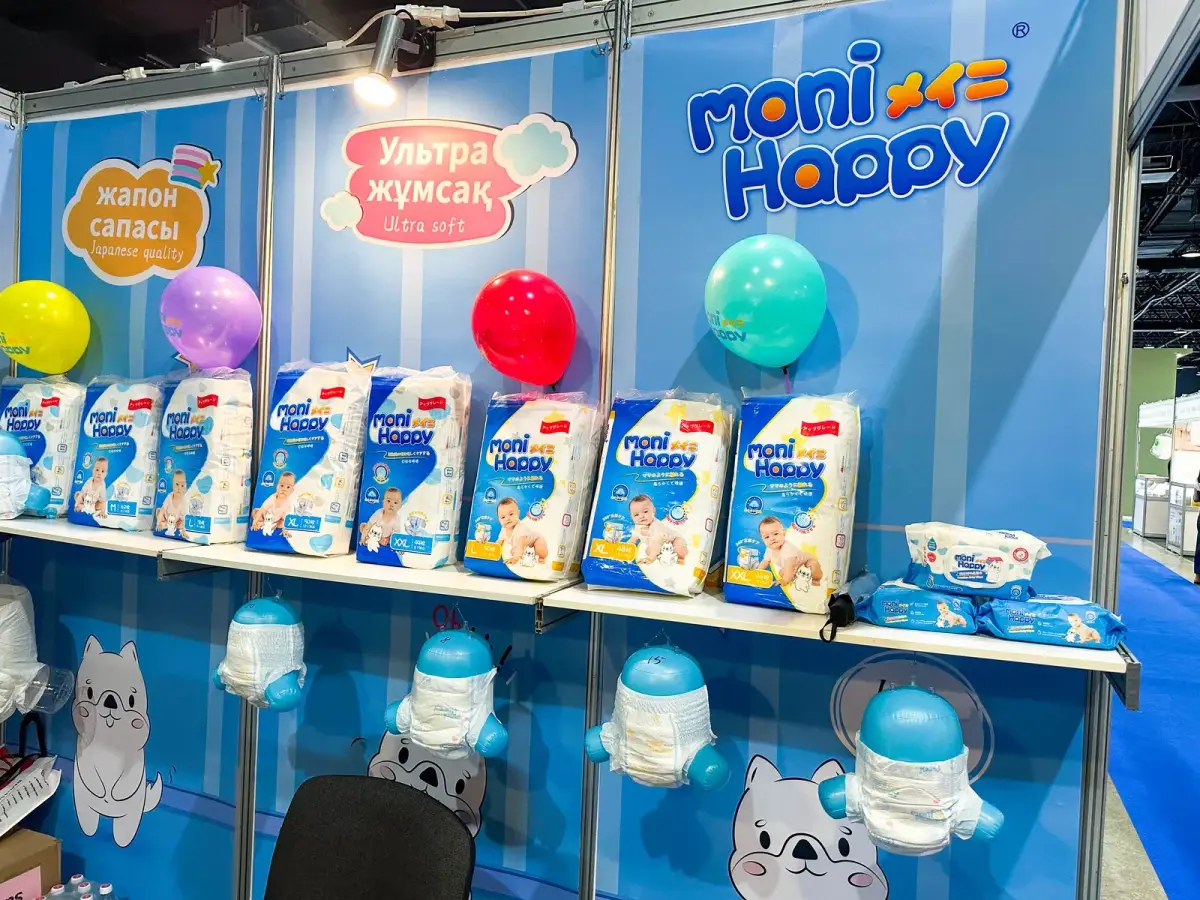
What shelf life is printed on a diaper export carton?
Most export cartons of baby diapers state 36 months from the production date, and the date code is printed on the carton seam and on each consumer pack. Some value-tier lines are packed at 24 months, and pull-up pants with elastic waistbands are frequently declared at 30 months because the elastane relaxes over time.
The printed figure is a storage claim, not a sales claim. It assumes dry storage below roughly 30°C, away from direct sunlight, with cartons stacked no higher than the compression limit printed on the box. A container parked on a Vientiane or Port Klang yard in April does not meet that assumption, which is why the first thing to check on arrival is carton condition and the smell of the packs, not the invoice.
For a distributor, the number that matters is the residue at the moment of retail delivery. Modern trade buyers in Malaysia, Vietnam and Thailand commonly apply a two-thirds rule: a pack must still have at least two-thirds of its declared diaper shelf life when it lands on the shelf, and one-third when it is sold. Working backwards from a 36-month declaration, that gives you roughly twelve months of usable selling window from the day the container is unloaded, not thirty-six.
How long before slow stock stops selling at full price?
In practice, a diaper line starts losing pricing power long before it loses integrity. The pattern is consistent across markets: the first two or three months after landing are full price, months four to six need promotional support, and from month seven the SKU is being pushed rather than pulled. The diaper shelf life printed on the carton is the wrong clock to manage against; the retailer’s remaining-life rule decides whether your pallet still has a buyer.
That is why dead stock is rarely an expiry problem. It is a pricing problem that arrives about two years before the expiry date. Any SKU that has not moved a full carton layer in 90 days should be flagged, and any SKU holding more than six months of cover at current run rate should be treated as a candidate for rationalisation rather than reorder.
The practical rule most distributors settle on: 0-90 days is healthy, 90-180 days is a discount decision, beyond 180 days it is a write-down decision. If you wait for the printed date to force the issue, you have already paid twelve months of carrying cost on stock that was never going to sell at list.
Why do sealed diapers deteriorate in storage?
Nothing in a sealed pack is inert. Four mechanisms do the damage, and only one of them is visible.
- Superabsorbent polymer takes up ambient moisture through the packaging film, so absorbency under load falls slowly and the core starts to feel stiff rather than soft.
- Construction adhesive used on the tape and the leg cuffs ages; the tape loses peel strength and the cuffs lose the recovery that keeps a leak barrier tight.
- Elastic waistbands and leg gathers in pull-up pants relax under compression, which is why a carton stored at the bottom of a stack for a year feels looser than a fresh one.
- Printing and film lamination can block or scuff when pallets are stored above 35°C for weeks, which turns a premium pack into a cosmetic second.
None of this shows up as a failed test. It shows up as a customer complaint about leaks in month nine, at which point the retailer returns the pallet and the loss lands on the distributor, not the factory. Storage discipline is therefore a margin decision, not a housekeeping one.
What diaper inventory turnover should a distributor target?
Aim for four to six turns a year on core sizes, which is roughly 60 to 90 days of cover. Below four turns, working capital is sitting in cartons; above eight turns, you are probably running too thin on fast sizes and losing sales at the shelf.
The diaper inventory turnover calculation is simple and should be run per SKU, not per brand: cost of goods sold for the period divided by average inventory at cost. Run it monthly on the top twenty SKUs, because a blended number hides the fact that two sizes are turning twelve times while four are turning twice.
A hypothetical illustration: a distributor holding USD 180,000 of diaper stock at cost with annual cost of goods sold of USD 900,000 is turning five times, which is acceptable. The same balance with cost of goods sold of USD 540,000 is turning three times, and the difference in cash tied up is the reason the second distributor cannot afford the next container.
How do I cost the damage from a slow-moving diaper SKU?
Costing a slow-moving diaper SKU means adding four lines, and the total is usually two to three times what the distributor assumed.
- Cost of capital on the stock value, at whatever rate the business actually borrows at.
- Warehouse cost per pallet per month, including the space the pallet blocks that a faster SKU could use.
- Price erosion, calculated as the discount you will eventually accept to clear the stock, not the discount you hope for.
- Handling cost of the clearance itself: repacking, relabelling, redistribution to secondary channels, and the admin of credit notes.
On a hypothetical USD 20,000 of slow-moving stock held for an extra nine months, capital at 8% costs about USD 1,200, storage might add USD 900, and a 15% clearance discount costs USD 3,000. The clearance discount is the smallest visible line and the largest real one, which is why distributors systematically underestimate the cost of waiting.
This is also where the price architecture matters. If your wholesale price was built with a 15-25% distributor margin, a 15% clearance discount removes the entire margin on that stock. The stock has not lost value, it has lost the reason you bought it.
What does FEFO stock rotation require in practice?
FEFO stock rotation means first expired, first out: the pallet with the earliest production date leaves first, regardless of where it sits. It fails in most warehouses for one reason, which is that the picker cannot see the date code without moving the pallet.
- Label every pallet at goods-in with production date, expiry date and a large two-digit month code, on the face the forklift sees.
- Reserve the front pick faces for the two oldest batches only, and keep newer receipts behind a physical marker.
- Record batch on the delivery note and the invoice, so a retail return can be traced to a production run instead of a guess.
- Do a wall-to-wall date audit once a quarter and reconcile it against the system; aged reports that are never physically verified drift within two cycles.
For a distributor running three or four container arrivals a year per brand, FEFO stock rotation is a fifteen-minute discipline per receipt. Skip it, and the oldest pallet is always the one at the back, which is exactly the pallet that becomes dead stock.
When is it better to cut a diaper SKU than to discount it?
Cut the SKU when the problem is structural, and discount when it is timing. Structural means the size does not match the market's birth-weight distribution, the pack count does not fit any local price point, or the line is being outsold by two competitors at the same shelf price. Discounting a structurally wrong SKU just teaches the market to wait for the next promotion.
Timing problems are different: a shipment that arrived late against a seasonal peak, a retailer that delisted without warning, or a promotion that under-delivered. Those clear with a short, time-boxed discount into a channel that does not compete with your core accounts.
The test is simple. If the same SKU, bought again at the same price, would still fail, cut it. If it would sell in a normal season, discount it once and protect the listing.
How do I clear dead stock without wrecking my price position?
Keep clearance out of the channels where your price is visible. Four routes work, in ascending order of damage.
- Bundle it with a fast-moving size as a mixed pallet offer to retailers who already buy the brand, framed as a stock-balancing deal rather than a price cut.
- Move it to a different territory where the SKU is not listed, through a wholesaler who sells outside your core accounts.
- Sell it to institutional buyers such as confinement centres, clinics or welfare organisations, where pack design matters less than unit cost.
- As a last resort, sell internally or through staff purchase, and write off the balance rather than dump it into your own retail channel at a price your retailers will remember.
Never clear through the same marketplace listing your retailers compete with. The recovered cash is smaller than the margin damage that follows when every account benchmarks your price to the clearance number for the next twelve months.
If you are planning a first container and want the size mix set up so this never happens, the wholesale price, MOQ and margin guide walks through the volume maths, and Moni Happy's partner desk will quote a size split against your market rather than a generic one.
What should I do this week if I already suspect dead stock?
Run an aged stock report by SKU and by production date, then physically verify the five oldest pallets. Anything past 180 days with no movement goes on a decision list with two options only: clearance route or write-down. Anything between 90 and 180 days gets a promotion slot in the next four weeks.
Then fix the buying side. Dead stock is created at order confirmation, not in the warehouse, and the cause is almost always a size curve copied from another market. If your market sells 60% in M and L, a container built on an even split across five sizes will strand the extremes every single time.
Frequently asked questions
- How long can baby diapers stay in a warehouse?
Most cartons declare 36 months from production, but plan on 12 months of full-price selling window because retailers reject packs with less than two-thirds of shelf life remaining. - Do baby diapers actually expire?
Yes. The absorbent core takes up ambient moisture and the adhesives and elastics age, so performance drops before the printed date, especially in hot and humid storage. - How do I calculate diaper inventory turnover?
Divide cost of goods sold for the period by average inventory at cost. Four to six turns a year is healthy for core sizes; run it per SKU, never as a brand average. - What is a reasonable sell-through for a new diaper SKU?
Expect 60-70% of the first order to sell within 90 days. Below 50%, the size mix or the pack price is wrong, and reordering the same curve will repeat the problem.
Sources and further reading
- EDANA - absorbent hygiene products industry standards
- ICC - Incoterms 2020 rules on risk transfer and delivery
- ITC Trade Map - bilateral trade flows for HS 4818 and 9619
Planning a container and want the size curve built around your market instead of a generic split? The distributor onboarding guide sets out the sample, first-order and territory steps, and Moni Happy's partner team will price a size split for your accounts.
Get pricing & free samples, or start your distributor application with Moni Happy.
Frequently Asked Questions
How long can baby diapers stay in a warehouse?
Most cartons declare 36 months from production, but plan on 12 months of full-price selling window because retailers reject packs with less than two-thirds of shelf life remaining.
Do baby diapers actually expire?
Yes. The absorbent core takes up ambient moisture and the adhesives and elastics age, so performance drops before the printed date, especially in hot and humid storage.
How do I calculate diaper inventory turnover?
Divide cost of goods sold for the period by average inventory at cost. Four to six turns a year is healthy for core sizes; run it per SKU, never as a brand average.
What is a reasonable sell-through for a new diaper SKU?
Expect 60-70% of the first order to sell within 90 days. Below 50%, the size mix or the pack price is wrong, and reordering the same curve will repeat the problem.
