
2026-08-27 · Moni Happy Editorial Team
Vietnam Traditional Market Baby Products Distribution: Cho Co & Neighborhood Shops
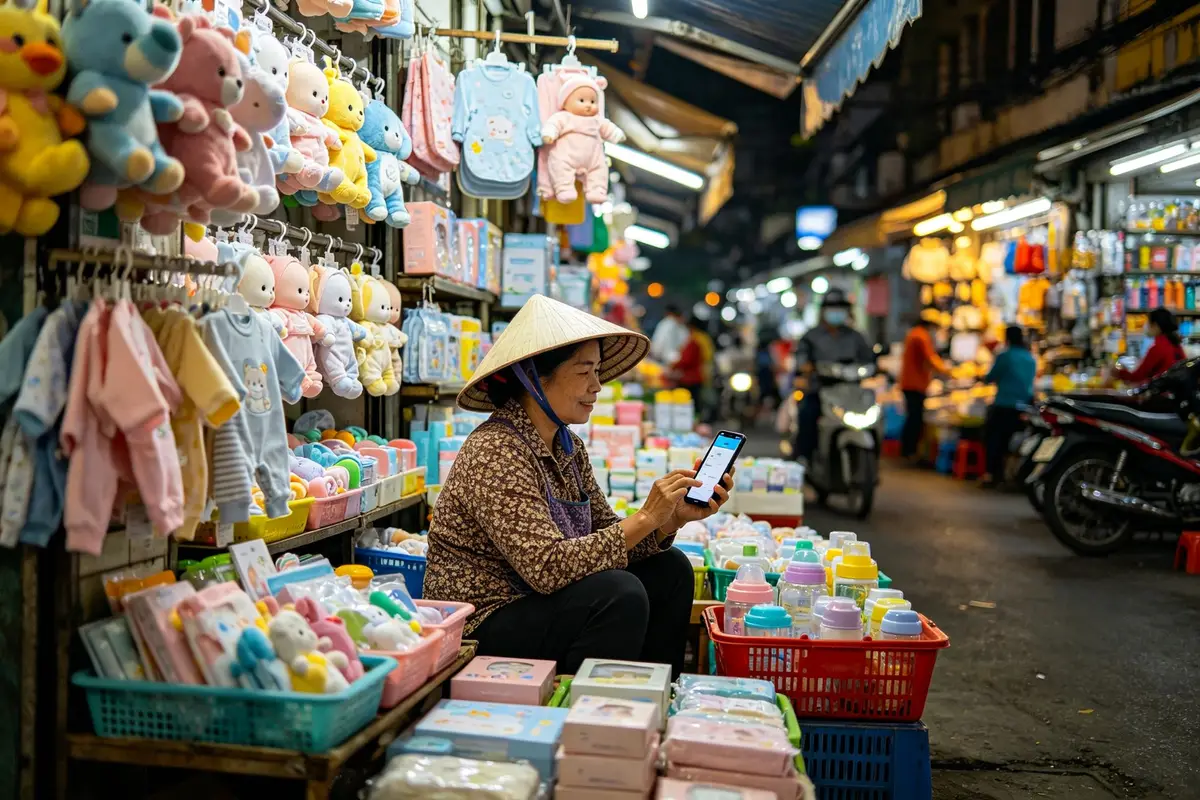
Traditional Markets: The Enduring Backbone of Vietnamese Retail
In Vietnam, traditional markets (cho co) and neighborhood shops remain the enduring backbone of the country's retail system, despite the rapid growth of modern trade and e-commerce in recent years. With thousands of traditional markets scattered across the country, from the bustling streets of Hanoi's Old Quarter to the floating markets of the Mekong Delta, these traditional retail outlets are the primary shopping destination for millions of Vietnamese consumers. For baby product brands, particularly in the mass market segment, understanding and effectively penetrating the traditional market channel is essential for success in Vietnam's diverse and dynamic market.
The importance of traditional markets in Vietnam's baby product distribution cannot be overstated. While supermarkets, hypermarkets, and convenience stores are growing rapidly in urban areas, and e-commerce is expanding across the country, traditional trade—including traditional markets, neighborhood shops, and small grocery stores—still accounts for approximately 50-60% of retail sales for fast-moving consumer goods (FMCG) in Vietnam. For mass market products like diapers and wipes, which are purchased frequently and consumed by a broad cross-section of the population, traditional markets are the most important point of sale, particularly in rural areas, smaller cities, and lower-income neighborhoods in major cities.
Understanding the Traditional Market Ecosystem
Traditional markets in Vietnam are a uniquely Vietnamese retail phenomenon, characterized by their vibrant atmosphere, diverse product assortment, and the personal relationships between vendors and customers. Despite their diversity, traditional markets share several common characteristics that shape the distribution landscape:
Ubiquity and Accessibility: Traditional markets are everywhere in Vietnam. They are found in every city, town, and village, often serving as the commercial and social center of the community. In urban areas like Hanoi and Ho Chi Minh City, traditional markets are scattered throughout residential neighborhoods, offering convenient access to fresh food, household goods, and personal care products. In rural areas, traditional markets may be held on specific days of the week, serving as the primary shopping destination for surrounding communities. Their ubiquity makes traditional markets the most accessible retail format for many Vietnamese consumers, particularly those who live in areas where modern retail is limited or who prefer to shop locally for everyday essentials.
Freshness and Affordability: Traditional markets are best known for their fresh produce, meat, and seafood, which are often sourced locally and sold at affordable prices. This focus on freshness and affordability extends to other product categories, including baby products. Consumers who shop at traditional markets are often price-sensitive and value-oriented, looking for good quality products at reasonable prices. For baby products, this means that mass market brands with competitive pricing and good value propositions are most likely to succeed in the traditional market channel. Vendors in traditional markets often have lower overhead costs than modern retailers, allowing them to offer products at competitive prices while still maintaining acceptable margins.
Personal Relationships and Trust: Traditional market vendors often have personal relationships with their customers, many of whom are regulars who shop at the same stalls every day or every week. This personal connection builds trust and loyalty, and vendors often play an informal advisory role, recommending products to customers based on their knowledge and experience. For baby products, this means that vendor recommendations can significantly influence purchasing decisions, particularly for first-time parents who may be unsure about which products to choose. Vendors may also offer credit to trusted customers, further strengthening the relationship and increasing customer loyalty. In many traditional markets, vendors are known for their personalized service and willingness to help customers find the right products for their needs.
Diverse Product Assortment: Traditional markets offer a diverse assortment of products, ranging from fresh food and groceries to household goods, personal care products, clothing, and electronics. Many markets have dedicated sections for specific product categories, such as a wet market for fresh produce, a dry goods section for packaged foods, and a household goods section for cleaning and personal care products. Baby products are typically found in the household goods or personal care sections, often alongside other products for mothers and children. The diverse product assortment in traditional markets makes them a one-stop shopping destination for many consumers, who can purchase all of their everyday essentials in a single trip.
Cash-Based and Informal Operations: Most transactions in traditional markets are cash-based, and many vendors operate informally, with limited record-keeping and business management systems. This can create challenges for distributors and brands, as it can be difficult to track sales, inventory, and pricing at the individual vendor level. However, the cash-based nature of traditional markets also means that vendors have immediate access to funds and can make purchasing decisions quickly, without the need for complex approval processes. In recent years, digital payment systems like MoMo, ZaloPay, and VNPay have begun to gain traction in traditional markets, particularly in urban areas, but cash remains the dominant payment method for most transactions.
The Multi-Layered Distribution Structure
Reaching thousands of traditional markets and neighborhood shops across Vietnam's diverse geography requires a complex, multi-layered distribution structure. The typical distribution chain for baby products involves several intermediaries, each playing a specific role in getting products from manufacturers to traditional market shelves:
National Distributors / Importers: At the top of the distribution chain are national distributors or importers who source products directly from manufacturers (either local or international). These companies have the scale and resources to import products in large quantities, manage warehousing and logistics at the national level, and distribute products to regional partners. For international brands, the national distributor is often the first point of contact in the Vietnamese market, responsible for managing the brand's distribution and marketing strategy across the country. Major national distributors in Vietnam include companies like Masan Consumer, Tan Hiep Phat, and specialized FMCG distributors that focus on specific product categories or market segments.
Regional Distributors: Below the national distributors are regional distributors who cover specific regions or provinces. Vietnam is divided into three major regions—Northern Vietnam (centered on Hanoi), Central Vietnam (centered on Da Nang and Hue), and Southern Vietnam (centered on Ho Chi Minh City)—each with its own distinct market characteristics, consumer preferences, and distribution challenges. Regional distributors typically have warehouses in major cities and distribute products to local wholesalers and large retail customers within their territory. They play a critical role in managing logistics, credit, and relationships at the regional level, particularly in areas outside of Hanoi and Ho Chi Minh City where national distributors may have limited direct presence.
Local Wholesalers / Dealers: Local wholesalers, also known as dealers or sub-distributors, operate at the district or commune level, often based in or near traditional markets. They purchase products from regional distributors in bulk and distribute them to smaller retailers, including traditional market vendors, neighborhood shops, and small grocery stores. Local wholesalers are the critical link between the formal distribution system and the informal retail sector, as they have the local knowledge, relationships, and logistics capabilities to reach small outlets that larger distributors cannot efficiently serve. Many local wholesalers specialize in specific product categories or channels, such as baby products or traditional market distribution, and they often have deep relationships with the vendors they serve.
Direct Sales Teams / Route Sellers: At the bottom of the distribution chain are direct sales teams or route sellers who visit traditional markets and neighborhood shops on a regular basis to take orders, deliver products, and manage merchandising. These salespeople are the face of the brand to traditional market vendors, and their relationships and effectiveness can significantly impact product placement and sales. Many local wholesalers employ their own sales teams, while some larger brands have their own direct sales forces that work alongside distributor teams to ensure consistent coverage and execution. In recent years, mobile technology has transformed route sales in Vietnam, with sales teams using smartphones and tablets to take orders, track inventory, and capture merchandising data in real time.
This multi-layered structure is necessary to reach Vietnam's vast and dispersed retail landscape, but it also creates challenges. Each layer adds margin, which can increase the final price to consumers. Communication and visibility can be limited, making it difficult for brands to track sales, inventory, and execution at the individual vendor level. And the complexity of managing multiple partners across different regions can make it difficult to ensure consistent pricing, promotion, and brand presentation.
Challenges in Traditional Market Distribution
While traditional markets offer enormous potential for baby product brands, they also present significant challenges that must be navigated effectively. Understanding these challenges is the first step to developing a successful traditional market distribution strategy:
Limited Shelf Space and Intense Competition: Traditional market stalls and neighborhood shops have limited shelf space, and baby products must compete with a wide range of other products for placement. Even within the baby category, there may be space for only a few brands and sizes. Gaining and maintaining shelf space requires ongoing effort, including building relationships with market vendors, offering competitive margins, and providing merchandising support. Brands that are not actively managed may find their products pushed off the shelf by competitors who offer better terms or more aggressive sales efforts. In crowded traditional markets, visibility is key, and brands that invest in attractive displays and signage are more likely to capture the attention of consumers.
Price Sensitivity and Margin Pressure: Traditional market customers are highly price-sensitive, and market vendors need to offer competitive prices to retain customers. This creates pressure on margins throughout the distribution chain, as each layer needs to make a profit while keeping the final price affordable. For baby product brands, this means that products targeted at the traditional market channel need to be priced competitively and offer good value for money. Premium products with high price points are generally not suitable for the traditional market channel, as they may not have sufficient demand or may be too expensive for the typical traditional market customer. However, some mid-premium products can succeed in traditional markets in more affluent neighborhoods, where consumers may be willing to pay a slight premium for better quality.
Credit Risk and Accounts Receivable Management: Many traditional market vendors purchase products on credit from wholesalers, creating credit risk for distributors. Managing accounts receivable and ensuring timely payment is a constant challenge, particularly for smaller vendors with limited cash flow. Distributors need to have strong credit management processes in place, including credit limits, payment terms, and collection procedures. For brands, working with distributors who have proven credit management capabilities is essential to minimize the risk of bad debt and ensure the financial health of the distribution chain. In recent years, some distributors have begun using digital tools and data analytics to better assess credit risk and manage accounts receivable, but credit management remains a significant challenge in the traditional market channel.
Logistics Complexity and Cost: Reaching thousands of traditional markets and neighborhood shops across Vietnam's diverse geography is logistically complex and costly. Products need to be transported from national warehouses to regional distribution centers, then to local wholesaler warehouses, and finally to individual market vendors and shops. This multi-stop distribution process increases transportation costs and the risk of product damage or loss. In remote areas, particularly in the mountainous regions of Northern Vietnam and the Mekong Delta, logistics can be particularly challenging, with poor infrastructure, limited transportation options, and long delivery times. Distributors need to have efficient logistics networks and strong relationships with transportation providers to ensure timely and cost-effective delivery. In recent years, the growth of third-party logistics providers and digital freight platforms has helped improve logistics efficiency in Vietnam, but reaching remote traditional markets remains a challenge.
Counterfeit and Gray Market Products: The informal nature of traditional markets makes them vulnerable to counterfeit and gray market products, which can undermine brand reputation and create unfair competition. Counterfeit baby products, in particular, pose a safety risk to consumers and can damage the brand's image. In Vietnam, counterfeit products are often smuggled across the border from neighboring countries or produced locally by unauthorized manufacturers, and they are often sold in traditional markets at significantly lower prices than genuine products. Brands need to implement strong anti-counterfeiting measures, including secure packaging, authentication systems, and regular monitoring of the distribution chain. Working with reputable distributors and maintaining strict control over pricing and promotion can also help reduce the risk of gray market activity. In recent years, the Vietnamese government has increased its efforts to combat counterfeit products, but enforcement remains a challenge, particularly in traditional markets.
Limited Marketing and Merchandising Capabilities: Traditional market vendors typically have limited time, resources, and expertise for marketing and merchandising. They may not have the ability to create attractive product displays, manage promotional programs, or provide product information to customers. This means that brands need to take an active role in providing merchandising support, including point-of-sale materials, display racks, product samples, and training for market vendors and their staff. Brands that invest in merchandising and marketing support at the traditional market level are more likely to achieve better visibility and sales. However, ensuring consistent merchandising execution across thousands of small vendors is a significant challenge, requiring regular visits and monitoring by sales teams.
Strategies for Success in Traditional Market Distribution
Despite the challenges, many baby product brands have achieved significant success in the traditional market channel by implementing effective strategies tailored to the unique characteristics of traditional trade. Key strategies for success include:
Offer Small Pack Sizes and Affordable Price Points: Given the price sensitivity of traditional market customers and the limited capital of market vendors, offering small pack sizes and affordable price points is essential for success in the traditional market channel. For diapers, this might mean offering small packs of 2-5 diapers that are affordable for market vendors to stock and for customers to purchase. For wipes, travel packs and small formats can be effective. Small pack sizes not only make products more accessible to price-sensitive consumers but also reduce the capital required for market vendors to stock the products, making it easier for them to try new brands. In Vietnam, the practice of buying products in small quantities (le) is common, particularly among lower-income consumers, and offering small pack sizes can help brands capture this segment of the market.
Build a Strong and Loyal Distributor Network: The foundation of successful traditional market distribution is a strong network of distributors and wholesalers who have existing relationships with traditional market vendors and the capabilities to reach them effectively. Brands should carefully select distribution partners based on their coverage, reputation, financial stability, and commitment to the brand. Investing in distributor training, incentives, and support can help build loyalty and ensure that distributors prioritize the brand in their sales efforts. Regular communication and performance monitoring are also essential to ensure that distribution partners are meeting coverage and sales targets. In Vietnam, where personal relationships are highly valued, building strong, trust-based relationships with distribution partners is particularly important for long-term success.
Offer Competitive Margins and Credit Terms: Traditional market vendors and distributors are motivated by margins and credit terms, so brands need to offer competitive terms that make it worthwhile for them to stock and promote the products. This includes not only base margins but also volume incentives, promotional allowances, and rebates for achieving sales targets. For traditional market vendors, offering favorable credit terms can be particularly important, as it reduces their financial risk and makes it easier for them to stock new products. However, brands need to work with distributors to ensure that credit terms are managed responsibly and that credit risk is minimized. In Vietnam, where credit is commonly extended in traditional trade, offering competitive credit terms can be a key differentiator for brands looking to gain distribution in traditional markets.
Invest in Merchandising and Point-of-Sale Materials: In a crowded traditional market environment, visibility is key. Brands that invest in attractive and functional merchandising materials—including display racks, shelf talkers, posters, banners, and product samples—are more likely to capture the attention of traditional market vendors and customers. Point-of-sale materials should be designed to be easy to install and maintain in a market environment, and they should clearly communicate the product's key benefits and value proposition in Vietnamese. Regular merchandising visits by sales teams can help ensure that products are displayed correctly and that materials are in good condition. In Vietnam's traditional markets, where vendors often have limited space and resources, providing free display racks and merchandising materials can be a powerful incentive for vendors to stock and promote a brand's products.
Leverage Digital Tools and Mobile Technology: Digital tools and mobile technology are transforming traditional market distribution in Vietnam, offering brands greater visibility, efficiency, and control over the traditional trade channel. Mobile sales apps allow sales teams to take orders electronically, track inventory, and capture merchandising data in real time. Digital platforms connect traditional market vendors directly with distributors, enabling them to order products online, access promotions, and manage their accounts more efficiently. In Vietnam, the rapid adoption of smartphones and mobile internet has made it possible to deploy these digital tools even in remote traditional markets. Brands that embrace these digital tools can improve distribution efficiency, reduce costs, and gain better visibility into traditional market sales and execution. The growth of digital payment systems like MoMo and ZaloPay is also helping to reduce the reliance on cash in traditional markets, improving financial transparency and reducing credit risk.
Build Relationships with Traditional Market Vendors: At the end of the day, traditional market distribution is about relationships. Traditional market vendors are more likely to stock and promote products from brands and distributors that they know and trust. Investing in relationship building—through regular sales visits, personalized service, and support for vendors' businesses—can pay significant dividends. Sales teams should be trained to understand the needs and challenges of traditional market vendors and to provide solutions that help them succeed. In Vietnam, where personal relationships and trust are highly valued in business, taking the time to build genuine relationships with market vendors can be a key competitive advantage. Brands that are seen as partners rather than just suppliers are more likely to achieve long-term success in the traditional market channel.
Future Outlook: The Evolving Traditional Market Channel
The traditional market channel in Vietnam is evolving rapidly, driven by digital technology, changing consumer behavior, and the modernization of traditional retail. Several trends are likely to shape the future of traditional market distribution:
Digital Transformation: Digital platforms and mobile technology are making it easier for traditional market vendors to order products, manage inventory, and access financial services. B2B e-commerce platforms and mobile ordering apps are launching programs specifically targeting traditional market vendors, enabling them to purchase products online and access a wider assortment than what is available from traditional distributors. This digital transformation is likely to increase efficiency, reduce costs, and improve visibility in the traditional market channel. In Vietnam, where smartphone penetration is high and digital adoption is rapid, the digital transformation of traditional markets is likely to accelerate in the coming years.
Modernization of Traditional Retail: Many traditional markets and neighborhood shops are evolving into more modern retail formats, offering a wider assortment of products, better shopping environments, and more professional operations. This modernization is being driven by increasing consumer expectations, competition from modern retail, and the availability of financing and support programs for small retailers. In Vietnam, the government has also launched programs to modernize traditional markets, improving infrastructure, hygiene, and organization. As traditional markets become more sophisticated, they are likely to carry a wider range of baby products, including premium and niche products that were previously only available in modern retail.
Financial Inclusion and Credit Access: Financial technology (fintech) companies are expanding access to credit and financial services for traditional market vendors, enabling them to purchase more inventory and grow their businesses. Digital payment systems are also becoming more widespread, reducing the reliance on cash and improving the efficiency of transactions. In Vietnam, the rapid growth of mobile wallets like MoMo and ZaloPay, combined with the government's push for a cashless society, is driving financial inclusion in traditional markets. This financial inclusion is likely to strengthen the traditional market channel and enable vendors to carry a wider assortment of products, including baby products.
Omnichannel Integration: The boundaries between online and offline retail are blurring, and traditional markets are increasingly becoming part of omnichannel retail ecosystems. Some e-commerce platforms are using traditional markets as pickup points for online orders, while others are enabling market vendors to sell products online through their platforms. In Vietnam, the growth of e-commerce and last-mile delivery services is creating new opportunities for traditional market vendors to reach customers beyond their immediate location. This omnichannel integration is likely to create new opportunities for baby product brands to reach consumers through the traditional market channel, both as a point of sale and as a fulfillment node for online orders.
For baby product brands, the future of traditional market distribution in Vietnam is both challenging and full of opportunity. By understanding the unique characteristics of the traditional market channel, building strong distributor relationships, investing in merchandising and marketing support, and embracing digital technology, brands can successfully penetrate this vast and important market. Those that can effectively navigate the complexities of traditional trade while adapting to the evolving retail landscape will be well-positioned to capture significant share in Vietnam's dynamic baby products market.
Frequently Asked Questions
How important are traditional markets for baby products in Vietnam?
Traditional markets (cho co) and neighborhood shops remain extremely important for baby products in Vietnam, particularly for mass market items like diapers and wipes. While modern trade is growing rapidly in urban areas, traditional trade still accounts for approximately 50-60% of retail sales for fast-moving consumer goods in Vietnam. For baby products, traditional markets are often the primary shopping destination for consumers in rural areas, smaller cities, and lower-income neighborhoods in major cities. Many Vietnamese consumers prefer traditional markets for their freshness, affordability, and the personal relationships they have with vendors.
What is the typical distribution structure for reaching traditional markets in Vietnam?
The distribution structure for reaching traditional markets in Vietnam typically involves multiple layers: (1) National distributors who source products from manufacturers and manage large-scale distribution; (2) Regional distributors who cover specific regions or provinces; (3) Local wholesalers or dealers who operate at the district or commune level, often based in traditional markets; (4) Market vendors and neighborhood shop owners who sell directly to consumers. Some larger brands also use direct selling teams that visit traditional markets and neighborhood shops on a regular basis to take orders and deliver products. The multi-layered structure is necessary due to Vietnam's diverse geography and the large number of small, dispersed retail outlets.
What are the main challenges of distributing through traditional markets?
The main challenges include: (1) Limited shelf space—traditional market stalls and neighborhood shops are small and can only carry a limited assortment; (2) Price sensitivity—traditional market customers are highly price-sensitive, making it difficult to command premium prices; (3) Credit dependence—many market vendors operate on credit, requiring distributors to manage accounts receivable; (4) Logistics complexity—reaching traditional markets in remote areas can be costly and time-consuming; (5) Counterfeit and gray market products—the informal nature of traditional markets makes them vulnerable to counterfeit products; (6) Limited marketing and merchandising capabilities—market vendors may have limited ability to display and promote products effectively; (7) Inconsistent pricing and promotion—ensuring consistent pricing and promotion across thousands of small vendors is challenging.
What strategies can brands use to succeed in traditional market distribution?
Key strategies include: (1) Offer small pack sizes and affordable price points that are suitable for traditional market customers; (2) Build a strong network of distributors and wholesalers who have existing relationships with market vendors; (3) Provide competitive margins and credit terms to market vendors; (4) Invest in point-of-sale materials, display racks, and signage to increase visibility in crowded markets; (5) Build relationships with market vendors through regular visits and personalized service; (6) Use mobile sales teams and digital ordering platforms to improve efficiency and coverage; (7) Develop products specifically for the traditional market channel, including durable packaging and clear, simple labeling in Vietnamese; (8) Partner with reputable local distributors who understand the traditional market landscape and have established networks.