
2026-11-04 · Moni Happy
What sell-through rate must a first diaper wholesale order hit to break even?
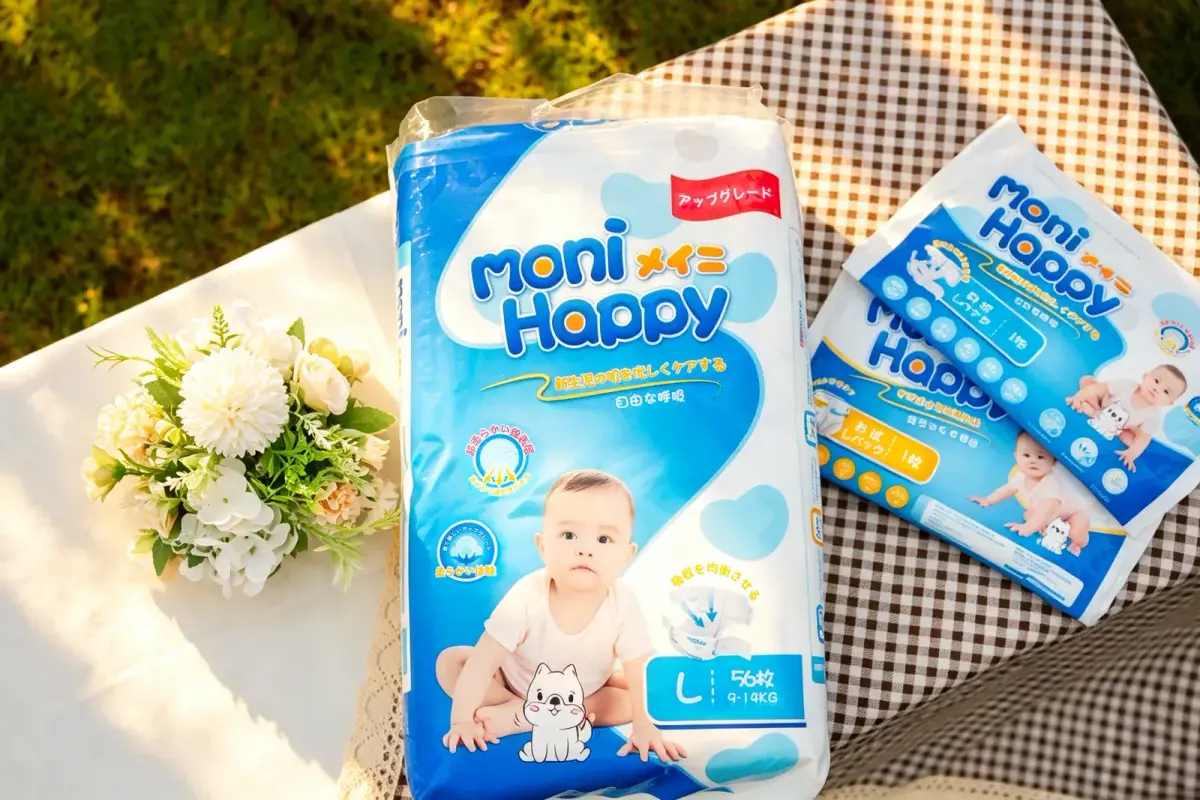
A first diaper wholesale order normally needs roughly 60–80% of the container sold at full price within 90 days to break even. That range is not a market statistic; it falls out of five numbers a distributor already holds: landed cost per piece, sell-in price, clearance value on the tail, fixed costs, and the credit extended to retailers.
Most first orders fail on timing rather than price. The margin on the quotation looks acceptable, but the cash comes back later than the second container is due. The sell-through rate is the number that shows whether that is happening, and it is the number most first-time importers never calculate.
What sell-through rate does a first diaper wholesale order need to break even?
Sixty to eighty per cent at full price, inside 90 days. The width of that range comes from two variables the buyer controls: how much the slow tail has to be marked down, and how much fixed cost sits outside the goods.
Two consequences follow, and both surprise first-time buyers. First, a container can be profitable on paper and still starve the business of cash, because the profit is sitting in a warehouse rather than a bank account. A first container is also the only order with no history behind it, so the threshold has to be calculated rather than assumed. Second, the threshold is not fixed: it worsens every month the stock ages and every time a retailer stretches payment. A rate that clears at 60% with a fast tail does not clear at all once the tail has to be cleared at a loss.
How do I calculate the break-even sell-through rate from a landed cost?
Use one formula. Sell-through is the fraction of the container that must go at full price for the contribution on those pieces to absorb both the fixed costs and the loss on everything that has to be cleared below cost.
The expression is: fixed costs plus the clearance loss on the whole container, divided by the contribution per piece plus the clearance loss per piece. That looks abstract until it is filled in.
- Pieces in the container (N). A 20GP of tape diapers typically carries around 48,000 pieces across the size mix.
- Landed cost per piece (c). Confirm with your broker by HS code; for tape diapers it commonly sits in the range of $0.18–0.28 depending on size and freight.
- Sell-in price per piece (p) to the retailer or sub-distributor.
- Clearance value per piece (s) — what the slow tail actually fetches when it is pushed out.
- Fixed costs (F) — listing and barcode fees, warehousing for the holding period, samples, launch support.
With a clearly hypothetical container of 48,000 pieces, landed at $0.22 and sold in at $0.30, with a clearance value of $0.15 and fixed costs of $1,500, the calculation gives a threshold of 67.5% of the container. That is the useful output: not a rule of thumb, but the number this particular order has to hit.
Why does the sell-through rate matter more than the gross margin on the quote?
Because margin is a rate and sell-through is a quantity. A 20% margin earned on stock that never leaves the warehouse is worth nothing. Distributor cash flow is the real constraint, and it is invisible in a margin percentage.
Suppliers quote margin percentages because that is how the trade talks. But a distributor's real constraint is how many pieces per month leave the warehouse at a price that covers the cost stack. A container with a 15–25% gross margin and 80% sell-through in a quarter is a better business than one with a 30% margin and 45% sell-through, because in the first case the second container is funded by the first, and in the second case it is funded by the bank.
What costs sit outside the container that the calculation has to absorb?
Five, and they are usually the reason the threshold lands in the upper half of the range rather than near the bottom. On a first container they are also front-loaded, paid before any revenue arrives.
- Listing and barcode fees per SKU per chain, payable before a single piece sells.
- Retailer credit of 30–60 days, which means you fund the goods before you are paid for them.
- Slow sizes. Newborn and small sizes move slowly in some channels and fast in others; the mismatch ties up cash in the wrong part of the range.
- Damage and returns, especially on wipes where seal failure is a packaging fault rather than a customer complaint.
- Promotional support agreed at listing, which lowers the price achieved on part of the volume.
Run the formula again with fixed costs at $3,000 instead of $1,500 and the same container needs 88.3%: an extra $1,500 of fixed cost adds more than twenty percentage points to the threshold. That sensitivity is why listing fees deserve the same scrutiny as the piece price.
How does discounting change the break-even sell-through rate?
It raises it sharply, and not proportionally. A 10% cut in sell-in price takes contribution per piece from $0.08 to $0.05 on the example above, and the threshold moves from 67.5% to 84.4%.
On a first container the discount is usually granted before the sell-through pattern is known, which is what makes it expensive. That is the arithmetic behind the most common first-order mistake. Ten per cent off looks like a small concession at the negotiating table and behaves like a twenty-five per cent increase in the volume needed. It also explains why promotional volume has to be tracked separately from full-price sell-through: a container reporting 90% sell-through sounds healthy until a third of that volume turns out to have moved on a two-for-one that returned cost plus a few cents. In cash terms it can be worse than a container that reports 70% at full price.
What sell-through should I expect at 30, 60 and 90 days?
Front-load the expectation, and treat the 30-day number as the early warning rather than the 90-day one.
A workable pattern for a first diaper wholesale order in a modern-trade channel is roughly 25–35% by day 30, 50–65% by day 60 and 60–80% by day 90, with the size curve flattening as the fast sizes reorder. If day 30 comes in below a quarter, the problem is almost always distribution rather than product: too few outlets, wrong outlets, or a size mix that does not match the catchment. Fixing it at day 30 costs a sales visit; fixing it at day 90 costs a margin.
How do I protect cash flow if sell-through runs behind plan?
Protecting distributor cash flow is a question of sequence as much as of choice. Act on three levers in order: distribution, transfer, and price. Price is last because it is the only one you cannot undo.
- Add outlets before adding discount. Moving stock from 20 stores to 35 stores at the same price solves a sell-through problem without touching contribution.
- Transfer between channels. Stock that is slow in pharmacy can be fast in independent baby stores, and the reverse. A regional transfer at cost is cheaper than a markdown.
- Discount only the size that is stuck, not the whole line. A size-specific markdown protects the price architecture of the rest of the range.
If the shortfall is structural — the landed cost is simply too high for the shelf price the market accepts — then the answer is a different specification or a different origin, not more discount. Our wholesale price, MOQ and margin guide sets out how the cost stack is built before an order is placed.
When should I reorder rather than discount?
Reorder when the fast sizes are down to a few weeks of cover, even if the slow sizes are still full. Holding a whole container hostage to its worst-performing size is the most common first-order mistake.
Place the second order against the size curve that actually sold, not against the original mix. That single discipline separates the distributor who survives year one from the one who accumulates dead stock. For the mechanics of a first order that clears its own cash, see the distributor onboarding guide; for channel selection, see the Southeast Asia distribution channel guide.
If you want the break-even calculation run against a real quotation rather than a hypothetical one, apply as a partner and we will work through the cost stack with you, including size mix and freight to your port.
Frequently asked questions
Is sell-through the same as stock turn?
No. Sell-through measures how much of a specific order has sold; stock turn measures how many times inventory cycles in a year. A container can show strong sell-through and still produce weak annual turn if the reorder pattern is irregular.
Does the 60–80% range apply to wipes and tissues too?
It is a reasonable starting range, but tissue and wipes have shorter shelf-life sensitivity and bulkier cartons, so warehousing cost per piece is higher and the threshold often lands at the top of the range.
What if my retailer insists on 90-day payment?
Then the container has to clear its break-even much earlier, or the payment terms have to be priced into the sell-in price. Ninety-day terms on a first order usually mean the second order is financed externally.
Sources and further reading
- International Trade Centre, Trade Map — import values and volumes by HS code for diapers and tissue in Southeast Asian markets.
- ASEAN, ASEAN Tariff Finder — current preferential and MFN duty rates to confirm the landed cost input.
- Euromonitor International, retail and channel data — category structure and modern-trade share by market.
Bottom line
Break-even on a first diaper wholesale order is a sell-through question before it is a margin question. Plan for 60–80% of the container sold at full price inside 90 days, track the 30-day figure as the early warning, and treat promotional volume as a separate line rather than as progress. The distributor who recalculates distributor cash flow before every reorder is the one who funds the second container from the first.
Frequently Asked Questions
What sell-through rate should I plan for on a first diaper container?
Plan for 60–80% of the container sold at full price within 90 days. Below that, the order is usually still consuming working capital when the second container is due, even if the per-piece margin looks healthy on paper.
Does a higher gross margin lower the break-even sell-through rate?
Yes, and steeply. Contribution per piece sits in both the top and bottom of the calculation, so a small gain in margin lowers the threshold by more than the same percentage gain in price would suggest.
Should I count promotional volume in the sell-through figure?
Count it separately. Pieces sold on promotion still move stock but contribute far less cash, so a container that reports 90% sell-through with a third of it discounted can be worse off than one at 70% sold at full price.
How often should I recalculate the break-even rate?
Before every reorder, and whenever landed cost, freight, clearance value or retailer payment terms change. A two-week shift in payment terms can move the threshold by several percentage points.
Distributor resources
If you are evaluating suppliers for your market, these are the pages that answer the commercial questions — in the order buyers usually need them.