
2026-09-06 · Moni Happy Mom
Baby Choking Prevention & First Aid: A Parent's Essential Guide

Summary: The thought of my baby choking terrified me — so much so that I avoided giving finger foods for weeks with my first baby. But after taking an infant CPR and first aid class, and after dealing with a few scary coughing episodes, I learned that knowledge is power. Here's what every parent should know about choking prevention, how to respond if your baby chokes, and how to keep mealtime safe.
What's the Difference Between Gagging and Choking?
This is the first thing I learned in my first aid class, and it's the most important distinction. Gagging is a normal, protective reflex — it's your baby's body pushing food forward to prevent choking. When a baby gags, they may cough, sputter, make faces, and even vomit, but they can still breathe and make noise. Gagging is actually a good sign — it means their airway is protected and they're learning how to manage food in their mouth.
Choking, on the other hand, means the airway is blocked. A choking baby cannot breathe, cough effectively, or make noise. They may have a silent cough, their lips or face may turn blue, and they may clutch their throat or wave their arms in distress. Choking is a medical emergency that requires immediate action.
With my first baby, I panicked every time he gagged — I thought he was choking. With my second and third, I learned to stay calm and watch for the signs: if they're coughing and making noise, they're gagging (let them cough it out). If they're silent and can't breathe, they're choking (take action immediately).
How Can I Prevent Choking?
Prevention is always better than dealing with an emergency. Here's what I did to reduce choking risk with all three of my babies:
1. Cut food into appropriate sizes and shapes. For babies just starting finger foods (around 6-9 months), cut food into long, thin strips (about the size of your pinky finger) that they can hold and gum. Small, round pieces (like whole grapes, cherry tomatoes, blueberries) are the most dangerous because they can perfectly block the airway. Always cut round foods into quarters or slices. As babies get older (9-12 months), you can start offering smaller bite-sized pieces, but still avoid anything round and hard.
2. Avoid high-risk foods. There are certain foods that are common choking hazards for babies and toddlers: whole grapes, hot dogs (cut into rounds — always cut lengthwise first, then into small pieces), nuts and seeds, popcorn, hard candy, marshmallows, chunks of peanut butter (spread thinly instead), raw carrots or apple chunks (cook until soft or grate), and chunks of cheese. I avoided all of these until my babies were at least 3-4 years old and could chew thoroughly.
3. Always supervise mealtime. Never leave your baby alone while eating — even for a second. I always sat with my babies at the table, put away distractions (no phones, no TV), and watched them eat. I also made sure they were sitting upright in a high chair with a harness — never let them eat while lying down, crawling, or walking around.
4. Cook hard foods until soft. Raw carrots, apples, and other hard fruits and vegetables are choking hazards. I cooked them until they were soft enough to squish between my thumb and forefinger. For younger babies, I also grated hard foods or offered them in very thin, long strips that they could gum.
5. Keep small objects out of reach. Choking isn't just about food — babies put everything in their mouths. I did regular "choking hazard checks" around the house, getting down on my hands and knees to look for small objects: coins, buttons, batteries, small toy parts, pen caps, jewelry, and houseplants (some are toxic). I used a toilet paper roll as a guide — if an object fits through the roll, it's a choking hazard for a baby under 3.
6. Use appropriate food textures. Start with smooth purees, then gradually move to lumpy purees, then soft finger foods, then table foods. The transition should happen gradually as your baby develops chewing and swallowing skills. I followed my babies' cues — if they were gagging a lot on a certain texture, I went back to a smoother texture for a week or two and tried again.
What Do I Do If My Baby Is Choking?
If your baby is choking (silent, can't breathe, blue lips), here's what to do — stay calm and act quickly:
Step 1: Call for help. If someone else is nearby, yell for them to call emergency services (911 or your local emergency number). If you're alone, do 2 minutes of first aid first, then call. (With a baby, you can carry them with you to the phone.)
Step 2: Give 5 back blows. Hold your baby face-down along your forearm, with their head lower than their body. Support their head and neck with your hand (hold the jaw, not the throat — don't compress the soft tissues of the neck). Give 5 firm back blows between the shoulder blades with the heel of your other hand. The blows should be firm but not violent — you're trying to dislodge the object, not hurt the baby.
Step 3: Give 5 chest thrusts. If back blows don't dislodge the object, turn your baby face-up along your forearm, still with their head lower than their body. Support their head and neck. Place two fingers (index and middle) on the center of their chest, just below the nipple line. Give 5 quick chest thrusts — push down about 1.5 inches, then let the chest come back up. This is like CPR compressions but slower and more deliberate.
Step 4: Repeat. Continue alternating 5 back blows and 5 chest thrusts until the object is dislodged, the baby starts breathing or crying, or the baby becomes unconscious. If the baby becomes unconscious, start CPR (30 chest compressions followed by 2 rescue breaths) and continue until help arrives.
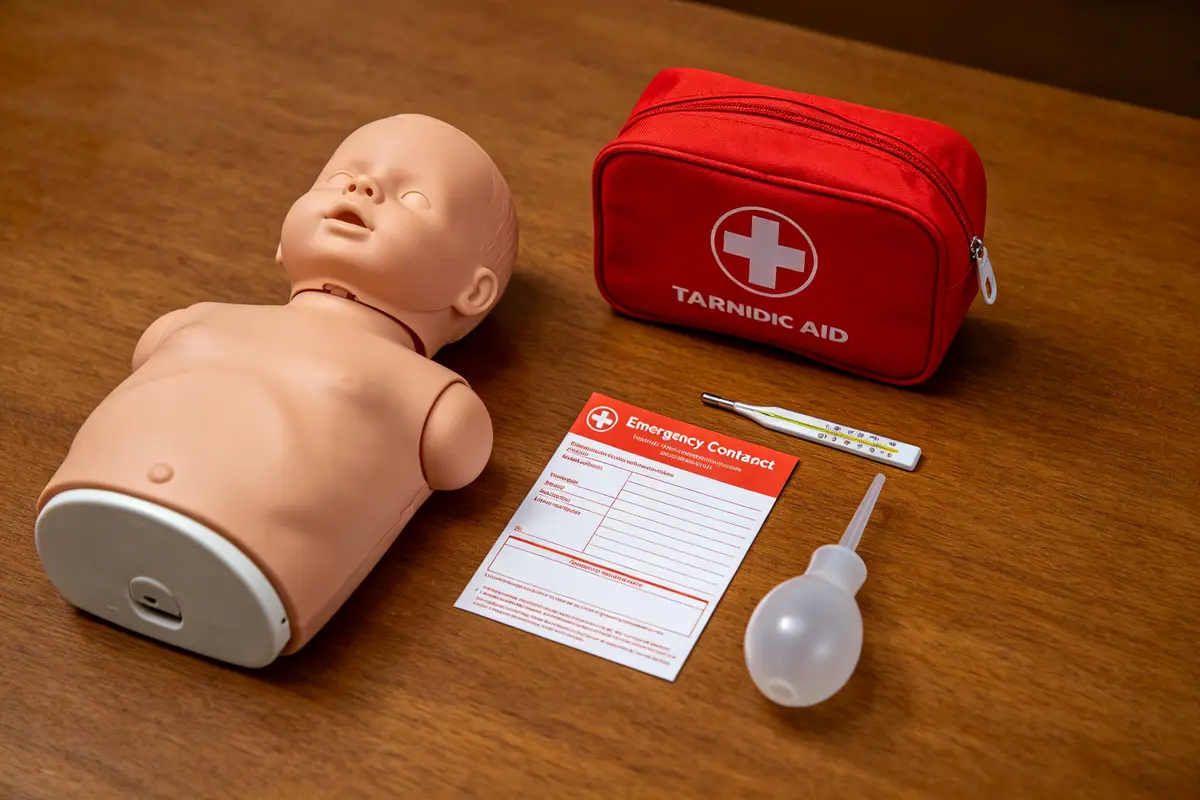
Important: Don't do blind finger sweeps — if you can't see the object, don't stick your finger in the mouth, as you could push the object further down. If you can see the object in the mouth and can easily remove it, do so carefully. I took an infant CPR and first aid class before my first baby started solids, and I cannot recommend it enough. The hands-on practice gave me the confidence to act quickly if needed. Many hospitals, community centers, and organizations like the Red Cross offer these classes — some are even free.
What Should Be in a Baby First Aid Kit?
I kept a well-stocked first aid kit in the house and a smaller one in the diaper bag. Here's what I found essential:
- Infant/children's acetaminophen (Tylenol) and ibuprofen (for babies over 6 months) — with dosage chart based on weight
- Digital thermometer (I preferred a rectal thermometer for newborns, then an ear or forehead thermometer for older babies)
- Bandages in various sizes (including small ones for tiny fingers)
- Sterile gauze pads and medical tape
- Antiseptic wipes or hydrogen peroxide (for cleaning minor cuts and scrapes)
- Antibiotic ointment (like Neosporin — check with your pediatrician before using on infants)
- Bulb syringe (for clearing nasal congestion — I also used it for clearing the mouth if needed)
- Tweezers (for removing splinters)
- Baby nail clippers and file
- Oral syringe or medicine dropper (for giving liquid medicine)
- Emergency contact numbers (pediatrician, poison control, emergency services)
- First aid guide or CPR instructions card
I also kept a pack of baby wipes and a small bottle of hand sanitizer in the first aid kit for cleaning hands and surfaces before treating minor injuries. I checked the kit every few months to replace expired items and restock anything I had used.
FAQ
Q: My baby gags a lot during meals. Is this normal?
A: Yes, gagging is completely normal and actually a good sign — it means your baby's protective reflex is working. Babies have a very sensitive gag reflex (it's further forward in the mouth than in adults), which helps protect them from choking. As babies get more practice with food and their gag reflex moves further back, gagging will decrease. If your baby is gagging so much that they're vomiting frequently or refusing to eat, talk to your pediatrician — it could be a sign of sensory issues or feeding difficulties.
Q: Should I do the Heimlich maneuver on a choking baby?
A: The Heimlich maneuver (abdominal thrusts) is NOT recommended for babies under 1 year old. For infants, use back blows and chest thrusts instead. Abdominal thrusts can cause internal injuries in babies, whose organs are more fragile and not as well protected by the ribcage. For children over 1 year old, abdominal thrusts (Heimlich) are appropriate. I always recommend taking an infant first aid class to learn the proper technique — it's different from adult first aid.
Q: When should I call emergency services for a choking episode?
A: Call emergency services immediately if: your baby is choking and you can't dislodge the object, your baby becomes unconscious, your baby's lips or face turn blue, your baby has difficulty breathing after the object is dislodged, or your baby loses consciousness at any point. Even if you successfully dislodge the object and your baby seems fine, it's a good idea to call your pediatrician to check for any injuries or complications. If your baby had a severe choking episode, they should be evaluated by a doctor.
Q: Can I give my baby water to help wash down food that's stuck?
A: No — never give a choking baby water or any liquid. If the airway is blocked, liquid can't get through anyway, and it could make the situation worse by entering the airway. If your baby is gagging (not choking) and seems to be having trouble with a piece of food, let them cough it out — don't give water, as it could cause them to aspirate. Once they've successfully coughed up the food and are breathing normally, you can offer a small sip of water if they want it.
Final Thoughts
Choking is scary, but being prepared makes all the difference. Take an infant CPR and first aid class, keep a well-stocked first aid kit, and practice choking prevention at every meal. Remember that gagging is normal and protective — it's how babies learn to eat. And if the worst happens and your baby chokes, stay calm, act quickly, and trust your training. You've got this, mama. And if you ever have questions or concerns about feeding safety, don't hesitate to ask your pediatrician — they're there to help.