
2026-09-05 · Moni Happy Mom
Baby Cognitive Development 0-12 Months: A Mom's Guide to Milestones & Activities
Summary: Cognitive development isn't just about hitting milestones — it's about how your baby learns to think, explore, and understand the world. As a mom of three, I've watched each child's mind unfold differently. Here's what cognitive development actually looks like month by month, and the simple activities that help it thrive.
What Is Cognitive Development, Exactly?
When people talk about baby development, they usually mean physical milestones — rolling, sitting, walking. But cognitive development is about the brain: how your baby thinks, learns, remembers, solves problems, and understands the world around them. It's the difference between a baby who stares at a toy and one who figures out how to make it make noise.
With my first baby, I worried constantly about whether he was "on track." With my third, I relaxed a lot more — I learned that every baby develops at their own pace, and what matters is that they're making progress, not hitting every milestone exactly on schedule.
What Does Cognitive Development Look Like Month by Month?
0-2 months: Newborns are taking in everything. They focus on faces (especially yours), respond to loud sounds, and start to follow objects with their eyes. My babies all loved staring at our faces during this stage — it's how they learn to recognize us. They also start to show preferences: my second baby clearly preferred certain toys and sounds from week one.
3-4 months: This is when things get fun. Babies start to intentionally reach for and bat at objects. They discover their hands and feet (my third spent weeks staring at his hands like they were the most fascinating thing in the world). They start to understand cause and effect — if I shake this rattle, it makes noise. They also start to recognize familiar people and may smile or get excited when they see you.
5-6 months: Object permanence starts to emerge — the understanding that things continue to exist even when you can't see them. This is why peekaboo becomes the greatest game ever invented. My babies would shriek with laughter when I "disappeared" and came back. They also start to transfer objects from hand to hand, and they may start to show frustration when a toy is out of reach (which is actually a cognitive milestone — they understand the toy exists and they want it).
7-9 months: This is a huge cognitive leap. Babies understand object permanence fully now — they'll look for a toy you hide under a blanket. They start to use tools intentionally (using a stick to reach a toy, for example). They develop separation anxiety (which is cognitive — they remember you exist when you're gone and they want you back). They start to understand simple words like "no" and their own name. My middle child started waving "bye bye" at 8 months, which blew my mind.
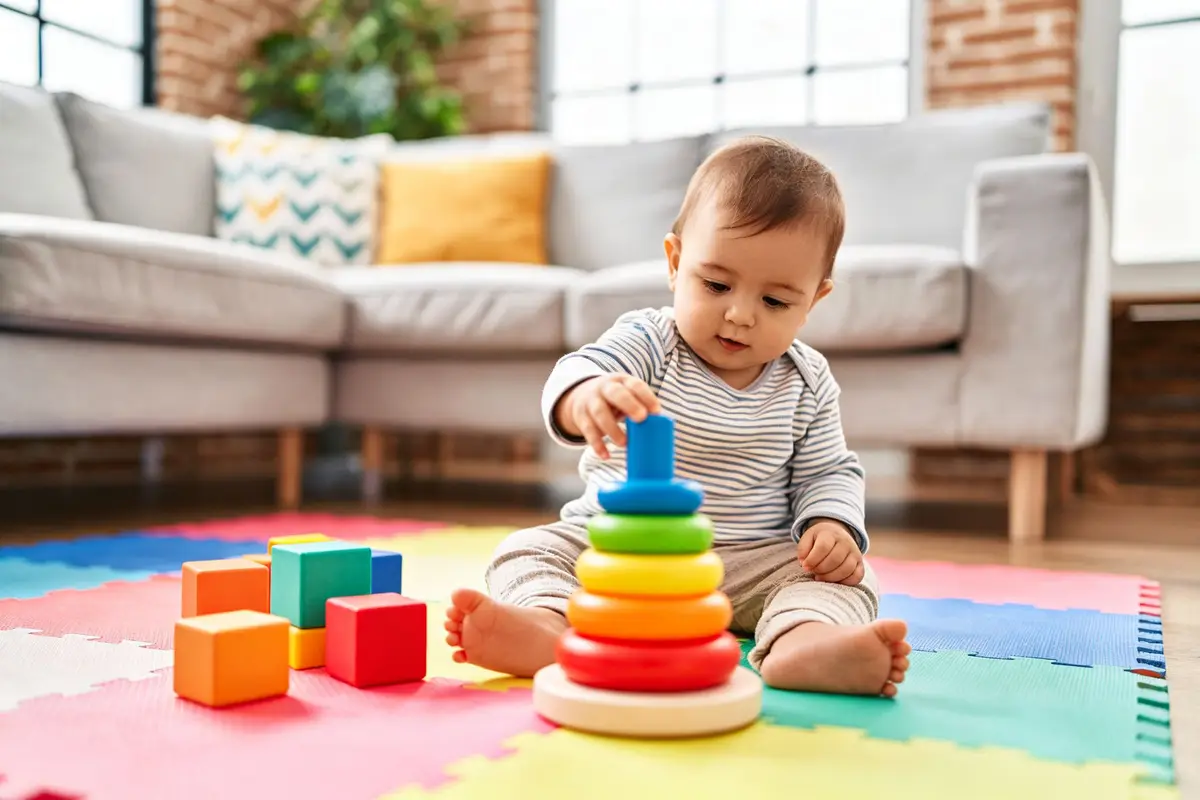
10-12 months: Babies become little problem solvers. They'll try different ways to get what they want — stacking boxes to reach a toy, for example. They understand more words and may follow simple instructions ("give me the ball"). They start to use gestures intentionally (pointing, waving, shaking head "no"). They may also start to show preferences for certain activities or toys. My first baby was obsessed with stacking rings at this age; my second preferred books.
What Activities Actually Help Cognitive Development?
You don't need expensive toys or baby Einstein classes. The best cognitive activities are simple, everyday interactions:
Talk to your baby constantly. Narrate what you're doing. "Now Mommy is putting your socks on. One sock, two socks." This builds language skills and helps them connect words to objects. I talked to all three of mine constantly, even when I felt silly doing it.
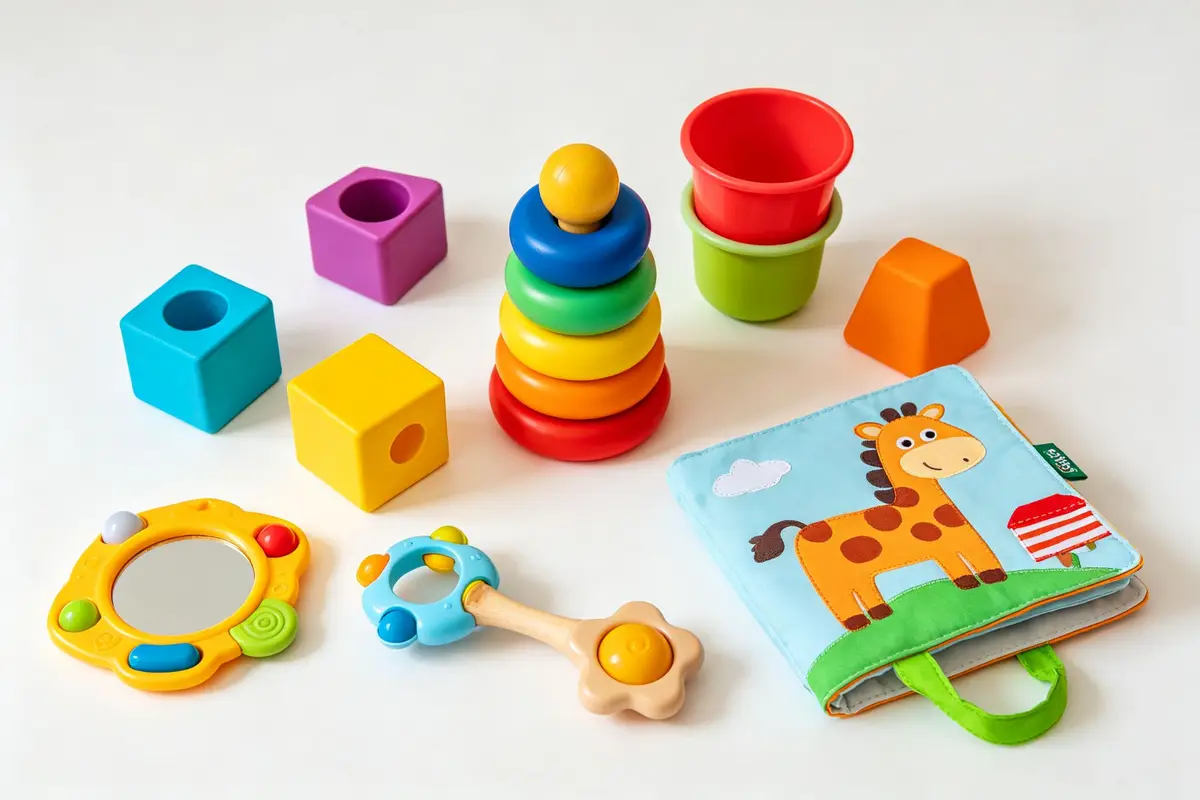
Read together. It's never too early. Even newborns benefit from hearing your voice and looking at high-contrast images. As they get older, let them touch and chew on board books (that's how they explore). We had a basket of soft books and cloth books that all three babies loved.
Play peekaboo and hide-and-seek with toys. These games build object permanence. Start simple — cover a toy with a blanket and see if they find it. Gradually make it harder.
Give them problem-solving opportunities. Stacking toys, shape sorters, nesting cups — these all help with spatial reasoning and problem solving. Don't show them how to do it immediately; let them try and figure it out. It's tempting to help, but the "aha!" moment is where the learning happens.
Sing songs and nursery rhymes. Music helps with pattern recognition, memory, and language. My babies all had favorite songs, and they'd start moving or cooing when they heard the first few notes.
Allow safe exploration. Baby-proof a room and let them explore freely. Touching, mouthing, shaking, dropping — all of this is cognitive work. They're learning about properties of objects (this is soft, this is hard, this makes noise when I shake it).
When Should I Worry About Cognitive Development?
Most babies develop at their own pace, and there's a wide range of "normal." But these are signs that warrant a conversation with your pediatrician:
- By 3 months: doesn't respond to loud sounds, doesn't follow moving objects with eyes, doesn't smile at people
- By 6 months: doesn't reach for or try to grasp objects, doesn't show affection for caregivers, doesn't respond to sounds around them
- By 9 months: doesn't look for objects you hide, doesn't babble, doesn't recognize familiar people
- By 12 months: doesn't use any gestures (pointing, waving), doesn't say any single words, doesn't search for hidden objects
With my first baby, I was convinced he was behind because he didn't wave until 11 months. My pediatrician reminded me that milestones are ranges, not deadlines. He was perfectly fine — just a little more deliberate about when he wanted to perform. If you're concerned, trust your instincts and talk to your doctor. Early intervention is always better than waiting.
FAQ
Q: Do I need to buy educational toys to help my baby's cognitive development?
A: No. The best "toy" for cognitive development is you — talking, singing, playing, and interacting. Simple household items (wooden spoons, plastic containers, soft scarves) are just as effective as expensive educational toys. What matters is engagement and interaction, not the price tag.
Q: My baby seems more interested in the box than the toy. Is that normal?
A: Completely normal. Babies learn through exploration, and a box offers more possibilities than a toy that does one thing. They can put things in it, take things out, bang it, crawl into it (if it's big enough). This is all cognitive work. Let them explore the box — it's not a waste.
Q: How much screen time is okay for a baby under 12 months?
A: The AAP recommends no screen time for babies under 18 months, except for video chatting. Babies learn best from real human interaction, not screens. I avoided screens entirely with all three of mine in the first year, and I think it made a difference in their attention spans and language development.
Q: Can I "overstimulate" my baby with too many activities?
A: Yes. Babies need downtime too. If your baby is turning away, crying, or rubbing their eyes, they're overstimulated and need a break. I learned to watch for these cues and give my babies quiet time — a dim room, a soft blanket, no toys. Rest is when the brain consolidates what it's learned.
Final Thoughts
Cognitive development is happening every single day, in every interaction. You don't need a fancy curriculum or expensive toys — you just need to talk, play, read, and let your baby explore. Every baby is different, and that's okay. What matters is that they're making progress, that they're curious and engaged, and that they feel safe and loved. The rest will follow.