
2026-09-03 · Moni Happy Editorial Team
Baby Play & Motor Development: Age-Appropriate Activities & Toys 0-12 Months
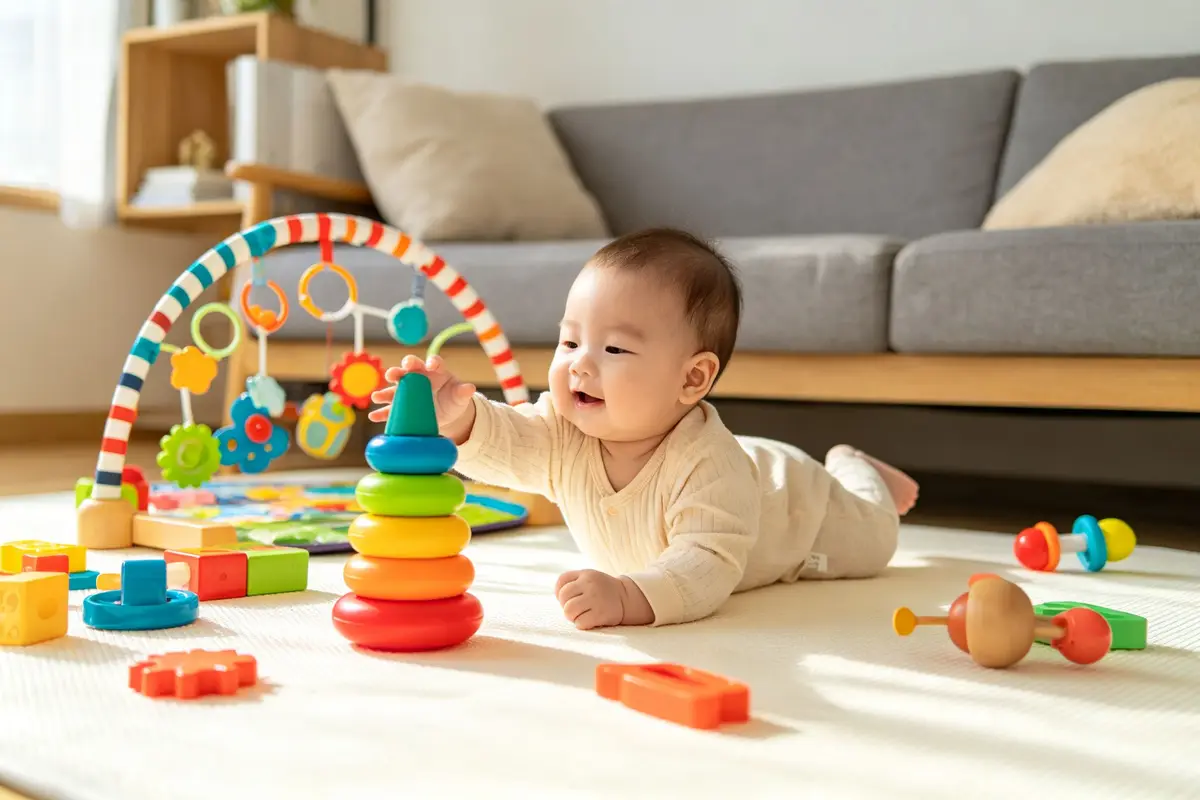
From tummy time to first steps: baby motor development and the toys that actually help
I'll admit it—when my first baby was 3 months old and still hadn't rolled over, I panicked. The mom group was full of babies rolling at 2 months, sitting at 4, walking at 9. My baby was content to lie there and stare at the ceiling fan. Was something wrong?
Spoiler: no. She rolled at 4.5 months, sat at 7, walked at 13. Totally normal. Every baby moves at their own pace, and the ranges are wider than you think. This guide covers what to expect month by month, which activities actually help development, and how to choose toys that aren't just plastic clutter.
What's the normal timeline for baby motor development?
These are the general ranges from the CDC and AAP. Remember: ranges, not deadlines.
| Age | Gross motor (big movements) | Fine motor (hands & fingers) |
|---|---|---|
| 0-2 months | Lifts head briefly during tummy time, moves arms and legs | Hands mostly fisted, grasps finger when placed in palm |
| 3-4 months | Rolls front to back, lifts head 90° during tummy time, pushes up on forearms | Opens hands, reaches for and bats at toys, brings hands to mouth |
| 5-6 months | Rolls both ways, sits with support, bears weight on legs when held standing | Transfers objects hand to hand, reaches and grabs objects, uses whole hand (palmar grasp) |
| 7-9 months | Sits independently, crawls or scoots, pulls to stand, cruises along furniture | Uses pincer grasp (thumb + finger), bangs objects together, drops objects on purpose |
| 10-12 months | Stands alone briefly, walks with one hand held, may take first independent steps | Pincer grasp refined, points with index finger, puts objects in containers and takes them out |
The most important thing to understand: these are ranges. A baby who sits at 5 months and a baby who sits at 8 months are both completely normal. What matters is that baby is making progress, not when they hit each milestone. If your baby was doing something and then stops, or if they're significantly behind across multiple areas, that's when to talk to your pediatrician.
My son crawled at 6 months and walked at 10. My daughter didn't crawl until 9 months and walked at 14. Both are perfectly healthy, active kids. The timeline doesn't predict intelligence or athletic ability. It just is what it is.
Tummy time: why it matters and how to make it less miserable
Tummy time is the foundation of all motor development. It strengthens the neck, shoulder, back, and core muscles needed for rolling, sitting, crawling, and walking. It also helps prevent flat spots on the back of the head (positional plagiocephaly).
How much: Start with 2-3 short sessions (1-2 minutes each) from day one, gradually building up to 15-20 minutes total per day by 3-4 months. Aim for at least 30 minutes of tummy time per day by 6 months.
Most babies hate tummy time at first. Mine screamed every single time. Here's what made it bearable:
- Do it when baby is happy and alert: Not when they're tired, hungry, or fussy. Right after a diaper change and before a feeding works well.
- Get on the floor with them: Lie down face to face, make silly faces, talk to them. Your face is the most interesting toy in the world. My baby would tolerate tummy time twice as long if I was lying there making faces.
- Use a nursing pillow or rolled-up blanket under the chest: This takes pressure off the arms and helps baby lift their head more easily. Just make sure they can still move their head freely.
- Put a mirror in front of them: Babies are fascinated by their own reflection. A shatterproof baby mirror is one of the best tummy time toys you can buy.
- Try tummy time on your chest: If baby absolutely refuses the floor, try lying them on your chest while you're reclined. It's still tummy time, just at an angle.
- Don't give up: It gets better. Around 3-4 months, when baby can lift their head and look around, they usually start tolerating tummy time more. Some even start enjoying it.
What activities help baby motor development at each stage?
0-3 months:
- Tummy time (as above)
- Move a toy slowly side to side in front of baby's face to encourage head turning and visual tracking
- Gently bicycle baby's legs and move arms in different directions to increase body awareness
- Let baby grasp your finger and gently pull up to a sitting position (they'll keep their head aligned if neck strength is developing)
- Talk, sing, and make faces—social interaction drives brain development
4-6 months:
- Place toys just out of reach to encourage rolling, reaching, and pivoting
- Practice sitting with support—use a Boppy or your legs around baby
- Let baby play on their side (a transitional position between back and tummy)
- Offer toys of different textures, shapes, and weights to explore with hands and mouth
- Encourage baby to bear weight on legs by holding them standing on your lap (they'll bounce!)
7-9 months:
- Create a safe, open space for crawling—baby-proof the floor area
- Put toys on a low couch or ottoman to encourage pulling to stand
- Play "drop and pick up"—baby drops a toy, you hand it back (repetitive, but great for fine motor and object permanence)
- Offer finger foods to practice pincer grasp (once solids are established)
- Encourage cruising by placing toys along the length of the couch
10-12 months:
- Practice walking with one hand held—let baby set the pace
- Use a push toy (not a walker—see below) for supported walking practice
- Play stacking games—stacking cups or blocks, then knocking them down (the knocking down is the fun part)
- Encourage climbing on soft surfaces (pillows, couch cushions) to build confidence and coordination
- Dance together—holding hands and moving to music builds balance and rhythm
What toys actually help? And what should you skip?
Before I had kids, I thought more toys = better development. After two kids, I can tell you: the best toys are simple, open-ended, and don't require batteries.
Worth buying:
- Play gym/activity mat (0-6 months): The kind with hanging toys. Great for tummy time and reaching/batting. Look for one with a mirror and high-contrast toys.
- Shatterproof mirror (0-12 months): Fascinating for babies at every stage. Great for tummy time, sitting practice, and self-discovery.
- Stacking cups (6 months+): Can be stacked, nested, filled, dumped, used in the bath. Endless possibilities, zero batteries. One of the most-used toys in our house.
- Soft blocks (6 months+): Fabric or foam blocks that baby can grab, bang, stack, and chew. Soft enough that getting hit in the head with one isn't a disaster.
- Shape sorter (9 months+): Great for problem-solving, fine motor, and shape recognition. Start with just 2-3 shapes and add more as baby gets better.
- Push toy / walker wagon (10 months+): A sturdy wagon or push toy that baby can hold onto and push. Much better than a seated walker (see below). Fill it with books or toys for weight if it tips too easily.
- Board books (all ages): Not technically a toy, but the best "toy" you can buy. Chewable, durable, and every interaction builds language and brain development.
Skip these:
- Seated baby walkers (the kind with wheels and a seat): The AAP strongly recommends against them. They don't help walking—in fact, they can delay it because baby doesn't have to balance or bear weight properly. They're also a major safety hazard (tip-overs, falls down stairs, reaching hot objects). Skip them entirely.
- Exersaucers / activity centers (prolonged use): They're fine for 10-15 minutes at a time while you take a shower, but don't leave baby in them for hours. They keep baby in a seated position that doesn't build the core muscles needed for independent sitting and crawling. Floor time is always better.
- Bouncy seats / swings (prolonged use): Same issue—great for short periods, but baby shouldn't spend hours confined. The AAP recommends limiting time in any confined equipment to no more than 1 hour total per day outside of travel.
- Flashy electronic toys with lights and sounds: They're entertaining for 5 minutes, but they do the playing for baby. The best toys require baby to be active and creative, not passive. A $5 set of stacking cups will hold your baby's attention longer than a $50 electronic toy.
When should I worry about motor development?
Talk to your pediatrician if:
- Baby doesn't lift their head at all during tummy time by 3 months
- Baby doesn't roll either way by 6 months
- Baby can't sit with support by 6 months or independently by 9 months
- Baby doesn't bear weight on legs when held standing by 9 months
- Baby doesn't crawl or scoot by 10-12 months
- Baby only uses one hand or one side of the body consistently
- Baby had a skill and then lost it (regression is always worth checking out)
- Baby seems unusually stiff or unusually floppy
Early intervention is key if there is a delay, and most babies catch up with a little extra support. But also remember: the ranges are wide, and your pediatrician sees dozens of babies and knows what's normal. If you're concerned, bring it up at your next well-child visit. That's what they're for.
Quick summary: baby motor development
- Timeline: Ranges, not deadlines. Head control by 3 mo, rolling by 4-6 mo, sitting by 6-8 mo, crawling by 7-10 mo, standing by 9-12 mo, walking by 10-18 mo. All normal.
- Tummy time: Start day one, build up to 30 min/day by 6 months. Get on the floor with baby, use mirrors and pillows. It gets better.
- Best activities: Floor play, reaching for toys, practice sitting/standing, finger foods, stacking games, dancing, and lots of face-to-face interaction.
- Best toys: Play gym, mirror, stacking cups, soft blocks, shape sorter, push toy, board books. Simple and open-ended beats electronic every time.
- Skip: Seated walkers (AAP warns against), prolonged exersaucer/bouncy seat use, flashy electronic toys.
- Worry if: Significant delay across multiple areas, regression of skills, only using one side, unusual stiffness or floppiness. When in doubt, ask your pediatrician.
- Remember: Your baby will reach milestones on their own timeline. Compare them to their own progress, not to other babies.
Watching your baby learn to move is one of the most incredible parts of parenting. One day they're a blob that can't lift their head, and the next they're crawling into the toilet. (Yes, that happened. Baby-proof early.) Enjoy the journey—and keep the camera charged.
For more on supporting your baby's development through feeding, check out our complete baby solid food guide and the developmental sequence of baby's first steps.
Frequently Asked Questions
What are the most important baby milestones?
Key milestones include: smiling socially (2 months), rolling over (4-6 months), sitting unsupported (6-8 months), crawling (7-10 months), pulling to stand (8-12 months), first words (8-15 months), and walking independently (9-18 months). Every baby develops at their own pace, and there's a wide range of normal. If your baby misses multiple milestones or loses skills they previously had, talk to your pediatrician.
How can I encourage my baby's development?
The best way to support development is through everyday interaction — talk, read, and sing to your baby from birth. Give them plenty of supervised tummy time to build neck and core strength. Provide age-appropriate toys that encourage reaching, grasping, and problem-solving. Limit screen time for babies under 18 months (except video chatting). Most importantly, respond to your baby's cues and give them lots of love and attention.
When should I worry about developmental delays?
Talk to your pediatrician if your baby: doesn't make eye contact by 3 months, doesn't smile by 3 months, doesn't babble by 9 months, doesn't respond to their name by 9 months, doesn't point or gesture by 12 months, doesn't say any words by 16 months, doesn't walk by 18 months, or loses any skills they previously had. Early intervention is key — if you have concerns, ask for a developmental screening.
How much tummy time does my baby need?
Aim for 10-15 minutes of supervised tummy time, 2-3 times a day, starting from the first weeks home. You can start with shorter sessions (2-3 minutes) and gradually increase as your baby builds strength. Tummy time helps build neck, shoulder, and core muscles, prevents flat spots on the back of the head, and encourages motor development. If your baby fusses during tummy time, try getting down on the floor with them, using a tummy time pillow, or doing it after a nap when they're well-rested.
Frequently Asked Questions
When should my baby start crawling?
Most babies begin crawling between 7 and 10 months old, but the normal range is wide. Some babies crawl as early as 6 months, others not until 11 or 12 months. Some skip crawling entirely and go straight to pulling up and cruising, which is also completely normal. What matters is that baby is finding a way to move independently and is making progress. If baby is not mobile at all by 12 months, mention it to your pediatrician.
How much tummy time does my baby need?
Start with 2-3 short sessions of 1-2 minutes each from the first week, gradually increasing. By 3-4 months, aim for 15-20 minutes total per day, and by 6 months, at least 30 minutes per day. Tummy time strengthens neck, shoulder, back, and core muscles needed for rolling, sitting, and crawling, and helps prevent flat head spots. Most babies hate it initially. Get on the floor face-to-face, use a shatterproof mirror, or try tummy time on your chest. It gets easier around 3-4 months.
Are baby walkers safe and do they help with walking?
No and no. The American Academy of Pediatrics strongly recommends against seated baby walkers. They do not help babies learn to walk. In fact, they can delay walking because baby does not have to balance or bear weight properly. They are also a major safety hazard, responsible for thousands of injuries each year from tip-overs, falls down stairs, and babies reaching dangerous objects. Use a sturdy push toy or wagon instead, which requires baby to balance and bear weight actively.
What are the best toys for baby development?
The best developmental toys are simple, open-ended, and do not require batteries. Top picks include: a play gym/activity mat for reaching and tummy time; a shatterproof mirror for self-discovery; stacking cups that can be stacked, nested, filled, and used in the bath; soft blocks for grasping, banging, and building; a shape sorter for problem-solving and fine motor; a sturdy push toy for walking practice; and board books for language and bonding. Skip flashy electronic toys that entertain briefly but do not encourage active play.