
2026-11-17 · Moni Happy
How should cotton towels be folded so a wipes wholesale carton stays inside its cube?
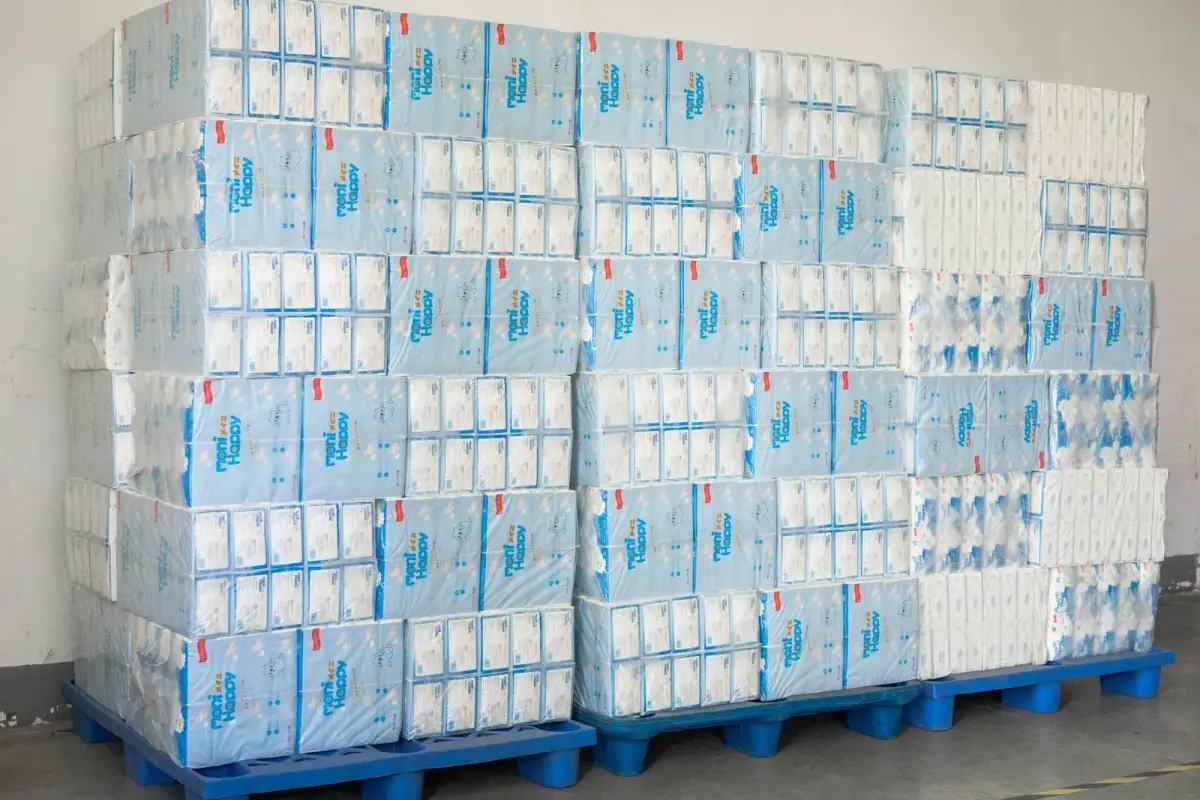
Six millimetres of extra pack thickness removes about 170 cartons from a 40HQ, roughly 4,100 packs of cotton towels, and pushes freight from $0.071 to $0.079 per pack. Nothing about the sheet changed. The fold did. Fold decides pack thickness, pack thickness decides carton height, carton height decides how many cartons fit in 68 usable cubic metres, and that number is the only one your freight forwarder will ask about. Buyers in a wipes wholesale negotiation spend their time on sheet count and GSM, then sign whichever sample feels right on the table.
Which fold types are actually on the market?
Three, and they are not interchangeable across pack formats.
Flat fold lays the 200 by 210mm sheet once or twice into a rectangle and stacks 100 of them. Z-fold bends the sheet into a zigzag so each one pulls the next up. Interfold links two stacks so removing a sheet lifts the following one, which is what most wet wipe packs use and what dry wipes copy when they want pop-up dispensing. A fourth variant, the quarter fold, gets a smaller footprint at the cost of two more creases and a slightly slower line. Each one changes the pack's outer dimensions and the amount of air inside the carton. The carton is where the money is, because the carton is what you pay to move.
What does the fold do to carton cube?
It changes carton height, and height is the dimension that decides how many cartons fit on a pallet and in a box.
Take a 100-sheet pack, sheet size 200 by 210mm, folded to a 210 by 105mm footprint. At 52mm thick, one pack occupies 0.00109 cubic metres. Twenty-four packs per carton gives 0.0262 cubic metres of product inside a carton measuring 480 by 330 by 260mm, which is 0.0412 cubic metres. That is 36% air, and air is normal, because cartons need board thickness and a little crush allowance. Now run the same pack at 58mm. Product volume rises to 0.0292 cubic metres, the carton has to grow to 290mm high, and the carton becomes 0.0460 cubic metres. Divide 68 usable cubic metres of a 40HQ by each number and the difference is 1,650 cartons against 1,478. The thinner fold wins 172 cartons, and at 24 packs per carton that is 4,128 packs of cotton towels that no longer fit in the same container.
Why does the wrong fold show up as a freight bill instead of a complaint?
Because nothing is defective. The pack weighs what it should and the sheet count is correct.
Freight on a 40HQ from Shanghai to Port Klang runs about $2,800 in a normal season. Spread over 39,600 packs, that is $0.071 per pack. Spread over 35,472 packs after the bulky fold, it is $0.079. The buyer pays $0.008 more per pack for the same product, which on a 40HQ is roughly $317 of pure cube loss. Nobody rejects the shipment, because there is nothing to reject. The loss sits in the landed cost sheet as a slightly worse number that nobody can explain, and it repeats on every container for the life of the SKU. A distributor running 12 containers a year is looking at close to $3,800 of avoidable freight across the range.
Which fold should a first order specify?
Pick by channel, then confirm the cube, in that order.
- Modern trade and pharmacy: Z-fold or interfold, because a shopper who pulls one sheet and gets two puts the pack back on the shelf.
- Traditional trade and provision shops: flat fold, because the pack hangs or stacks and price per pack decides the sale.
- Food service and hotel accounts: flat fold in a dispenser carton, since staff pull from a box rather than a shelf.
- E-commerce: flat fold plus a tighter carton, because marketplace fees are charged on volumetric weight as well as cube.
Then ask the factory for the carton dimensions in writing, not the pack dimensions. A supplier quoting pack size and leaving carton height blank is quoting half a product. For dry wipes sold as cotton towels, the same sheet can legitimately arrive in three different cartons, and the price per pack will differ by more than the sheet cost does.
What does a wrong fold cost in rework?
About 13 hours of labour per container, if you catch it after packing.
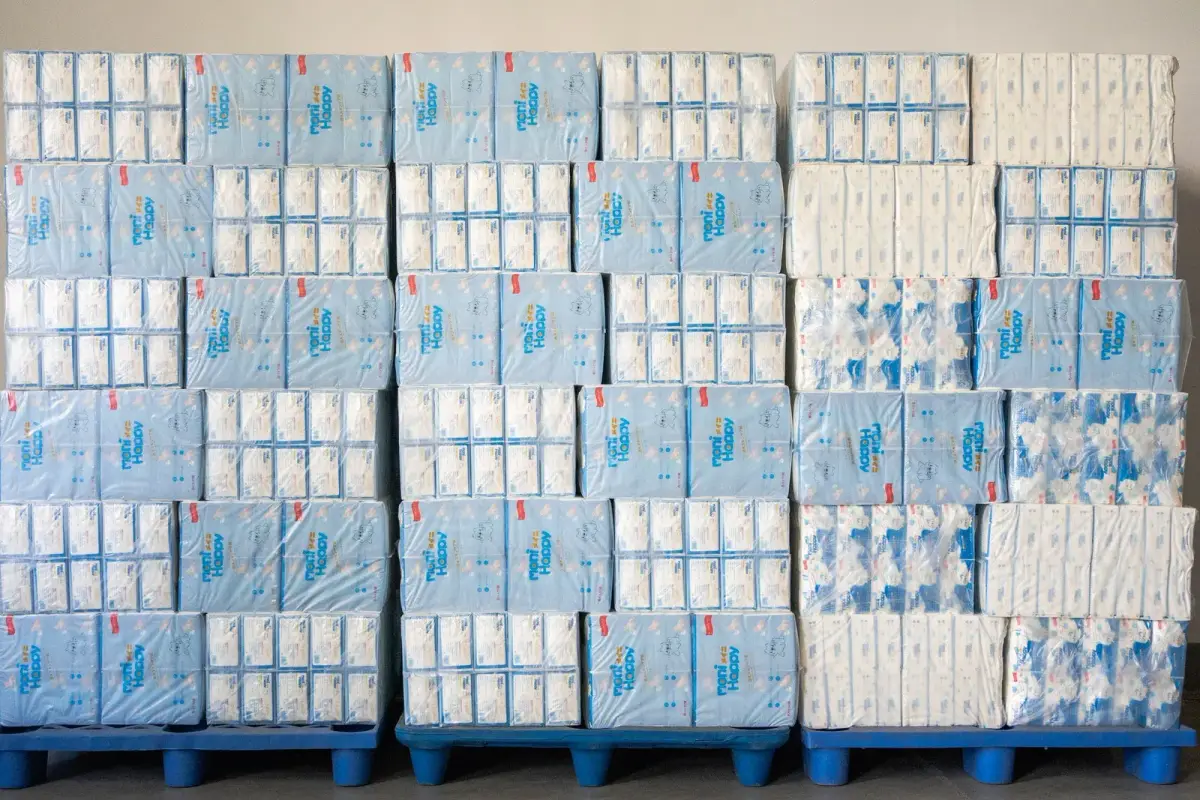
One person refolds roughly 60 packs an hour by hand. A 40HQ holds 39,600 packs; a 2% refold rate is 792 packs, which is 13 hours, plus new bags and a new carton, plus the risk of a crushed sheet. Catching it at the sample stage costs nothing. Catching it at the loading dock costs a shift. That is why the sample approval should include a carton, a pallet layer and a stack of five cartons photographed from the side, so the height is visible before 40,000 packs exist. A supplier who cannot send a carton sample for a new cotton towel line is telling you something about how the line is run.
How do you test a fold before committing to a container?
Four checks, all doable in a day with one carton.
First, pull test: with the pack on a table, pull one sheet ten times and count how often a second sheet follows. More than twice in ten is a fold problem, not a sheet problem. Second, thickness: measure five packs with a caliper at the centre and at the edge, and note the spread. Third, stack: build a pallet layer and photograph it from the side, then measure the layer height. Fourth, drop: drop a carton from 800mm onto a corner and open it, because a fold with too much trapped air crushes at the crease. Record all four numbers next to the sample. They become the specification your next supplier has to match. If you are comparing two factories on the same dry wipes brief, compare quotations line by line rather than by headline price, and see the cotton towel range for the sheet sizes we hold.
How does fold interact with sheet count and GSM?
Badly, if they are negotiated separately.
A 60 GSM sheet folded twice is thinner than an 80 GSM sheet folded once, so a buyer who raises GSM and keeps the fold gets a taller pack and a taller carton without noticing. Run the three variables together: sheet size, GSM and fold. On a 200 by 210mm sheet, moving from 60 to 80 GSM adds roughly 15% to pack thickness at the same count, which on the arithmetic above is another 100 cartons out of a 40HQ. Buyers who specify GSM for feel and then discover the freight consequence tend to blame the factory. The factory built what was asked for. For a group of wipes wholesale buyers comparing landed cost across pack formats, the honest comparison is per 1,000 sheets landed, not per pack.
Frequently asked questions
Does a Z-fold pack always cost more than a flat fold?
Per pack, yes, because the line runs slower and the pack is thicker. Per sheet at retail, it can win, since shoppers pay for pickup convenience in modern trade.
Can a factory change the fold without changing the carton?
Sometimes, by reducing sheet count or GSM. Ask for the carton dimensions on the revised spec, and check whether the count changed quietly.
Is 36% air inside a carton too much?
No. Board thickness, crush allowance and pallet overhang eat most of it. Below 25% the cartons start bulging and pallets become unstable.
How much cube does a 100-sheet pack need per pack?
About 0.0011 cubic metres at 52mm thick. Multiply by packs per carton, then divide usable container volume by that figure.
Sources and further reading
- ISO 9073 series, test methods for nonwoven textiles including thickness and mass per unit area, iso.org.
- EDANA, nonwoven and absorbent hygiene product industry standards and glossary, edana.org.
- INDA, Association of the Nonwoven Fabrics Industry, technical resources, inda.org.
Bottom line: fold is a freight decision disguised as a packaging decision. Fix the carton dimensions in millimetres before you approve the sample, then test the pull, the thickness and the pallet layer. A distributor who lands cotton towels at $0.071 per pack instead of $0.079 keeps the difference, and it compounds across every container in the year.
Frequently Asked Questions
Does a Z-fold pack always cost more than a flat fold?
Per pack, yes, because the line runs slower and the pack is thicker. Per sheet at retail it can win, since shoppers pay for pickup convenience in modern trade.
Can a factory change the fold without changing the carton?
Sometimes, by reducing sheet count or GSM. Ask for the carton dimensions on the revised spec, and check whether the count changed quietly.
Is 36% air inside a carton too much?
No. Board thickness, crush allowance and pallet overhang eat most of it. Below 25% the cartons start bulging and pallets become unstable.
How much cube does a 100-sheet pack need per pack?
About 0.0011 cubic metres at 52mm thick. Multiply by packs per carton, then divide usable container volume by that figure.
Distributor resources
If you are evaluating suppliers for your market, these are the pages that answer the commercial questions — in the order buyers usually need them.
