
2026-11-11 · Moni Happy
What wet strength figure should a cotton towel hit before wipes wholesale sign-off?
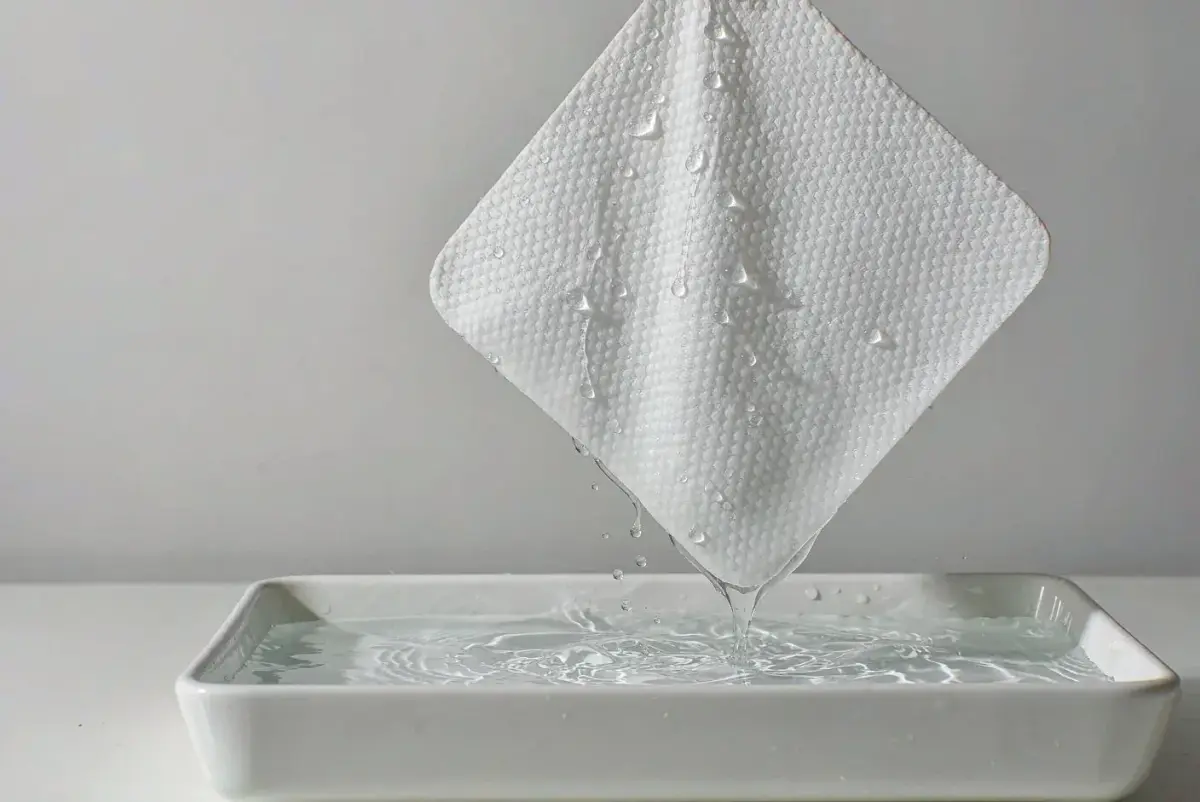
For a 100 percent viscose cotton towel, the working target is roughly a quarter to two fifths of dry tensile retained when wet. Below that band the towel shreds at the fold when a parent wets it, and above it the towel usually feels stiff and wipes badly. The exact figure has to be confirmed on the approved sample, because the number depends on the fibre blend, the GSM and how heavily the web is hydroentangled.
This is the line most wipes wholesale specifications leave blank. Buyers specify GSM, sheet size and pack count, and then discover the gap at the first complaint, when a parent reports that the towel came apart while cleaning a face. Wet strength is not an exotic test: it is a standard tissue and nonwoven measurement, it takes an afternoon, and it is the single best predictor of whether a dry wipe behaves like a cloth or like paper in the hand.
What does wet strength actually mean on a cotton towel?
It is the tensile force the sheet carries after it has been wetted, expressed either as an absolute value or as a percentage of the dry tensile.
A dry wipe is a web of fibres bonded at crossover points, and in a viscose spunlace towel most of the dry strength comes from hydrogen bonding between those fibres plus the mechanical entanglement created by the water jets. Water interferes with the hydrogen bonds and lubricates the fibre contacts, so the network softens. How much it softens is a property of the blend: viscose alone loses a large share, while a polyester component retains far more because the filaments do not swell and do not rely on hydrogen bonding in the same way.
That is why the ratio matters more than the absolute number, and why the same figure has to be read differently for dry wipes than for a pre-wetted pack. Two towels can both read 3 N/50 mm wet, but one started at 6 N dry and the other at 18 N. The first is a towel that softens gracefully; the second is a towel that was heavily bonded to begin with and may feel like a shop rag.
How is wet strength measured so the number is comparable?
With the same strip geometry, the same conditioning, the same test speed and the same wetting liquid on both the reference sample and the production batch.
The tissue and nonwoven standards family gives you the method: ISO 12625-4 for dry tensile and ISO 12625-5 for wet tensile, with specimens normally cut 50 mm wide and clamped at a 100 mm gauge length. Condition the sheets before testing, and wet the specimen through the full thickness rather than spraying the surface, then blot the excess so the test measures the wetted web and not a puddle.
- Report machine direction and cross direction separately. A towel that holds in one direction and fails in the other will tear along the weak axis during use.
- State the wetting liquid. Water, the finished lotion, or a diluted version of it, with the soak time. Two labs reporting different numbers are usually reporting different liquids.
- State the test speed. Methods in this family differ on rate, so a number without the method attached cannot be compared to a supplier's claim.
- Keep the raw curves. The peak value hides whether the sheet failed suddenly or stretched first, and the shape of the curve is what tells you if the bonding is uniform.
None of this requires an in-house laboratory. A third-party lab in the region will run both tests on a submitted sample and return a report with the method stated, which is what you need in order to hold a supplier to a number later.

Where does a cotton towel fail first when it is wetted?
At the fold and at the edge, not in the middle of the sheet, which is why a mid-sheet tensile figure can flatter a weak product.
Practical failures cluster in three places. The fold line, because a parent folds the towel to wipe and the crease concentrates stress on the same fibres every time. The perforation or the cut edge, where the web has been severed and the remaining bonded area is narrowest. And the embossed or bonded band, where the pattern can either reinforce the web or create a line of lower density depending on how it was applied.
For a 200 by 210 mm dry wipe, the fold is roughly through the middle, so a mid-sheet test actually does cover the fold region. For a larger sheet the fold lands between test positions, which is one reason to sample at three positions across the width rather than three along the length. If a supplier's report shows only a single average with no spread, that is a report about a different question.
Why does the lotion change the wet strength number?
Because surfactants reduce surface tension and lubricate the fibre contacts, so the same sheet reads lower in lotion than in water.
This matters when the towel is sold both as a dry wipe and as a pre-wetted product from the same substrate. The dry wipes are wetted by the consumer, usually with tap water, while the pre-wetted product is wetted in the plant with a formulated lotion that may contain surfactants, humectants, preservatives and a pH buffer. The second case is the harsher test, and it is the one that should set the specification if the same substrate is used for both.
There is a second effect worth watching. A heavily loaded pack - one where the towels carry a high lotion ratio - keeps the fibres wet for the whole shelf life, so the loss of strength is permanent rather than momentary. A towel that is only just inside the band when tested dry-wetted may sit below it after eighteen months in a warm warehouse. If the product has a long shelf life and a humid destination, specify the wet figure with margin rather than at the floor.
What sample plan catches a weak batch before it ships?
Three positions per batch, five specimens in each direction at each position, and a retained control sample that stays in your own store.
- Sample across the batch, not from the top. Take rolls or packs from the first, middle and last part of the run, because bonding variation follows the line, not the pallet.
- Test both directions and both states. Dry and wet, machine and cross. The interesting result is usually a batch that is fine dry and marginal wet.
- Compare against the approved sample, not against a number alone. The approved sample is the physical reference; a report without it is a claim.
- Record the coefficient of variation. A batch with a good average and a wide spread will generate returns at the weak end, which is the part the customer receives.
- Retain a control. Keep sealed packs from each batch for the shelf life of the product, so a complaint eighteen months later can be tested against the actual goods.
For a first order, run this on the pre-production sample and again on the shipment sample. The gap between those two results is the most useful number in the file, because it tells you how much the line drifts between a hand-made sample and a commercial run.
How should the wipes wholesale specification sheet state it?
As a target with a floor, a method, a wetting liquid and a direction - five items, one line each.
Write the target as a ratio rather than as an absolute figure, because the ratio survives a change of GSM. Write a floor, since the ratio is what the customer experiences and the floor is what you reject on. Name the standard, the specimen width, the gauge length and the test speed. Name the liquid and the soak time. Name the direction. Then add the sentence that makes the line enforceable: who tests, on which sample, and what happens if the result falls between the floor and the target.
The same discipline applies to the rest of the sheet. A cotton towel specification that states GSM, sheet size, sheet count, pack format, wet strength ratio, linting and the packaging material is a document a supplier can be held to, and it is the same sheet whether the goods ship as cotton towels or as dry wipes. One that states GSM and size is a purchase order, and it will be fulfilled to the purchase order rather than to the product you imagined.
We supply 100 percent viscose cotton towels in 200 by 210 mm and quote the wet strength ratio with the test method attached, so a buyer can check the claim rather than accept it. See the cotton towel range or request samples and the specification sheet.
Frequently asked questions
Is a heavier cotton towel always stronger when wet?
Not reliably. GSM raises the mass of fibre available to carry load, but wet strength per unit width depends more on the blend and the degree of hydroentanglement. A 60 GSM towel with a polyester component can outperform a 70 GSM pure viscose towel in the wet test while feeling different in use.
Can a supplier quote wet strength from a dry test result?
No, and a supplier who offers to do so is guessing. The wet-to-dry ratio varies with the blend, the bonding and the wetting liquid, so it cannot be derived from a dry figure. Ask for the wet test report with the method stated.
Does wet strength affect how the towel dispenses from a pack?
Yes. A towel that is weak when wet tears at the perforation instead of separating cleanly, which produces half-sheets and a pack that looks damaged after a few uses. That is a wet strength problem presenting as a packaging complaint.
What about linting, which parents notice more than tensile?
Linting and wet strength usually move together, because both are governed by how well the fibres are entangled and how much loose fibre sits at the surface. A wet strength test will not measure linting directly, so specify a separate rub or tape test on the same sample rather than assuming one number covers both.
Sources and further reading
- International Organization for Standardization, ISO 12625-4 Tissue paper and tissue products - Part 4: Determination of tensile strength, stretch at maximum force and tensile energy absorption. iso.org (current edition)
- International Organization for Standardization, ISO 12625-5 Tissue paper and tissue products - Part 5: Determination of wet tensile strength. iso.org (current edition)
- EDANA, nonwovens industry association - test methods and terminology for hydroentangled and spunlace materials. edana.org
Bottom line: wet strength is the difference between a cotton towel that behaves like a cloth and one that behaves like paper, and it belongs on the specification sheet with a method attached. Ask for a wet-to-dry ratio in both directions, tested in the liquid the pack will carry, with a floor you can reject on. If the sheet has no wet figure on it, the specification is not finished - and the fastest way to get one is to ask for the sample and the test report together.
Frequently Asked Questions
Why can a cotton towel pass a dry tensile test and still fail in use?
Because dry tensile measures the fibre network before it is wetted. Viscose loses a large share of its strength once water breaks the hydrogen bonding between fibres, so a towel that feels strong in the hand can tear at the fold the moment a parent wets it. The two tests answer different questions and both belong on the sheet.
Should wet strength be measured with water or with the lotion?
With the liquid the pack will actually carry. Surfactants and preservatives lower surface tension and act as a lubricant between fibres, so a towel tested in tap water can read higher than the same towel tested in a lotion. If the product is sold as a dry wipe for wetting at home, test with water and say so.
Does a higher wet strength always mean a better towel?
No. Wet strength usually comes from a higher polyester share or heavier hydroentanglement, and both change the hand feel and the absorbency a parent notices. A towel engineered only for wet strength tends to feel stiff and wipes less well, which is a different route to the same return rate.
How many specimens should a wipes wholesale buyer test per batch?
Enough to see variation, not just an average. Five specimens in each direction from each of three positions in the batch gives a usable spread; a single specimen per roll tells you almost nothing, because the failure you are looking for is a weak edge or a poorly bonded band rather than a uniform shortfall.
Distributor resources
If you are evaluating suppliers for your market, these are the pages that answer the commercial questions — in the order buyers usually need them.
