
2026-11-09 · Moni Happy
What margin disappears when a Vietnamese buyer quotes cotton towels by kilogram?
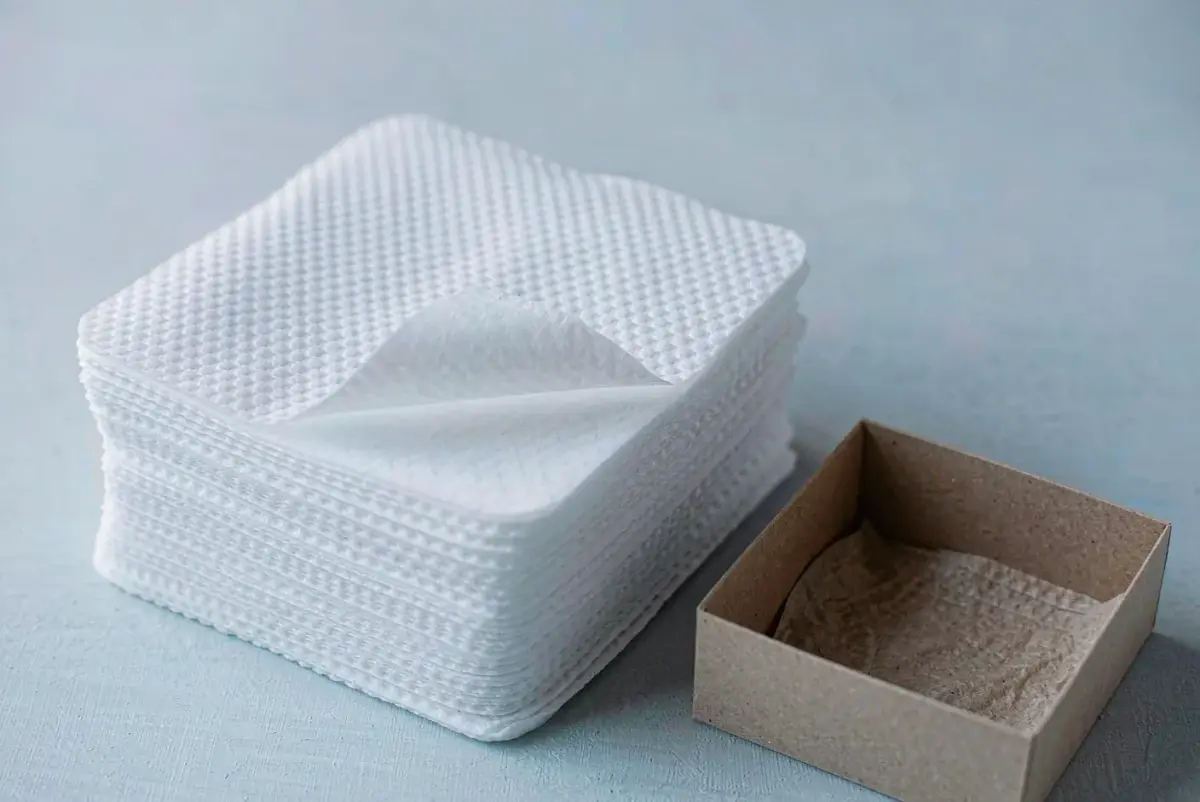
Between six and ten percent of what the price appears to buy. On a carton holding 4.2 kg of cotton towels, roughly 0.35 kg is bag, header card and carton board, and a five percent GSM tolerance then moves the sheet count per kilogram by about a tenth - and neither of those is visible in a price quoted per kilogram.
The kilogram is a perfectly good unit for a nonwoven roll. It is a poor unit for a packed consumer product, because the thing being bought and sold at retail is a pack of a stated number of sheets, and the kilogram measures everything in the carton including the parts the shopper throws away. In Vietnam, where converters and wholesalers commonly quote cotton towels and dry wipes by weight, that mismatch is worth real money on every container. The cost of kilogram pricing is not the price itself; it is what the price leaves out.
What exactly disappears when the quote is per kilogram?
Two things: the packaging that sits inside the gross weight, and the sheet count that a tolerance can move without moving the price. Both are consequences of kilogram pricing rather than of any one supplier's arithmetic.
Start with the packaging. A 200 by 210 millimetre sheet at 50 GSM weighs about 2.1 grams. A pack of 100 sheets is therefore 210 grams of product. A carton of 20 packs carries 4.2 kg net, and around 0.35 kg of bag film, header card, label and carton board on top of that. If the price is quoted per kilogram of gross weight, the buyer is paying product price for 0.35 kg of packaging on every carton - about eight percent of what they believe they are buying.
Then the tolerance. GSM is specified with a tolerance because nonwoven production varies, and plus or minus five percent is ordinary. At 47.5 GSM a sheet weighs 1.995 grams; at 52.5 GSM it weighs 2.205 grams. Same nominal product, same price per kilogram, ten percent fewer or more sheets in the carton. The buyer who compares on price per kilogram sees nothing. The buyer who compares on cost per pack of 100 sheets sees the whole difference.
How much of a kilogram is actually packaging?
Roughly eight percent on a standard 20-pack carton, and more on smaller retail formats.
The ratio worsens as the pack gets smaller, which is exactly where the growth in this category is. A 20-pack carton has one carton board, one label and twenty bags for 4.2 kg of product. A carton of 40 smaller packs has the same board and label but twice the number of bags, bags and header cards per kilogram of product. The packaging share can climb into double digits, and it is invisible in a per-kilogram quote because it is inside the kilogram. The same arithmetic applies to dry wipes packed in the same carton format.
- Bag film: the largest single item, and the one most likely to be upgraded without the buyer noticing - a thicker film protects the pack and adds weight to the carton.
- Header card or label: heavier per unit than most buyers assume, especially on retail-ready formats.
- Carton board: fixed per carton, so it dilutes as carton size increases.
- Pallet and stretch wrap: outside the carton, but frequently inside a delivered price per kilogram.
None of this is dishonest. It is simply what a weight-based unit does: it prices the shipment rather than the product.
Why does GSM tolerance move the sheet count rather than the price?
Because the price is anchored to a unit that the tolerance changes, and the tolerance is written into the specification rather than into the price list.
Run the numbers on one carton. At a nominal 50 GSM, a 100-sheet pack holds 210 grams of product. At the low end of a five percent band it holds 199.5 grams; at the high end, 220.5 grams. A buyer ordering 1,000 cartons is therefore buying somewhere between 3,990 kg and 4,410 kg of product, and paying the same price per kilogram either way. For dry wipes packed at the same sheet count, the swing is identical. What changes is how many packs come out of the container - and packs are what the retailer orders.
This is why a cost per pack comparison is the only one that survives contact with a shelf. Kilogram pricing cannot show that difference, because both suppliers quote the same number. Convert to cost per pack of a stated sheet count, then compare. If two suppliers quote the same price per kilogram and one delivers 100 sheets per pack at 47.5 GSM while the other delivers 100 sheets at 52.5 GSM, the first is not cheaper per kilogram of product; it is cheaper per kilogram and more expensive per sheet, or the reverse, depending on which end of the band each one sits.

What does moisture regain do to a kilogram quote?
It makes the kilogram depend on the weather, unless the contract names the conditions under which the weight is taken. Moisture regain is the mechanism behind that, and it is measurable.
Cotton towels and dry wipes in this category are usually viscose or a viscose-polyester blend, and viscose takes up moisture from the air - that is moisture regain, and it is a property of the fibre rather than a defect in the batch. The same bale weighs more in a humid warehouse than in a dry one, and more on a wet day than on a dry one. A weight agreed at one set of conditions and checked at another can differ by several percent without anything having been added or removed.
The fix is procedural, not technical: name the weight basis. Either oven-dry weight, or conditioned weight at a stated temperature and relative humidity, with the standard atmosphere referenced in the specification. Textile conditioning standards exist for exactly this reason, and a supplier who sells by weight in this region will recognise the reference immediately. A contract that says only "per kilogram" leaves the difference to whoever is holding the scale.
How do I convert a kilogram quote into a cost per pack?
Work from the sheet up, not from the carton down, and keep the arithmetic in one place so both sides can check it.
- Sheet weight: sheet area in square metres multiplied by GSM. A 0.2 by 0.21 metre sheet at 50 GSM is 0.042 square metres times 50, or 2.1 grams.
- Pack weight: sheet weight multiplied by sheet count. 2.1 grams times 100 is 210 grams.
- Carton net weight: pack weight multiplied by packs per carton. 210 grams times 20 is 4.2 kg.
- Carton cost: price per kilogram multiplied by carton gross weight, if the quote is on gross weight. Alternatively, price per kilogram of net product multiplied by 4.2 kg, then add packaging separately.
- Cost per pack: carton cost divided by packs per carton. This is the only number that can be compared with another supplier, and the only one that can be compared with a retail price.
Do it twice - once at the low end of the GSM tolerance, once at the high end - and the range you get is the range of margin the quote actually contains. The arithmetic is dull, and it is the only defence against kilogram pricing that reads well and delivers less. If the spread is wider than the margin you planned, the specification needs tightening before the price is agreed.
Which weight basis should the contract name?
Name three things: the weight basis, the tolerance, and the unit the price is attached to.
The weight basis is oven-dry or conditioned at a stated atmosphere, which is the only way to turn moisture regain into a fixed number rather than a daily one. The tolerance is the accepted band on GSM, on sheet dimensions and on pack count, with the remedy if a shipment falls outside it. The unit is the commercial unit: a pack of a stated sheet count, at a stated sheet size. That is the practical fix for kilogram pricing - keep the weight as a check figure and move the price onto the pack. Put the kilogram in as a secondary check figure so the shipping documents still reconcile with the forwarder, but do not let it be the unit the price is attached to.
That single change moves the risk of tolerance from the buyer to the specification, where it can be measured and claimed. It also makes quotations comparable, which is the larger commercial benefit: a distributor comparing five suppliers on cost per pack is making a decision, while one comparing five prices per kilogram is making a guess.
If you are sourcing cotton towels or dry wipes and want the sheet weight, pack count and carton configuration set out for your market, apply as a partner and we will send samples with the packing specification attached. Distributors in Vietnam usually compare the dry wipe and cotton towel formats side by side before choosing, and the cotton towel range page lists the sheet sizes and pack formats available.
Frequently asked questions
Does a higher GSM always mean a better cotton towel?
No. Higher GSM means more fibre per square metre, which usually means more absorbency and more cost. Whether that is better depends on the use: a face towel and a general-purpose wipe are specified differently, and paying for GSM the shopper does not need is margin given away.
Is a per-pack price worse for the supplier?
Not if the specification is written properly. A per-pack price with a stated sheet count, size and GSM tolerance is simply a price for a defined product, and it removes the disputes that a weight-based price creates at goods-in.
How do I check a delivered carton against the quote?
Weigh one carton, count one pack, count the sheets in one pack and measure a sheet. Four measurements settle the question, and they take ten minutes at goods-in.
Does the same logic apply to facial tissue?
Yes, and to wet wipes. Any packed product sold by weight has the same gap between the commercial unit and the unit the price is quoted in, and the gap grows as the pack gets smaller.
Sources and further reading
- ISO 139 - Textiles: standard atmospheres for conditioning and testing (ISO): the reference conditions that make a conditioned weight repeatable.
- EDANA - nonwoven test methods and definitions (EDANA, current): mass per unit area and related test methods used in nonwoven specifications.
- Vietnam Customs - tariff and import procedure information (General Department of Vietnam Customs, current): classification and declaration reference for imported nonwoven consumer goods.
Bottom line
A kilogram quote on cotton towels prices the shipment, not the product, and the gap is roughly eight percent of packaging plus up to a tenth from GSM tolerance. Convert to cost per pack of a stated sheet count, at a stated sheet size and GSM band, on a named weight basis. The kilogram can stay in the documents as a check; it should not be the unit the price hangs on.
Frequently Asked Questions
Why do Vietnamese buyers quote cotton towels by kilogram at all?
Because the product is bought and sold as a nonwoven roll or bale upstream, where weight is the natural unit, and because it makes two suppliers look comparable when their pack counts differ. It is convenient for the buyer and it transfers two hidden costs to them.
What is moisture regain and why does it matter here?
Viscose nonwoven absorbs water from the air, so the same bale weighs differently in a humid warehouse than in a dry one. Without an agreed conditioning standard, the kilogram is whatever the air says it is on the day of weighing.
Is GSM the same as the weight per sheet?
No. GSM is grams per square metre, so the weight of a sheet depends on both GSM and sheet area. Two suppliers can both quote 50 GSM and still deliver sheets of different weight if the cut size differs.
What should the purchase order state instead of a price per kilogram?
A price per pack, for a stated sheet count, at a stated sheet dimension and GSM with a tolerance, on a stated weight basis. The kilogram can stay in the order as a check figure, not as the commercial unit.
Distributor resources
If you are evaluating suppliers for your market, these are the pages that answer the commercial questions — in the order buyers usually need them.
