
2026-11-19 · Moni Happy
Should a wet wipes wholesale line use Z-fold or C-fold in the pack?
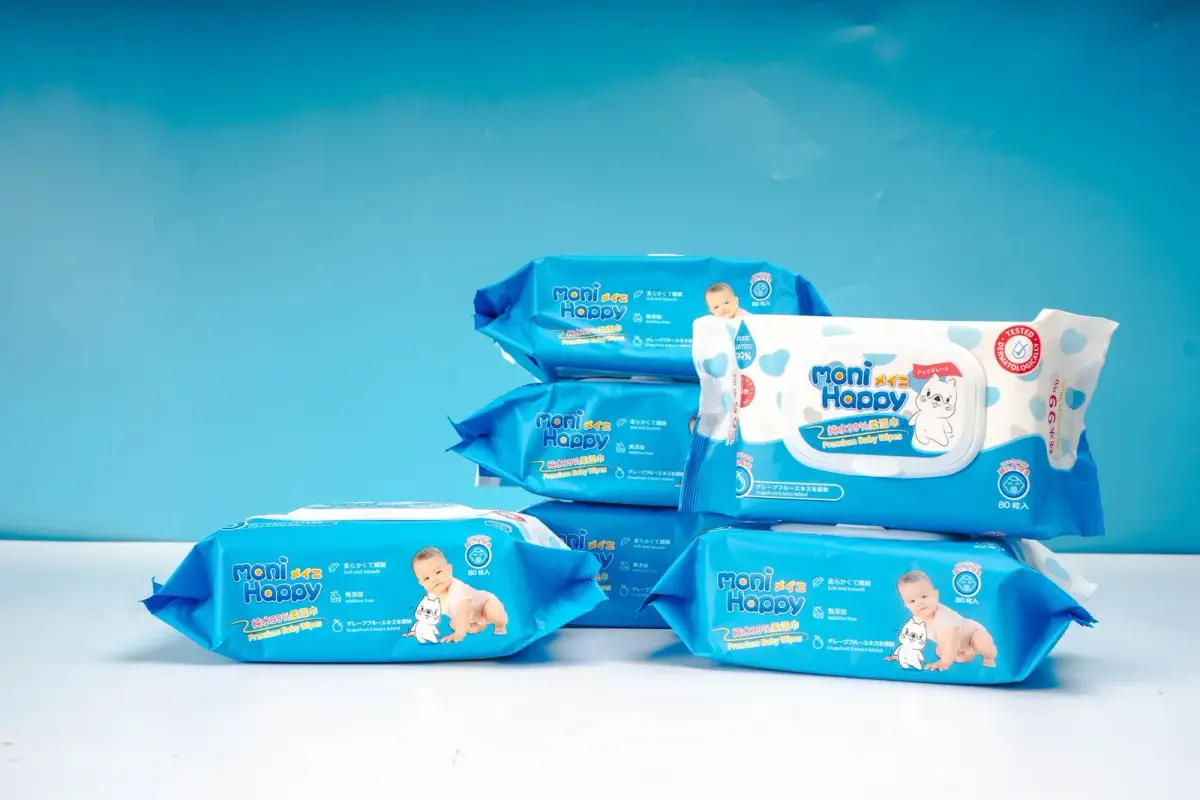
Z-fold is the right choice for any wet wipes pack sold as a pop-up on a shelf, and C-fold is the cheaper answer for large-count value packs where the shopper expects to pull two sheets. The difference is mechanical: a Z-fold stack interleaves each sheet into the next, so pulling one lifts the following sheet into the film opening. A C-fold stack lays sheets on top of each other, so the friction inside a full pack drags two or three out at once. On a wipes wholesale line carrying six SKUs, the fold is usually inherited from whichever machine was bought first, and nobody revisits it until a retail customer returns a pallet for dispensing complaints.
What does the fold actually change inside the pack?
Three things: how many sheets leave the pack per pull, how tall the stack stands, and how much air sits between the sheets.
A standard baby wipe is 200mm by 150mm, folded twice down to roughly 100mm by 75mm. In a Z-fold stack the folds alternate direction so every sheet overlaps its neighbour by about 15mm at the leading edge. That overlap is the entire mechanism. In a C-fold stack each sheet sits inside the previous one like a nested cup, with no leading edge exposed, which is why the first ten pulls on a fresh 100-sheet pack tend to bring out a clump.
The stack height differs too, and this is where cost enters. Interleaving adds 4mm to 8mm to a 60-sheet stack because the folds cannot compress flat against each other. Multiply that by a pack and then by 24 packs in a carton and the carton grows 10mm to 25mm in one dimension.
Why does pack thickness decide the carton cube more than the fold price?
Because freight is charged on the box, and the box is charged on the pallet, and a 15mm gain per pack can cost a pallet tier.
Take a 24-pack carton of 80-sheet packs. At 52mm pack thickness the carton runs about 320mm high, and 12 cartons layer onto a 1,200mm pallet with room to spare. Push pack thickness to 58mm and the carton reaches 355mm, the twelfth layer no longer fits under a 1,800mm stacking limit, and the pallet drops to 11 layers. That is 8% of the pallet gone for 6mm of film. On a 40HQ carrying 24 pallets, one lost layer per pallet is 24 cartons that cannot ship.
This is why the carton cube conversation and the fold conversation are the same conversation. A wet wipes wholesale buyer who specifies 80 sheets, a 200 by 150mm sheet and Z-fold has already fixed the cube; the only lever left is film gauge and how hard the pack is compressed.
Which fold do retail customers actually complain about?
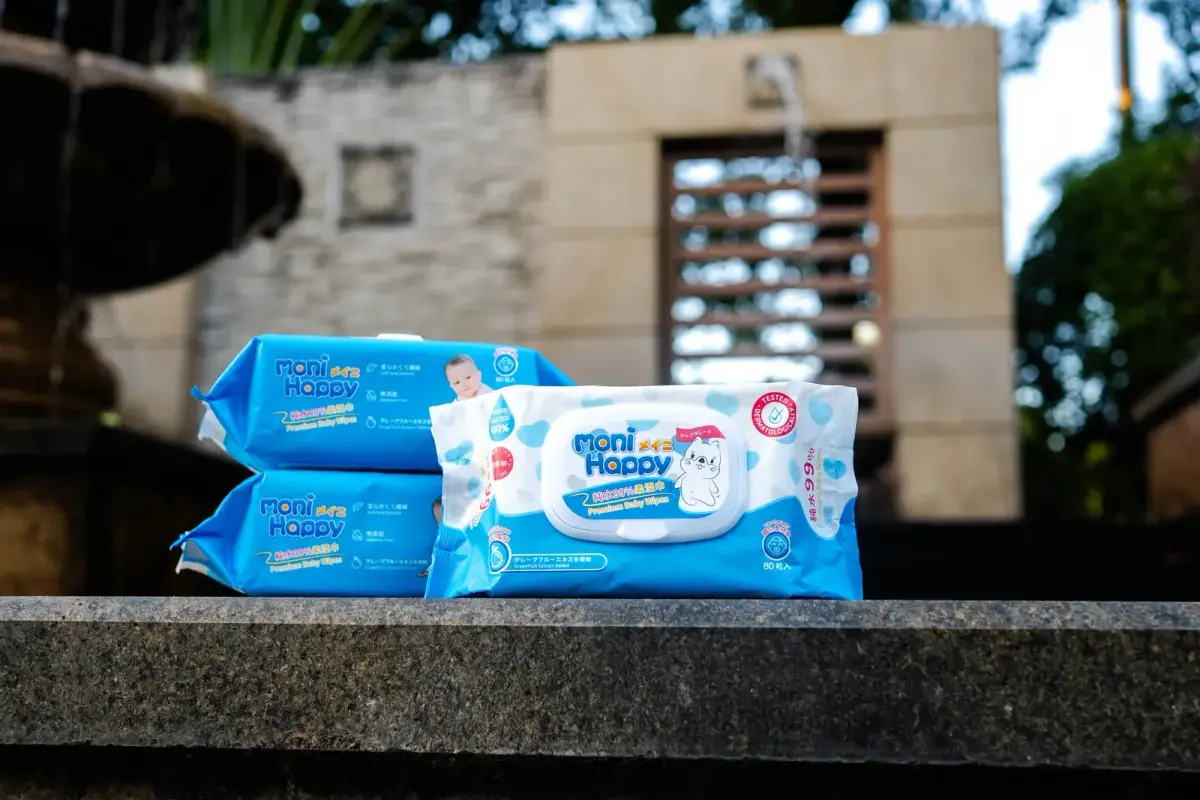
The one that releases three sheets into a nappy change at 3am, and that is almost always C-fold in a high-count pack.
Complaint data from retail returns is not published, but the mechanism is easy to reason about. Pull force rises with stack weight and film tension. A 100-sheet C-fold pack near full requires roughly double the pull force of the same pack at half capacity, so the shopper over-pulls, gets a clump, and folds the clump back in. The sheets that go back in are contaminated and usually end up discarded, so the true cost is not the two extra sheets, it is 5% to 10% of the pack wasted through handling.
Z-fold does not remove the problem, it moves it. At 120 sheets the interleaving overlap starts to slip under its own weight, and the sheet that should stand up collapses back into the pack. That is why 80 to 100 sheets is the practical ceiling for a pop-up pack, and why anything above that belongs in a tub with a rigid lid or a larger film opening.
How does the fold interact with moisture retention?
Loosely. The fold changes how much surface is exposed at the opening, and exposure is where the water leaves.
A Z-fold pack holds the leading sheet upright against the film flap, so the same sheet is exposed to air between uses. A C-fold pack buries the leading edge, so less surface sits at the opening. Over a four week shelf test at 30 degrees Celsius, the top sheet in an opened Z-fold pack loses moisture faster, and the practical result is a drier first sheet that customers read as an old pack.
The fix is film, not fold: a 70 micron laminated film with a proper reclose label holds the load ratio far better than a 55 micron mono film, and the label matters more than the fold for anything sitting in a 35 degree warehouse.
Which fold should a six-SKU range standardise on?
One fold for the pop-up sizes, one exception for the value pack, and no more variation than that.
Every SKU a wipes wholesale line adds costs a changeover, and a changeover on an interleaving unit runs half a shift at 60 to 90 packs a minute. Six SKUs across two folds means up to six changeovers a week on a single line, which is 3 to 4 hours of lost output. The arrangement that holds up commercially is Z-fold on the 80 and 100 sheet pop-ups that carry the shelf, and C-fold on the 120 sheet value pack and any travel size below 30 sheets. That keeps one changeover in the week rather than six, and it keeps the fold matched to the pull problem each pack actually has.
What should the specification sheet say?
Seven lines, and if any one is missing the quotation is not comparable.
- Sheet size before folding, in millimetres, with tolerance.
- Fold type, spelled out as interleaved Z or nested C, because suppliers use the words loosely.
- Sheets per pack and packs per carton.
- Pack thickness in millimetres, measured at the sealed edge.
- Film structure and gauge, with the reclose label type.
- Load ratio, expressed as liquid weight over dry nonwoven weight.
- Carton dimensions and gross weight, which feed the carton cube and the container plan.
Suppliers who quote on "80 sheets, Z-fold" alone will deliver a pack that fits their existing film roll, not the one that fits a 1,200mm pallet. Distributors building a first range can compare the packing options in the wet wipes range and take the cube arithmetic into the mixed container plan. Buyers who want fold samples before committing to a run can request them through the partner programme.
Frequently asked questions
Is W-fold better than Z-fold?
W-fold gives a taller, more stable leading edge and suits 100 to 120 sheet packs. It costs more per pack and needs a wider film opening, so it is normally reserved for premium lines.
Does the fold affect the load ratio?
Not directly. Load ratio is liquid over dry nonwoven weight and is set by the dosing line, not the folder. What the fold changes is how fast that liquid leaves after opening.
Can a supplier switch fold on an existing pack without new film?
Sometimes. If the new stack height stays inside the film's fill window, only the folder settings change. Beyond 6mm of extra height the film has to be re-specified.
Which fold is cheaper at 30 sheets?
C-fold, and at that count the pull problem barely appears. Small travel packs are the one place where the cheaper fold is also the better one.
Sources and further reading
- EDANA, nonwovens industry standards and glossary, for the fold and stack terminology used in specification sheets.
- ISO, ISO 13485 medical device quality management, relevant to wipes lines that also supply hygiene channels.
- ASEAN Secretariat, ASEAN Tariff Finder, for the duty lines that apply to cartons entered under different HS codes.
Bottom line
Z-fold for pop-up packs at 80 to 100 sheets, C-fold for high-count value packs and travel sizes, and never let a supplier choose the fold for you. Fix pack thickness in millimetres on the specification sheet, because that number moves the pallet, and the pallet moves the freight. The fold premium is 3% to 6% of pack cost; a lost pallet tier is closer to 8% of the load.
Frequently Asked Questions
Which fold suits an 80-sheet pop-up pack?
Z-fold. Interleaving is what makes a single sheet stand up out of the film opening, and at 80 sheets the stack is tall enough that a C-fold would release two or three.
How much does the fold change unit cost?
Expect 3% to 6% per pack, mostly machine time and interleaving waste. On an illustrative $0.55 pack that is under $0.04.
Does the fold change carton dimensions?
Yes. Interleaving raises stack height by 4mm to 8mm per pack, which can add a carton tier and cut the count per pallet.
Can one line run both folds?
Only with a changeover, and changeover on an interleaving unit costs half a shift. Most plants put Z-fold on one line and keep C-fold on another.
Distributor resources
If you are evaluating suppliers for your market, these are the pages that answer the commercial questions — in the order buyers usually need them.
