
2026-11-14 · Moni Happy
What fill weight per pack should a wet wipes wholesale buyer specify?
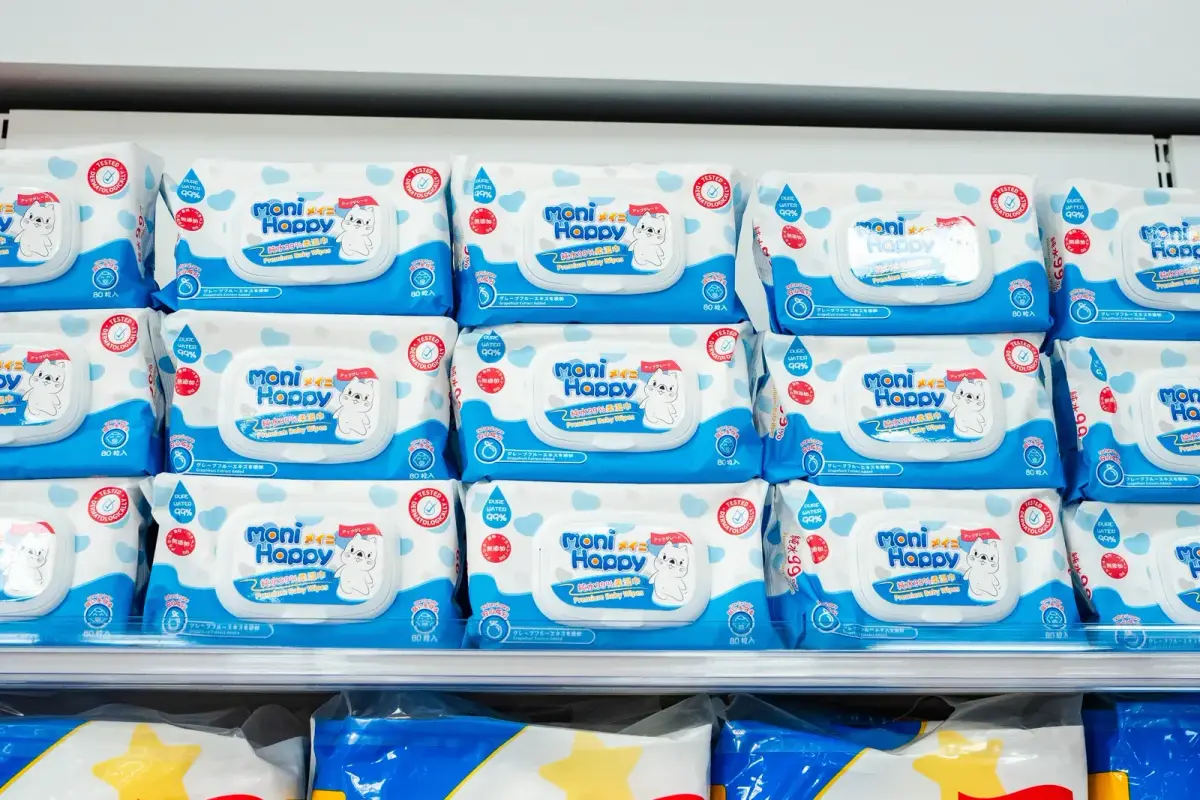
Specify 3.0 to 3.5 times the dry substrate weight, and write the number into the purchase order as a ratio rather than as a pack weight. An 80 sheet pack of 200 by 150 millimetre 50 gsm spunlace carries 120 grams of dry fibre, so that ratio means 360 to 420 grams of lotion and a net pack weight of 480 to 540 grams.
Most wet wipes wholesale disputes about dry packs are not about the total weight at all. They are about where the liquid sits inside the pack, and about a ratio that was set once for a European winter and never revisited for a Southeast Asian warehouse. A wipes wholesale buyer who specifies only a pack weight has left the supplier free to move substrate grammage and keep the number.
What fill weight should one pack carry?
Between 2.8 and 3.5 times the dry substrate weight for a retail pack, and 3.0 to 3.5 is the band worth specifying. Under 2.8 the bottom sheets read dry; over 3.8 the pack starts fighting its own seal.
The ratio is a better specification than a gram figure because it survives a change of substrate. If a supplier switches from 50 to 60 gsm spunlace without telling you, a fixed 400 gram fill silently drops from a 3.3 ratio to a 2.8 ratio, and the complaint arrives six weeks later from a store 2,000 kilometres away. A ratio in the wipes wholesale order forces the conversation at quotation stage.
For a 60 gsm substrate and the same 80 sheets, dry fibre is 144 grams, so the same 3.2 ratio means 461 grams of lotion and a net pack of 605 grams. Heavier pack, wetter feel, higher freight. All three follow from the grammage, which is why the two numbers have to be specified together.
How do I calculate fill weight from sheet count and gsm?
Sheet area times grammage times sheet count gives dry substrate weight. Multiply by the load ratio and you have the lotion weight. Four multiplications.
- Sheet area. 200 by 150 millimetres is 0.03 square metres.
- Dry weight per sheet. 0.03 square metres at 50 grams per square metre is 1.5 grams.
- Dry weight per pack. 1.5 grams times 80 sheets is 120 grams.
- Lotion. 120 grams at a 3.2 ratio is 384 grams, so the pack nets 504 grams before film and label.
Check the arithmetic against the declared net weight on the artwork before you approve print. A pack label that declares 500 grams net when the specification produces 504 grams is a labelling problem in every market that enforces weights and measures, and the fix costs a print run.

What goes wrong below a 2.8 load ratio?
The top sheets stay wet and the bottom sheets do not, because gravity moves lotion down only as fast as the substrate wicks it. The shopper notices on the last ten sheets, which is the point at which they decide whether to buy the brand again.
Underfilled packs also feel light in the hand, and weight is one of the few cues a shopper uses in a category where every pack is a sealed white rectangle. Retailers in Malaysia and Thailand have started putting packs on the shelf edge of a scale in promotional displays for exactly this reason.
The commercial risk is a return, not a complaint. A distributor who receives 200 cartons of a pack that dries out at sheet 70 has stock it cannot sell at full price, and the supplier's defence will be that the total weight matched the specification. That defence holds unless the purchase order states a ratio and a bottom-sheet test.
What goes wrong above a 3.8 load ratio?
The pack bulges, the resealable label lifts, and liquid finds the weakest point of the seal. In a hot container the pressure rise does the rest.
Three failures follow in sequence. First the label: a pack with 400 grams of free liquid presses against the label adhesive, and a label that lifts on the shelf reads as a manufacturing defect even when the wipe inside is fine. Second the carton: bulged packs do not stack square, so carton dimensions grow by 3 to 8 millimetres and the pallet pattern you costed no longer fits. Third the container: packs that weep leave a film on the carton base, and a buyer who opens a container to a smell will reject the lot regardless of the lab report.
There is a fourth cost that buyers miss. Every extra gram of lotion is a gram you pay freight on and a gram the retailer pays to shelve, and none of it adds shelf life. Above about 3.5 the extra liquid mostly sits in the pack rather than doing work.
How much of the freight bill is water?
About three quarters of the shipped mass. On the 80 sheet example, 384 grams of the 504 gram pack is lotion, which is 76 percent.
That share is why load ratio is a freight decision as much as a product decision. Worked as a planning example, clearly hypothetical: a 20 foot container taking 1,300 cartons of 12 packs at 504 grams net is 15,600 packs and 7.9 tonnes of product, of which 6.0 tonnes is liquid. Drop the ratio to 2.6 and the same container holds about 18,200 packs at the same weight limit, which cuts freight per pack by roughly 14 percent.
Whether that trade is worth taking depends on the channel. A discount line selling on price per pack can absorb a drier wipe. A pharmacy line selling on skin feel cannot, and the 14 percent saving will be spent twice over on returns. Decide which line you are buying before you decide the ratio.
Which incoming tests prove the fill weight?
Three, all of them possible in a warehouse with a scale and a tray. Weigh, squeeze, and cut.
- Weigh ten unopened packs. A 1 gram scale, ten packs from three cartons across the container. Compare the mean against declared net plus film weight, and look at the spread. A mean on target with a 15 gram spread is a filling machine problem, not a formulation one.
- Squeeze the bottom sheet. Open a pack, take the last sheet, press it against a white tray. Free liquid should bead within two seconds. No bead means the lotion is not distributed, whatever the total weight says.
- Cut and weigh the dry substrate. Take one sheet, rinse it clear of lotion, dry it and weigh it. That gives you the actual grammage, which is the number the ratio depends on and the number suppliers substitute most quietly.
Record the three results against the batch code. Two containers of data turn a subjective argument about wetness into a trend line, and a trend line is what a claim needs.
How does fill weight interact with preservative and shelf life?
Free water is the variable that microbial growth responds to, so raising the ratio raises the preservative demand in a way that is not proportional.
This is the technical reason a fill weight change is not a cosmetic change. A pack at 3.0 and a pack at 3.6 have the same substrate and the same preservative concentration on paper, but the second has more available water and a different challenge profile. Any supplier that raises fill weight without re-running a preservation challenge test has either tested it already or is guessing.
Ask for the challenge test date alongside the specification sheet, and ask whether it was run on the current formulation at the current ratio. A test report dated before a formulation change tells you about a product that is no longer being made.
For buyers assembling a first wipes order across several pack formats, the partner programme returns fill weight, substrate grammage and carton cube on the same sheet, which is what the landed cost calculation needs. The wet wipes range lists the pack counts and sheet sizes we run, and the onboarding guide covers where the specification sits in the order sequence.
Frequently asked questions
Is a heavier pack always a wetter pack?
No. Weight is substrate plus liquid, so a 60 gsm substrate carries 30 grams more dry fibre per 80 sheets than a 50 gsm one. Two packs can weigh the same while the heavier-substrate pack holds less lotion. Compare the ratio.
Can I check fill weight on arrival without opening every carton?
Yes. Weigh ten unopened packs on a 1 gram scale against declared net plus film, then open one and squeeze a bottom sheet onto a white tray. A dry bottom sheet at correct total weight means uneven distribution.
Does a higher load ratio shorten shelf life?
Not by itself. Free water drives microbial growth, so a higher ratio raises preservative demand. What shortens shelf life is raising the ratio without re-testing, which is why any fill weight change needs a fresh challenge test.
Why do buyers in tropical markets specify a lower ratio?
Heat softens the film and raises internal pressure, so a ratio that seals cleanly at 20 degrees can weep at 35. Southeast Asian buyers often hold at 3.0 to 3.2 and spend the difference on a heavier substrate, which feels wetter without free liquid.
Sources and further reading
- EDANA (current): nonwovens industry association, including guidance on spunlace substrates and wet wipe construction.
- Regulation (EC) No 1223/2009 (European Union, current): cosmetic product rules covering preservative limits and the preservation challenge testing that a fill weight change triggers.
- ISO 22716:2007 (International Organization for Standardization): good manufacturing practice guidelines for cosmetic products, including filling and lot traceability.
Bottom line
Specify fill weight as a ratio of 3.0 to 3.5 against dry substrate, not as a pack weight, and specify grammage in the same clause. Under 2.8 the bottom sheets dry out and the shopper decides not to rebuy. Above 3.8 the label lifts, the carton grows and you pay freight on water. Weigh ten packs, squeeze a bottom sheet, and keep the batch numbers.
Frequently Asked Questions
Is a heavier pack always a wetter pack?
No. Weight is substrate plus liquid, and a 60 gsm substrate carries 30 grams more dry fibre per 80 sheets than a 50 gsm one. Two packs can weigh the same while the heavier-substrate pack carries 60 grams less lotion. Compare the load ratio, not the pack weight.
Can I check fill weight on arrival without opening every carton?
Yes. Weigh ten unopened packs on a 1 gram scale, compare against the declared net weight plus film, then open one and squeeze a bottom sheet across a white tray. A dry bottom sheet with a correct total weight points to uneven lotion distribution rather than underfill.
Does a higher load ratio shorten shelf life?
Not by itself. Free water is what drives microbial growth, so a higher ratio raises the preservative demand. What shortens shelf life is a ratio raised without re-testing the preservative system, which is why any change to fill weight needs a new challenge test rather than an extension of the old one.
Why do buyers in tropical markets specify a lower ratio?
Heat softens the film and raises the internal pressure in the pack, so a ratio that seals cleanly at 20 degrees can weep at 35. Buyers shipping into Southeast Asia often hold to 3.0 to 3.2 and spend the difference on a heavier substrate, which feels wetter without adding free liquid.
Distributor resources
If you are evaluating suppliers for your market, these are the pages that answer the commercial questions — in the order buyers usually need them.
