
2026-11-14 · Moni Happy
What does a week of empty shelf space cost a diaper wholesale distributor?
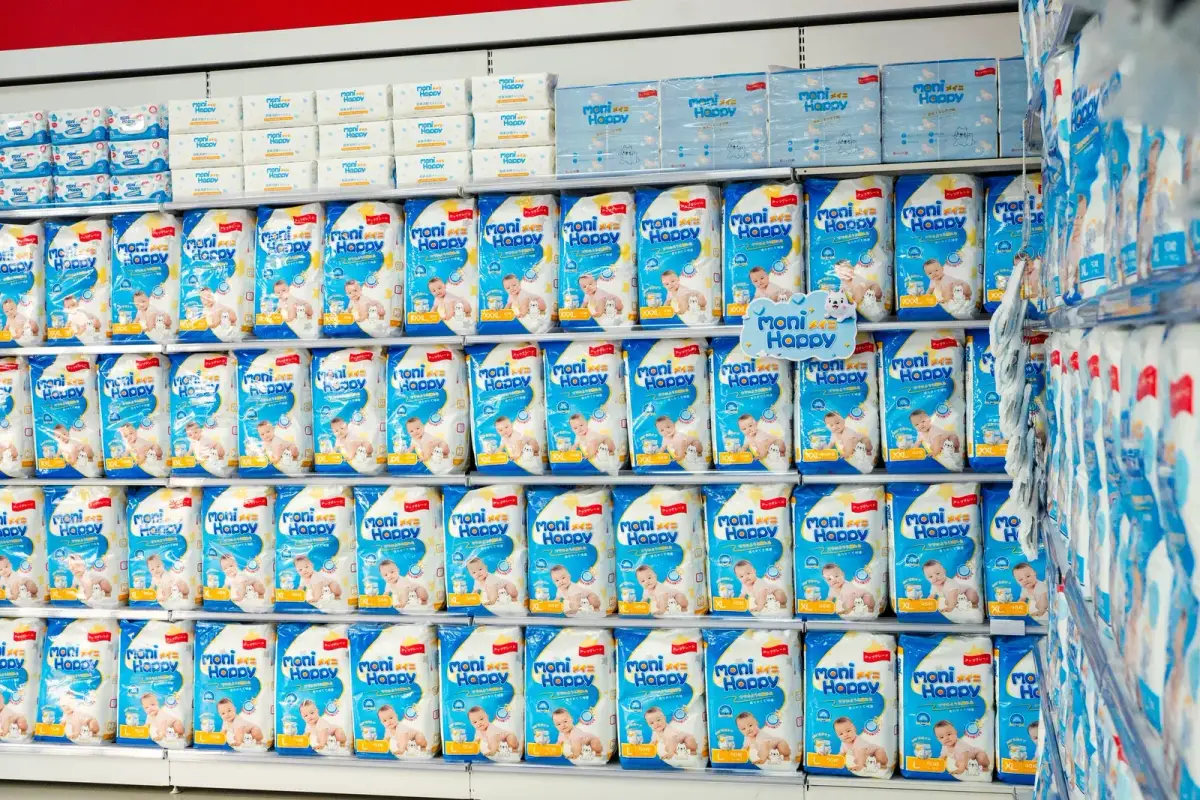
A week of empty shelf space on one diaper line costs five to six times the margin it loses. Take one store, one line, 30 packs a week at USD 7.20 wholesale. The missed sale is USD 216 and the margin at a fifth is USD 43. That USD 43 is why nobody escalates. The true cost of the same week is closer to USD 270, and it puts a facing worth USD 11,232 of annual wholesale revenue at risk.
Once the gap is priced at the full cost instead of the margin, two decisions change. How much safety stock you fund, and whether you transfer or air-freight stock when a warehouse runs short. Both are cheap against the number above, and both are usually decided by whoever shouts loudest instead.
What does one week of empty shelf space actually cost?
About USD 270 for the week on a line doing USD 216 of weekly wholesale, and a facing worth USD 11,232 a year sitting behind it.
Build the number in three parts rather than one, because the three behave differently and only one of them is visible in the sales report.
- The sale you did not make. 30 packs at USD 7.20 is USD 216 of revenue and USD 43 of margin at a twenty percent gross margin. This part is real, small, and already lost.
- The shopper who does not come back. Assume one in five of those 30 weekly buyers substitutes, and half of those never return to the line. That is 3 packs a week, 156 packs a year, USD 1,123 of revenue, and about USD 225 of margin gone permanently rather than for a week.
- The facing. A facing here means one pack-width of shelf in one store. At 30 packs a week it carries USD 11,232 of wholesale revenue a year and roughly USD 2,250 of margin. Lose it at the next review and the cost is not a week, it is a year.
Parts one and two together are USD 268 for the week. Part three is the reason the week matters out of proportion to its size.
Why is the lost margin the smallest part of the bill?
Because the margin is the only part that stops when the stock arrives. Substitution and facing loss keep running after the pallet lands.
A distributor's sales report shows the gap as one missing line for one period. The retailer's report shows the line at zero rate of sale for the week, which is what the category buyer reads, and the buyer reads it next to every other line on the same shelf. Rate of sale is the number that decides facings, and a zero week drags the monthly average down even when the other three weeks were normal.
The permanent switch is the part nobody records. A shopper who buys a competing brand because the shelf was empty may return, or may not, and the retailer will not tell you which. Treat the uncertainty as a cost rather than as a rounding error. At one in five substituting and half of those not returning, the annual figure on this line is larger than two weeks of the missing margin.
How does a stockout cost turn into lost facings?
Through two cycles of the category review, usually three to six months after the gap. One bad week rarely costs a facing. A pattern does.
The mechanism is straightforward once you have seen it. The buyer ranks lines by sales per facing per week and by gross margin return on inventory. A line that missed a week scores lower on the first measure through no fault of its own, and if the same line misses again in the next period the buyer has two data points pointing the same way. The cut is not punitive. It is the buyer optimising a fixed shelf.
What makes this expensive is the asymmetry. Winning a facing takes a listing fee, a promotional plan and a quarter of proof. Losing one takes a bad month. That asymmetry is the whole argument for funding safety stock on listed lines and not on the rest of the range.
What service level should a diaper wholesale distributor promise?
Ninety-five to ninety-seven percent case fill on listed lines, ninety to ninety-five percent on general trade, and no promise at all on lines you cannot replenish inside the lead time.
The cost of service is not linear. Moving from 95 to 97 percent raises safety stock by roughly a third. Moving from 97 to 99 percent roughly doubles it again, because the normal distribution has a long tail and you are buying cover for rarer and rarer events. Most distributors are better at 97 percent with money left to defend a facing than at 99 percent with none.
Write the number into the supply agreement and measure it the way the retailer measures it: cases delivered against cases ordered, per order, per month, with the shortfall visible rather than netted off. A fill rate computed on value hides the cheap fast-moving line that went short, which is the one the buyer notices.
How much safety stock does a 97 percent service level need?
Multiply the demand standard deviation by the square root of the replenishment lead time, then by 1.88. That is the whole formula for a 97 percent service level.
Worked as a planning example, clearly hypothetical: a distributor shipping 1,800 packs a week across a 20 line range, with weekly demand varying by a standard deviation of 420 packs, and a replenishment lead time of six weeks (three weeks production plus three weeks sea and clearance).
- Step one: 420 packs a week times the square root of 6, which is 2.449, gives 1,029 packs of lead-time variability.
- Step two: multiply by the service factor for 97 percent, 1.88, giving 1,934 packs of safety stock.
- Step three: value it at landed cost. A 30 piece pack landed at USD 0.20 a piece is USD 6.00, so 1,934 packs is USD 11,604.
That holding is about 1.1 weeks of demand, which sounds low against a six week lead time and is exactly the point. Safety stock covers variability, not average demand. The average is covered by stock in transit and on order, and a distributor who confuses the two ends up holding three months of cover and calling it prudence.

Which signals warn you before the shelf runs empty?
Four, and three of them fire before the retailer's own system notices. Watch the fill rate on the last two orders, the weeks of cover on the fastest size, the retailer's distribution centre stock, and the promotional volume the account has already committed to.
The most useful is weeks of cover on the top size only, computed daily. A range can show four weeks of cover in total while size L sits at eight days, because the total is flattered by slow sizes nobody buys. Size L going short is what creates the gap, and it is visible a fortnight before the shelf shows it.
The second is a promotional commitment the warehouse has not reserved. A supermarket that has agreed a leaflet feature will take three to five times normal volume in one week, and the stock for it comes out of the same warehouse. If the order is booked as a normal replenishment, the gap is scheduled rather than accidental.
The third is the retailer's own distribution centre. Once their DC goes short they stop ordering from you and start allocating, and allocation is the first step toward a range review.
Is it cheaper to hold stock or to pay for the gap?
Hold it, on listed lines, and only on listed lines. The comparison is not close once the facing is priced.
Cost of holding: 1,934 packs at USD 11,604, carried at a funding cost of seven percent plus three percent for storage and handling, is USD 1,160 a year. Cost of one lost facing: roughly USD 2,250 of margin a year, and it does not come back without a listing fee and a quarter of trading.
The conclusion flips for unlisted lines. A line with no facing has no facing to protect, and the only cost of a gap is the sale, which is USD 43 a week in the example above. Hold buffer on those only when the lead time is long enough that a gap cannot be closed inside a month.
If you are building this model for your own range, the partner programme returns landed cost and carton configuration together, which is what the safety stock valuation needs. The working capital note covers how the same holding shows up in the cash cycle, and the diaper range lists the pack formats that fit a modern trade planogram.
Frequently asked questions
Is a stockout on one line worth escalating to the brand?
Yes, once you can put a number on it. One store losing one line for a week costs about USD 270 including substitution and facing risk, and that figure in an email changes how a brand allocates stock. A complaint does not.
What fill rate should a diaper wholesale distributor promise a supermarket?
Ninety-five to ninety-seven percent case fill on listed lines, measured monthly. Below 95 percent you trigger service penalties in most contracts. Above 98 percent the safety stock climbs faster than the penalty avoided.
Does safety stock have to be the full lead time of demand?
No. Safety stock covers variability during the lead time, not the average. Cycle stock covers the average. A distributor holding a full lead time as buffer is financing two to three times the inventory needed for the same service level.
Is air freight ever the right answer to a gap?
For a listed line with a review coming, sometimes. Air freight on 200 packs is expensive per piece and small against the annual margin on a facing worth USD 11,000 of revenue. Price both, and take the decision above warehouse level.
Sources and further reading
- GS1 standards (GS1, current): order-to-invoice and logistics identification standards behind case fill measurement and retail replenishment.
- Council of Supply Chain Management Professionals (CSCMP, current): definitions of safety stock, cycle stock and service level used in supply chain planning.
- EDANA (current): absorbent hygiene product industry association, including packaging and compression guidance that affects case configuration.
Bottom line
One week of empty shelf on one line costs five to six times the margin it appears to lose, because substitution and facing loss keep running after the stock arrives. Price the three bills separately, put a fill rate target in the supply agreement, and fund safety stock on the lines that carry a facing. The number is small enough to compute in an afternoon and large enough to change what you order.
Frequently Asked Questions
Is a stockout on one line worth escalating to the brand?
Yes, once you can put a number on it. One store losing one line for a week costs about USD 270 when substitution and facing risk are included, and it takes 30 seconds to write that in an email. A brand that receives the number starts allocating stock differently; a brand that receives a complaint does not.
What fill rate should a diaper wholesale distributor promise a supermarket?
Ninety-five to ninety-seven percent case fill on listed lines, measured monthly. Below 95 percent you trigger service penalties in most modern trade contracts. Above 98 percent the safety stock requirement climbs faster than the penalty you avoid, so the last two points are usually a poor trade.
Does safety stock have to be the full lead time of demand?
No. Safety stock covers the variability of demand during the lead time, not the average demand itself. Cycle stock covers the average. A distributor who holds a full lead time as buffer is financing two to three times the inventory needed for the same service level.
Is air freight ever the right answer to a gap?
For a listed line at a chain with a review coming, sometimes yes. Air freight on 200 packs of diapers is expensive per piece, but it is small against the annual margin on a facing worth USD 11,000 of wholesale revenue. Price both before deciding, and keep the decision out of the warehouse manager's hands.
Distributor resources
If you are evaluating suppliers for your market, these are the pages that answer the commercial questions — in the order buyers usually need them.
