
2026-11-21 · Moni Happy
What pallet spec does a Thai hypermarket DC demand from a diaper distributor?

A Thai hypermarket distribution centre will reject a load for four reasons before anyone opens a carton: wrong footprint, overhang or excess height, a missing pallet label, and a wooden pallet without the ISPM-15 stamp.
None of those four is about the diapers. That is the point. The buyer who negotiated the listing and the dock that receives the goods are two different functions with two different scorecards, and the dock's scorecard is the one that decides whether your container gets unloaded on Tuesday or sits on a trailer until Thursday. For a diaper distributor running a 40HQ into Laem Chabang and then into a regional DC, the gap between a pass and a refusal is usually a carton dimension and a piece of paperwork.
Which pallet footprint will a Thai DC accept?
1200 by 1000 millimetres in most flows, with 1100 by 1100 still alive in domestic distribution.
Thailand runs two footprints side by side. The 1200 by 1000 pallet is the working standard across manufacturing and modern trade, and it is what most regional DCs are racked for. The 1100 by 1100 square pallet is common in domestic flows and in Japanese-linked supply chains, and some facilities accept the 1219 by 1016 GMA size that arrives with imported cargo. Accepting and preferring are different things, and the difference shows up as a slower slot and a manual put-away.
The container arithmetic follows the pallet. A 40HQ is 12.03 metres long internally, so ten pallets fit along the length at 1200 millimetres, two across at 1000 millimetres each. That is 20 pallets in a single tier. The same box takes 20 pallets of 1100 by 1100 as well, but with less clearance for the last row, which is why the loading plan has to be drawn for the footprint the DC uses rather than the one that loads easiest.
Why is the ISPM-15 mark non-negotiable for wood from China?
Because it is a phytosanitary control, and it is enforced at the border rather than debated.
Any solid wood packaging entering Thailand, including pallets, crates and dunnage, must be heat treated or fumigated and stamped with the ISPM-15 mark. Cargo arriving without it can be ordered re-exported or treated on arrival, and both outcomes are charged to the importer. The treatment itself is cheap and the stamp is small; the failure is expensive because it happens after the container is already on the quay and the storage clock is running.
Two ways around it, and only two. Use plastic or processed-wood pallets, which are outside the scope of the standard, or buy certified heat-treated pallets and check the stamp on every unit rather than on the first one. The third approach, hoping the inspection is light, is what turns a 20-pallet delivery into a two-week delay.
How high can a pallet be built?
1.8 to 2.0 metres including the pallet, with no overhang in any direction.
The ceiling comes from the racking and from the trailer, and individual DCs set their own figure inside that band. A standard wooden pallet is 144 millimetres high, so a 1.8 metre cap leaves about 1.65 metres of load, which on a 400 by 300 millimetre diaper carton is four layers of nine, or 36 cartons. Push to 2.0 metres and you get a fifth layer in some facilities, but the load becomes unstable without corner boards, and an unstable pallet is a refusal waiting to happen.
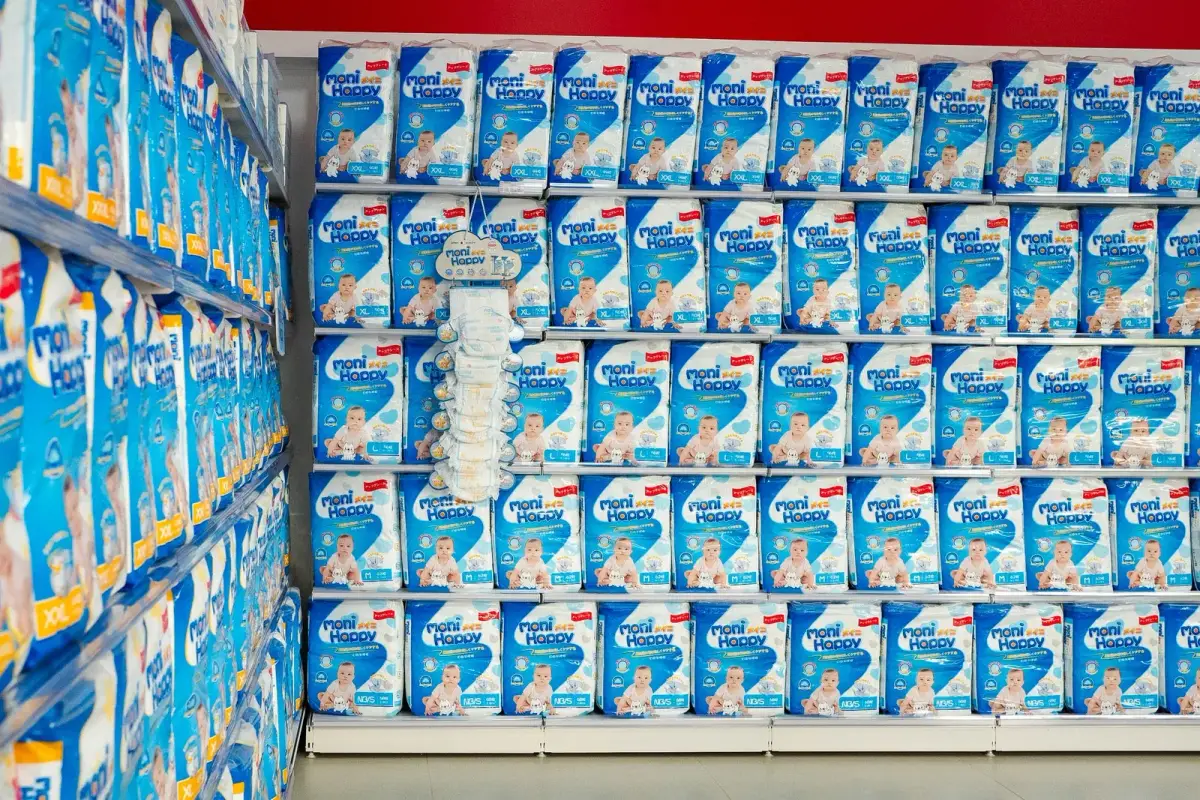
Wrapping is part of the specification, not an afterthought. Three to four turns of stretch film, a top sheet, and corner boards on any load above 1.6 metres is the pattern most Thai DCs expect. The film is there to hold the load together through a forklift turn, not to keep dust off.
What has to be on the pallet label?
An SSCC label carrying the SSCC-18 barcode, matched to the advance shipping notice, plus the human-readable summary the dock can check at a glance.
- SSCC-18 serial shipping container code, barcoded, one per pallet.
- GTIN and description for each carton on the pallet, with the quantity.
- Batch or lot code and the expiry or best-before date.
- Destination DC code and the purchase order or delivery note number.
- Pallet count in the shipment, so the dock knows whether the trailer is complete.
The failure that costs the most time is a mismatch between the SSCC label and the advance shipping notice. The dock scans, the system disagrees, and the pallet goes to a holding area while somebody calls the supplier. A label printed from the same data as the notice costs nothing extra; a label printed by hand from a packing list costs a day.
How do delivery windows and bookings work?
You book a slot, you arrive inside it, and late arrival means a new slot on another day.
Thai modern trade runs on booked windows, typically two to four hours, allocated by the DC against its receiving capacity. The booking is made through the supplier portal days ahead, and the window is not a suggestion: a trailer that arrives outside its slot waits, and waiting time is either charged or converted into a rebooking. Multiply that by a Songkran week, when the whole logistics chain closes for three days, and a missed window can cost a week of shelf availability.
Two habits keep this manageable. Book the slot before the container clears customs rather than after, and keep a buffer of at least two working days between the estimated clearance date and the booked window. For a diaper distributor shipping monthly, the booking calendar is as much a part of the supply plan as the production schedule.
Which carton faults cause rejection at the gate?
Five, and four of them are visible in ten seconds.
- Crushed corners or a deformed carton, which means the packs inside are compressed and the retail unit will not stand on shelf.
- Wet or damp cartons, which in a tropical container means condensation damage rather than rain.
- Mixed SKUs on one pallet when the purchase order specified single-SKU pallets.
- A barcode that does not scan first time, usually because the print is too light or the label is wrinkled.
- A missing or non-compliant Thai label on the retail pack, which is an import compliance issue that surfaces at the DC rather than at customs.
The third one catches new suppliers most often, because mixing size bands on a pallet is efficient at the factory and useless at the dock. Single-SKU pallets, one GTIN per pallet label, is the default unless the buyer has agreed otherwise in writing.
How should a diaper distributor cost the pallet regime?
As a per-carton handling charge, not as a line in the freight invoice.
Four costs sit behind a compliant pallet: the pallet itself, whether bought or rented through a pooling operator; the stretch film, around 0.3 kilograms per pallet; the labour to build and wrap it; and the slot risk, which is the cost of a rebooking expressed in lost shelf days. On a pallet carrying 36 cartons the handling cost per carton is 33 percent higher than on a pallet carrying 48, because the pallet, the film and the booking are fixed per pallet while the cartons are not.
That is the argument for a smaller carton, and it is an argument a factory will resist because a smaller carton costs more board per piece. The compromise is usually a carton sized to the pallet rather than to the case pack: if nine cartons fit a layer either way, the question is whether four layers or five is allowed, and whether the fifth layer survives the trip.
Frequently asked questions
Can a plastic pallet skip the ISPM-15 requirement?
Yes. ISPM-15 covers solid wood packaging, including pallets, crates and dunnage. A plastic or processed-wood pallet does not need the mark, though the DC may still refuse a non-standard footprint.
What happens if the load arrives with overhang?
It is usually refused at the gate. Overhang damages racking and the neighbouring pallet, so the dock asks for the load to be rebuilt, which means unloading and re-stacking at the supplier's cost.
How many diaper cartons fit on one pallet?
With a 400 by 300 millimetre carton on a 1200 by 1000 footprint, nine per layer and four layers under a 1.8 metre cap, so 36 cartons. A smaller carton reaches 48 and cuts handling cost per carton by a quarter.
Does the pallet exchange system cost extra?
Pooled pallets are rented per trip, with a loss charge for anything not returned. White wood pallets are cheaper to buy and carry a repair and disposal problem that the dock notices.
Sources and further reading
- Thai Industrial Standards Institute, standards referenced for packaging and pallet dimensions in the Thai market, accessed November 2026.
- Thai Customs Department, guidance on wood packaging and ISPM-15 compliance at import.
- Department of International Trade Promotion, logistics and distribution notes for suppliers entering Thai modern trade.
- CHEP, pallet pooling terms for the Thailand and wider ASEAN network.
Bottom line. The pallet specification is written by the dock, and it is enforced without negotiation. Confirm the footprint and height cap with the destination DC before the cartons are printed, put an ISPM-15 stamp or a plastic pallet under every load, and label from the same data as the shipping notice. A diaper distributor who treats the pallet as part of the product lands on the booked window; one who treats it as packaging lands in the holding area.
We build Thailand-bound orders to the receiving DC's pallet sheet, with the label data supplied in advance so it can be checked against the notice. Ask for the pallet and carton specification sheet, or see the diaper and pull-up pants ranges that go into these loads.
Frequently Asked Questions
Can a plastic pallet skip the ISPM-15 requirement?
Yes. ISPM-15 applies to solid wood packaging, including wooden pallets, crates and dunnage. A plastic or presswood-composite pallet does not need the mark, but the receiving DC may still refuse a non-standard footprint.
What happens if the load arrives with overhang?
It is refused at the gate more often than it is accepted with a note. Overhang damages the racking and the adjacent pallet, so the dock will usually ask for the load to be rebuilt, which means unloading and re-stacking at your cost.
How many diaper cartons fit on one pallet?
On a 1200 by 1000 millimetre footprint with a 400 by 300 millimetre carton, nine per layer, and four layers under a 1.8 metre cap, so 36 cartons per pallet. A smaller carton gets you to 48 and cuts handling cost per carton by a quarter.
Does the pallet exchange system cost extra?
Pooled pallets are rented rather than bought, so the cost is a per-trip charge plus a loss charge for anything not returned. White wood pallets are cheaper to buy and carry a repair and disposal problem, and the dock treats them accordingly.
Distributor resources
If you are evaluating suppliers for your market, these are the pages that answer the commercial questions — in the order buyers usually need them.
