
2026-11-10 · Moni Happy
What happens to baby diapers inside a container during Vietnam's rainy season?
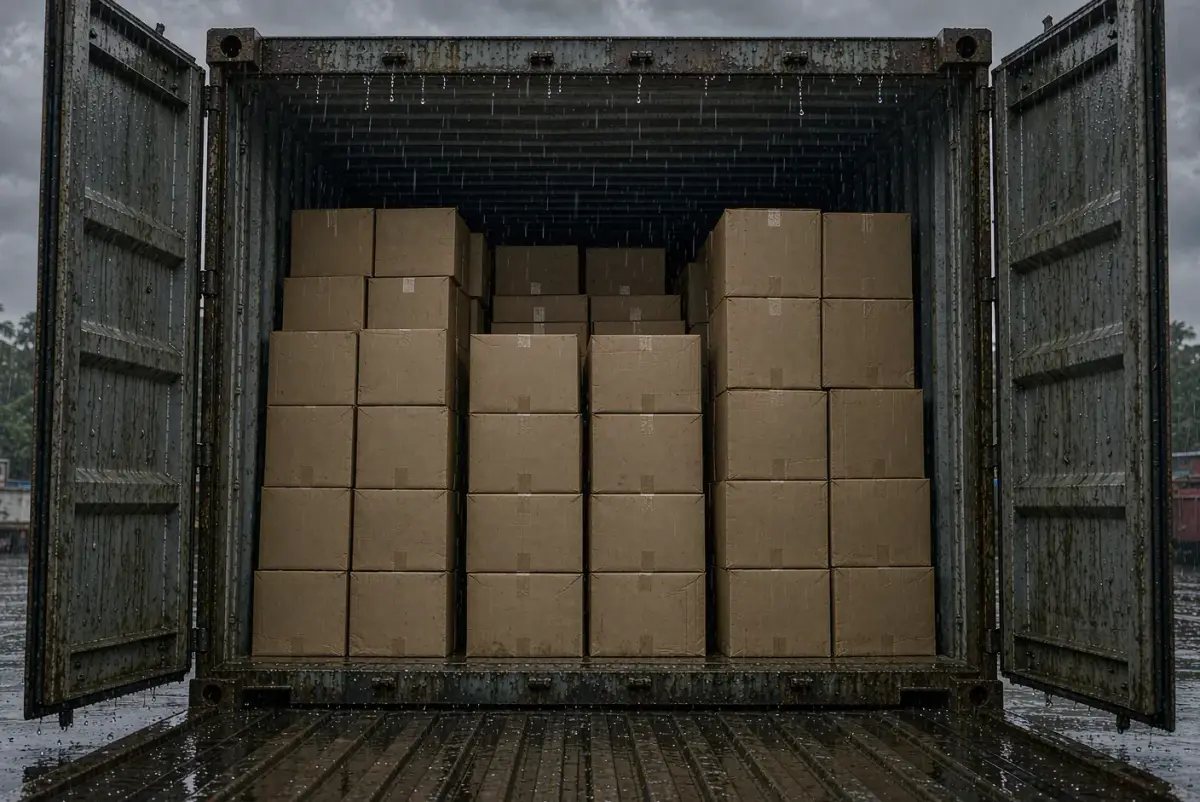
The cartons get wet from the inside. Warm, humid air trapped in a sealed container condenses on the steel roof as the outside temperature drops overnight, and the water runs down onto the top layer of cartons. The absorbent product usually survives because the pack is a decent barrier; the carton does not. Board that has absorbed moisture loses a large part of its carton compression strength, so the stack crushes itself, print transfers between cartons, and the bottom layer arrives looking like it spent a week in the rain.
Southern Vietnam is where this becomes routine rather than exceptional. The southwest monsoon runs roughly from May to November, relative humidity sits high for months, and a container that spends time in a yard before unstuffing collects condensation whether or not it ever meets a storm. None of this is a reason to avoid the market. It is a reason to specify the packaging and the landing window before the order is placed rather than after the first claim.
When does the rainy season actually affect a shipment?
From the moment the container is sealed at origin until the cartons are inside a dry warehouse in Vietnam, and the risk is not evenly spread across that period.
There are two distinct mechanisms. Cargo sweat forms when moisture already inside the goods and packaging migrates to the surface as the container cools. Container sweat forms when moisture in the air inside the box condenses on the steel structure. In both cases the water ends up on the cargo, and in both cases the driver is the day-night temperature cycle rather than rainfall itself. Cargo sweat follows the goods; container sweat follows the box. A container crossing from a cool origin into tropical humidity, then sitting in a yard where the roof reaches 60 degrees by day and 26 at night, is a condensation engine.
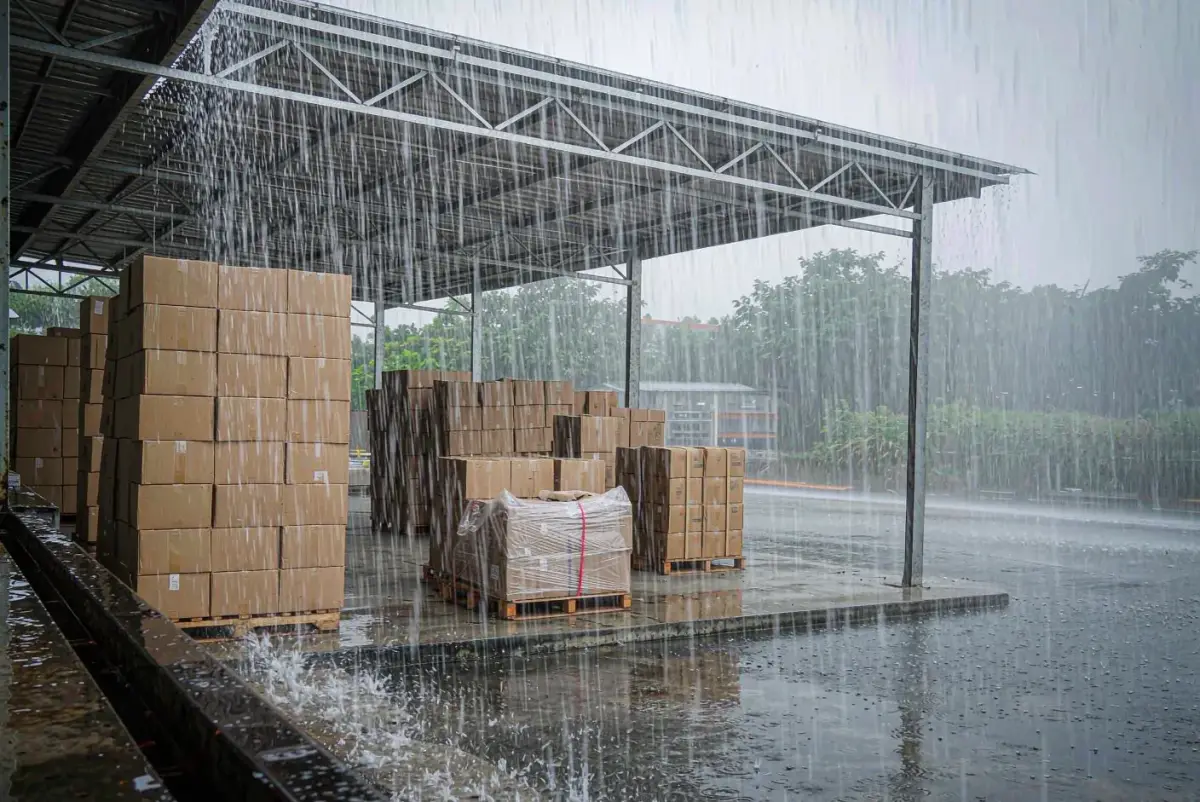
The rain matters most at the two ends: loading in wet weather at origin, and unstuffing in the open at destination. A container opened in a downpour with cartons handed straight onto a truck is a wet shipment no matter how good the packaging was.
What does the moisture actually do to a carton of baby diapers?
Carton compression strength is the first thing it takes away, then the appearance, and finally the resale value.
Corrugated board holds its compression strength through the stiffness of the liner and the structure of the flutes. Absorb a few percent of moisture and carton compression strength falls sharply; the cartons at the bottom of a stack then carry the load with less support and deform. The visible result is a bowed carton with crushed corners, which a retail distribution centre will reject on receipt because it cannot be stacked or scanned reliably.
- Structural: crushing, bowing, corner collapse and pallet instability.
- Cosmetic: water staining, print offset between cartons, and a musty smell that survives drying.
- Commercial: a buyer who rejects part of a container still pays for the whole freight bill, and the replacement shipment goes to the back of the production queue.
- Financial: a ten percent write-off on a container with a landed value near $8,600 is about $860, which is the same order as the import tax on the shipment and considerably harder to recover.
That last comparison is worth keeping in view. Distributors spend a lot of attention on the tax and duty lines, and comparatively little on the packaging line that decides whether the goods arrive saleable.
Which packaging changes are worth paying for?
An inner liner, correctly sized desiccant, corner protection and a pallet. In that order.
- Inner liner. A polyethylene bag or liner inside the outer carton, or around the pallet load, keeps condensed water off the board. It is the cheapest effective intervention and the one most often omitted on price-focused quotations.
- Desiccant. Sized to the carton volume and transit days rather than added as a token sachet. Ask for the calculation, not just the presence.
- Corner boards and stretch wrap. These protect against the handling damage that a soft carton attracts, and they keep a pallet square when the board has taken up moisture.
- Palletisation. A pallet lifts the bottom cartons off the container floor, where standing water collects, and creates an air gap. It costs cube, and in a wet season it is usually worth the cube. Those four items decide whether a container of baby diapers arrives in the condition the buyer approved.
What is generally not worth paying for is a heavier board on its own. A thicker carton that absorbs moisture still loses carton compression strength; the barrier matters more than the grammage.
How should the order calendar shift around the rains and Tet?
Land before the peak weeks or after them, and never plan a first container to arrive in the fortnight around Tet.
A rainy season order is a packaging order before it is a quantity order, and production and shipping run on a calendar that the weather does not respect, so the distributor has to choose the arrival window deliberately. A container that lands in June meets the start of the wet season with a warehouse that is still dry; one that lands in September meets the peak with a yard that is not. If the order cannot be moved, move the packaging specification up instead of accepting the window.
Tet matters for a different reason. Plants and inland trucking in southern Vietnam slow or stop around the lunar new year, which falls in late January or early February depending on the year, and the weeks immediately before it are the busiest of the year for every forwarder in the country. Confirm the exact shutdown dates with the supplier and the forwarder for the specific year, because they shift, and build a buffer of two to three weeks on either side rather than assuming last year's dates still apply.
Does marine insurance solve this?
Only partly, and often not for the failure that actually happens.
A marine insurance policy is written against accidents and specified perils, and the widest cover is not unlimited. Condensation inside a container is frequently characterised as an inherent characteristic of the cargo or its packaging rather than a fortuitous event, which means a claim for sweat damage can be declined even under broad clauses. Damage caused by handling and by water ingress through a damaged container is a different matter and is usually covered.
The practical consequence is that marine insurance should be treated as protection against the catastrophic loss, not as a substitute for packaging. Read the exclusions with the broker before the first rainy season shipment, get the answer in writing, and assume that a musty-smell claim will be argued. A distributor who has specified a liner and a desiccant is arguing from a stronger position than one who has not.
How do I inspect a wet-season container on arrival?
Before unloading, in a covered area, with photographs of the container number and the seal.
- Look at the roof before touching the cargo. Drops hanging from the ceiling ribs tell you immediately whether condensation occurred.
- Unstuff under cover. Opening the doors in the rain turns a recoverable shipment into a rejected one.
- Check the bottom layer first. Pull cartons from the lowest row on the pallet, not from the top, because that is where crushing and standing water show.
- Smell the carton, not the product. A musty note in the board is the earliest reliable indicator of moisture uptake.
- Record before you move. Photograph the stack as loaded, then the damage in place. Once the pallets are broken down, the evidence is gone and the claim becomes an opinion.
Do this on every baby diapers container that lands between May and November, not only on the ones that look wrong. A batch that passes inspection in the yard can still fail at the retail distribution centre a month later, and the photographs taken on arrival are what separate a packaging problem from a handling problem.
If you are planning a first order into Vietnam and want the pack specification and the landing window reviewed before the purchase order goes out, apply as a partner and we will go through the liner, the desiccant sizing and the delivery dates with you. The specification for each line sits on the baby diapers and diaper pants pages, since the two pack differently and the pants carton tolerates compression better than the diaper carton does.
Frequently asked questions
Is a 40-foot container worse than a 20-foot for condensation?
It has more roof area and more air volume, so it produces more container sweat in absolute terms. What matters more is the temperature cycle the box experiences and how long it sits sealed before unstuffing.
Can I ventilate the container instead?
Ventilated containers exist but are rarely available on this trade lane at a sensible rate. A liner and desiccant address the same problem at a fraction of the cost and work on any vessel.
Does the season affect the piece price?
The goods price does not change; the packaging specification does, and freight and insurance may move too. Ask for the quotation to state the packaging items separately so the seasonal cost is visible rather than absorbed into the piece price.
What if the cartons are stained but the packs are intact?
Then you have a commercial decision rather than a quality failure. Some modern trade buyers reject any stained carton; independent shops and wholesalers often accept it at a discount. Sort and price it deliberately rather than shipping it and hoping.
Sources and further reading
- Vietnam Customs (General Department of Vietnam Customs, current): clearance procedures and documentation for imported consumer goods.
- Saigon Newport Corporation (current): terminal operations at Cat Lai and Cai Mep, the two gateways most containers of baby diapers enter southern Vietnam through.
- International Chamber of Commerce - Incoterms 2020 (ICC, 2020): the terms that decide where risk passes and who carries the loss between the port and the warehouse.
Bottom line
In the Vietnamese rainy season the container sweats from the inside, and the damage lands on the carton before it reaches the product, which makes it a packaging decision rather than a product one. Specify an inner liner, sized desiccant, corner boards and a pallet, choose an arrival window outside the peak weeks and outside Tet, and inspect before unloading with photographs. Insurance covers the catastrophe; the specification is what prevents the claim.
Frequently Asked Questions
Does the product itself get damaged, or only the carton?
Usually the carton first. A sealed pack of baby diapers is a reasonable moisture barrier, so the product often survives while the outer carton softens, stains and loses print quality. That still makes the shipment unsaleable to a retail buyer.
Is container sweat covered by marine insurance?
Not automatically. Condensation inside a container is frequently treated as an inherent risk of the cargo or packaging rather than an accident, so read the clauses and ask the broker in writing what is excluded before the first rainy-season shipment.
Which weeks should I avoid?
The peak of the southwest monsoon, roughly July to October in the south, plus the fortnight around Tet when plants and trucking stop. Ask the supplier and the forwarder to confirm the current year dates rather than working from last year calendar.
Do I need desiccant in every carton?
Ask the supplier to size it rather than adding a fixed sachet. The quantity depends on carton volume, pack barrier and transit days, and an undersized sachet is worse than none because it gives a false sense of protection.
