
2026-11-08 · Moni Happy
When does facial tissue embossing stop being worth the cost per carton?
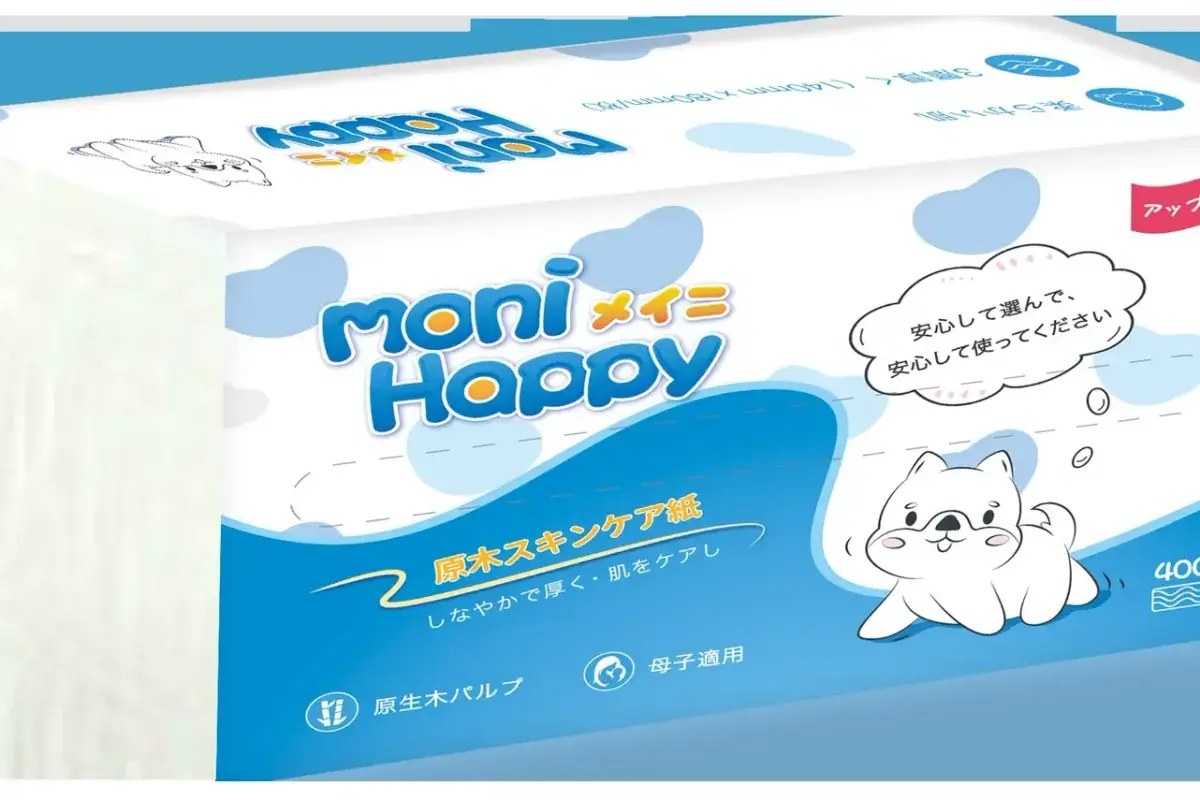
Embossing pays back while it adds under roughly 5 percent to the cost per carton and earns at least twice that back at the shelf. Past a registered full-face pattern the arithmetic reverses: the line slows, waste rises, the sheet compresses, and the price a shopper will accept stops moving. The decision is therefore not "emboss or not" but "how much emboss, on which pack, for which channel".
This is one of the few places in a facial tissue range where a distributor can add real differentiation without changing the ply, the sheet count or the carton. It is also one of the easiest places to spend money that never comes back, because emboss is bought at the converting stage and paid for at the shelf, and the two are rarely modelled together. Buyers who treat embossing as a specification item rather than a design flourish usually end up with a simpler range and a better return on the same shelf.
What does embossing actually change in a facial tissue line?
It changes three things at once: the feel of the sheet, the speed of the converting line, and the amount of trim waste. Only the first is visible to the shopper.
Embossing is a mechanical step, not a coating. The sheet passes between a steel pattern roll and a rubber roll, and the pattern is pressed into the paper. That pressing does three things. It bonds the plies together where the pattern contacts, which stops a two-ply sheet separating in the hand. It adds bulk and apparent thickness, which is why a lightly embossed two-ply often feels better than a flat three-ply at the same weight. And it breaks some fibre bonds at the contact points, which is why a heavy pattern can make a sheet feel softer and weaker at the same time.
The cost side is the part buyers underestimate. A pattern roll is a capital item that is specific to one width and one design. Running a registered pattern means the pattern has to land in the same place on every sheet, which slows the line and increases the trim at the edges of the parent reel. None of that appears in the piece price you were quoted for a flat sheet.
Why does the payback turn negative above a certain pattern depth?
Because the cost curve steepens while the willingness-to-pay curve flattens. The first increment of emboss buys almost all of the perceived quality; the last increment buys none of it.
- The first increment is nearly free. An edge emboss that seals the plies and gives the sheet a defined border runs with the existing set-up on most converting lines. It removes the single most common complaint at goods-in, which is ply separation.
- The second increment is cheap but not free. A light all-over pattern adds a small percentage to the cost per carton and gives the sheet the loft that shoppers read as softness through the pack film.
- The third increment is where it breaks. A registered full-face pattern needs registration control, slower running and more waste. The added cost per carton is no longer a rounding error, and the shopper cannot feel the difference through the pack.
The practical test is simple. If the added cost per carton divided by the packs per carton exceeds the shelf price increment the retailer will actually hold for a full quarter, the emboss is being funded by the distributor, not by the shopper. In a category where a distributor is defending the 15 to 25 percent margin band this trade normally supports, that is a permanent subtraction from the return on the listing.
Which emboss types exist, and what does each cost in practice?
Four types cover almost every facial tissue programme sold in this region. They sit on a clear cost ladder, and each one only makes sense on a specific pack.
- Edge emboss. A border pattern that bonds the plies at the perimeter. Lowest cost, highest functional return, and the default for a standard or value pack.
- Light all-over pattern. A shallow repeating motif across the sheet. Modest cost, visible through the film as texture, and the right choice for a mid-tier pack that needs to look different from the value pack beside it.
- Deep all-over pattern. A heavier version of the same idea. Higher cost, real compression risk, and only defensible where the pack is sold on touch rather than on price.
- Registered full-face pattern. A design that must land in a fixed position on every sheet, usually with a matching print on the film. Highest cost, slowest line, and appropriate only for a premium pack with a proven shelf price.
Specify the type and the pattern depth in the purchase specification, not just the pattern name. Two suppliers will quote the same "embossed" description and deliver sheets that feel completely different, and a specification that names only the pattern leaves you with no claim when they do.
How do I test whether the emboss is earning its cost?
Put three packs in front of buyers and shoppers without labels, and ask which one feels softer and which one they would pay more for. Then compare the answer with the cost per carton difference. If the two do not line up, the emboss is decoration.
A structured version of that test takes an afternoon and settles the question for a year:
- Blind hand test. Same ply, same sheet count, three emboss levels, no film print. Ask for a softness ranking and a price ranking separately.
- Shelf-distance test. Look at the three packs from two metres. If you cannot tell them apart at shelf distance, neither can a shopper, and the emboss is doing nothing commercially.
- Open-and-pull test. Take a sheet from each pack and pull it apart at the edge. Ply separation at this step is the defect that generates returns, and edge emboss is the cheapest way to prevent it.
- Cost reconciliation. Put the three cost per carton figures beside the three price rankings. The pattern that wins on feel but loses on cost is the one to drop.
Run the test with the actual film on the pack, because the film changes what is visible. A pattern that reads clearly on a matt film can disappear under a high-gloss one, and that single variable has decided more emboss programmes than any technical argument.
How does embossing interact with ply and sheet count?
It substitutes for them up to a point, and then it stops. A lightly embossed two-ply can hold a shelf position that would otherwise need a three-ply, which is where the real saving sits.
Because emboss adds bulk, it raises perceived thickness without adding fibre. That is why a well-embossed two-ply at a given sheet size often outperforms a flat three-ply on the softness question, at a materially lower material cost. The limit is strength: emboss breaks fibre bonds, so the more you rely on it for bulk, the less wet strength the sheet retains. For a facial tissue sold mainly for nose-blowing, that trade becomes visible at the point where the sheet tears in use.
Sheet count behaves differently. Emboss does not let you cut sheet count without the pack feeling lighter, because the shopper counts sheets through the film thickness. If the pack has to shrink to hold a price, take the reduction in sheet count and put the saving into a better emboss rather than the other way round. That is the sequence that keeps the shelf price and the quality perception moving in the same direction.
What goes wrong with heavy emboss in tropical humidity?
Two things: the sheet holds creases instead of relaxing, and the pack loses the loft that made the emboss worth buying. Both show up after the container has been in country for a few weeks.
Tissue paper is hygroscopic; it takes on moisture from the air. In a market running high humidity for most of the year, a deeply embossed sheet that has absorbed moisture does not spring back the way a lightly embossed one does. The pattern flattens where the pack is compressed in the carton, and the sheets at the bottom of the pack look different from the sheets at the top. Buyers notice, and the complaint arrives as "quality varies within the pack", which is expensive to answer because it is true.
There are three practical mitigations, none of them free. Specify a moisture-resistant wrap on the pack. Keep the carton compression within the supplier's stated limit rather than filling to the maximum. And keep the emboss depth at the light end for anything shipped into a humid market and stored in a non-airconditioned warehouse, which describes a large share of the volume in this region.
Which emboss should I specify for each channel?
Match the emboss to what the channel sells on. Modern trade sells on shelf presence, independent stores sell on price, and both punish a pack that does not feel right in the hand.
- Value and standard packs in modern trade. Edge emboss only, with the differentiation carried by the film print and the pack size. Spend the saving on sheet count or ply.
- Mid-tier packs. Light all-over pattern. Enough texture to read at shelf distance, low enough cost to keep the pack competitive against the value line beside it.
- Premium packs. Light all-over pattern with a registered border, or a registered full-face pattern where the retailer will hold a premium shelf price for at least two quarters.
- Independent stores and refill formats. Edge emboss and nothing more. This channel buys on cost per carton and resells on price, so every cent of emboss is a cent out of the retailer's margin.
Whatever the channel, keep the emboss consistent across the range. A value pack with a heavier pattern than the premium pack confuses the ladder and gives the buyer a reason to renegotiate the whole listing. If you are assembling the range from scratch, the wholesale price and margin guide shows how the specification decisions feed into the price ladder, and the facial tissue range shows how the packs are positioned.
For distributors building a tissue line alongside diapers, the fastest way to test the emboss question is to request samples at two levels and put them in front of three buyers. The distributor application route sets out how samples and a first quotation are handled.
Frequently asked questions
Can I change emboss without changing the carton?
Usually yes, if the sheet dimensions and pack count stay the same. Changing the pattern rarely changes the carton specification, which makes it one of the few specification changes a distributor can make mid-programme without a full repack.
Does emboss affect the declared sheet count?
No. Sheet count is a physical count and the pattern does not change it. What changes is the perceived thickness of the pack, which is why a heavier emboss can make a smaller pack feel acceptable.
Is embossed tissue harder to convert at the packing stage?
It can be. A deep pattern on a light sheet is more prone to folding faults at the interfolder, which shows up as packs that will not sit flat. Ask the supplier for the folding fault rate on the proposed pattern before you commit to volume.
What should the specification document name?
Pattern type, pattern depth in millimetres, whether the pattern is registered, ply, base sheet grammage and sheet dimensions. A specification that names only the pattern leaves the supplier free to choose the depth, and depth is what the shopper feels.
Sources and further reading
- ISO 12625 series, tissue paper and tissue products test methods including thickness, softness and tensile strength - iso.org
- EDANA, nonwoven and absorbent hygiene product industry reference material - edana.org
- ASEAN Tariff Finder, duty treatment for tissue paper and converted tissue products - tariff-finder.asean.org
Bottom line: Edge emboss on every pack, a light all-over pattern on the mid and premium tiers, and a registered pattern only where the shelf price is proven for at least two quarters. Above that level the cost per carton rises faster than the shopper will pay, and in humid markets the sheet loses the loft that justified the spend.
Frequently Asked Questions
Does embossing raise the cost per carton much?
Edge emboss is close to free because it runs with the existing converting set-up. A light all-over pattern typically adds a low single-digit percentage to the cost per carton, and a registered full-face pattern adds considerably more because it slows the line and raises waste.
Will shoppers actually pay for it?
They pay for what they can feel through the pack and see at the shelf edge. Softness and a clean embossed edge sell; a pattern visible only after opening does not, which is why emboss decisions belong with the pack design rather than the converting team alone.
Is deeper emboss better?
No. Past a light pattern, deeper emboss compresses the sheet, and a compressed sheet feels thinner in the hand at the same ply. In humid markets it can also hold creases and reduce the loft that buyers associate with quality.
Which emboss should a first order specify?
Edge emboss on the standard pack and one light all-over pattern on the premium pack, with both in the same ply so the range stays simple. Add a registered pattern only once the premium pack has proven it holds its shelf price.
