
2026-11-13 · Moni Happy
Why does facial tissue shed lint, and what should a tissue supplier guarantee?
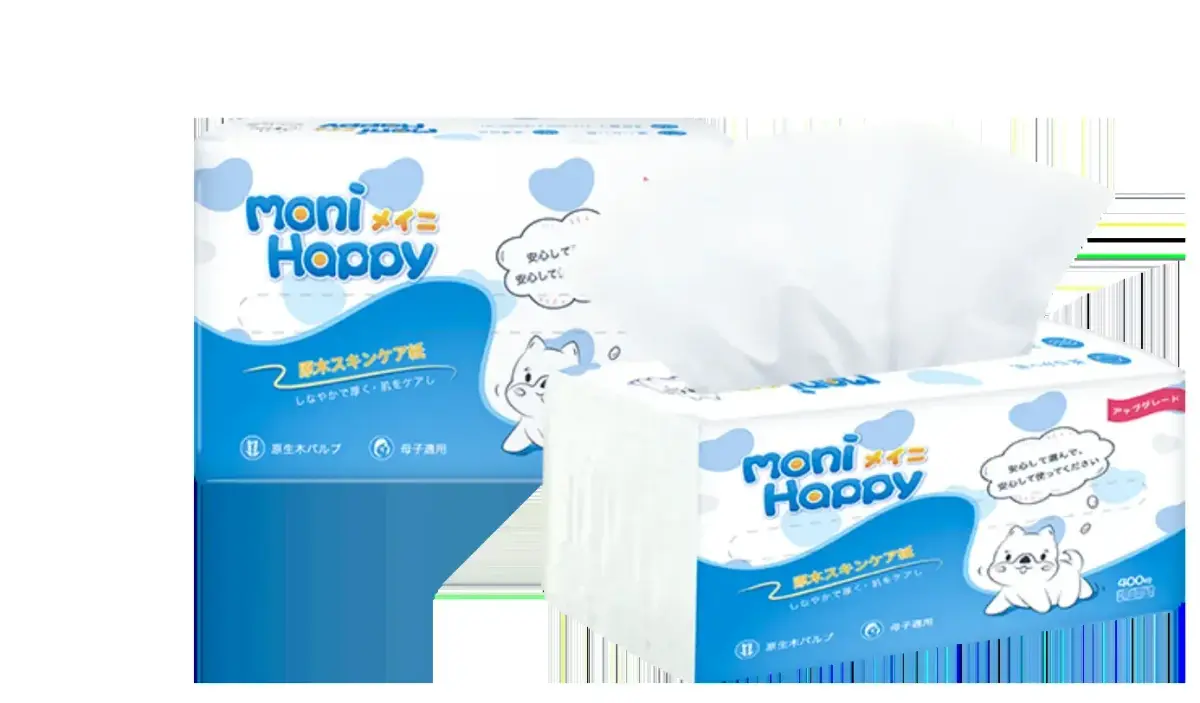
Facial tissue sheds lint because of what the sheet is made from, not how thick it is. Three sources account for most of the dust: short hardwood fibre that breaks free of the surface, mineral filler that powders out when the sheet is rubbed, and fibre torn loose at the cut edges. A 13 gsm two-ply sheet built from long fibre will test cleaner than an 18 gsm sheet loaded with filler, which is why grammage comparisons mislead buyers.
The commercial consequence is narrow but real. Lint ends up on spectacles, on dark clothing, on camera lenses and on the inside of a car windscreen. A retailer hears about it from customers, and the distributor hears about it from the retailer three weeks after the container has been paid for. By then the only remedy is a markdown.
Why does facial tissue shed lint on the shelf rather than in the box?
Because the sheet is only handled once it leaves the box. Fibre that is loosely bound at the surface stays put inside a compressed stack and releases the moment a sheet is drawn out and rubbed.
Two mechanisms do the work. Abrasion releases surface fibre that was never bonded into the sheet structure. Filler release happens when the mineral content is high enough that particles sit at the surface rather than inside the fibre network. Both are set at the paper machine and neither can be fixed downstream by packing, so a buyer who discovers the problem after arrival is buying the next container differently or not at all.
Humidity makes it worse. A sheet that has absorbed moisture from tropical air softens, and a softer sheet releases surface fibre more readily. That is one reason the same batch can feel acceptable in a dry, air-conditioned sample room and draw complaints in a humid store.
Which part of the sheet produces the dust?
The surface and the cut edge, in roughly equal measure. The middle of the sheet contributes very little.
A tissue sheet is creped, which means the surface is deliberately wrinkled to create bulk and softness. Those crepe folds are hills and valleys, and the tops of the hills carry fibre ends that are only partly bonded. Every rub works them loose. The cut edges are worse per unit area, because cutting slices through the fibre network and leaves loose ends pointing outward along every one of the four edges.
This explains a pattern buyers notice but rarely diagnose: a box of tissue that measures well on softness can still produce visible dust, because softness comes from exactly the surface structure that releases fibre. The specification has to balance the two rather than maximise one.
How do I test lint without a laboratory?
Rub the sheet on black cotton, collect what comes off, and weigh it. The method is crude, repeatable and sufficient to compare batches.
- Materials. Black cotton cloth, a 0.01 g scale, a fixed light source, and a template so the same area is rubbed every time.
- Method. Ten strokes back and forth under light finger pressure, folded side inward on the second half so both faces are sampled. Collect the debris onto the cloth, then brush it into the scale.
- Record. Write down the weight in grams per sheet, plus the batch code, the grammage from the carton and the ply count. Three numbers turn an opinion into a record.
- Compare. Against your approved reference sample, not against a theoretical figure. The reference sample is the whole point: it is the batch you accepted, and drift away from it is the signal.

Run the test on at least five boxes from three cartons across the container, and again after 30 days in your own store. A batch that passes on arrival and fails a month later has a moisture problem in the packaging rather than a fibre problem in the sheet.
Which numbers belong in the tissue supplier specification?
Four: fibre furnish, ash content, ply bond strength and moisture content. Together they cover the three lint sources and the humidity behaviour that makes them visible.
- Fibre furnish. Virgin pulp with a stated softwood share. Softwood fibre is longer and bonds better; a sheet built mostly from short hardwood fibre sheds more. Ask for the percentage, not the word virgin.
- Ash content. The mineral filler load, measured as a percentage of sheet weight. Higher ash means a brighter, smoother sheet and more dust. Ask for the tested value and the tolerance.
- Ply bond strength. Measured as the force needed to separate the plies. Edge-bonded construction releases the middle layer when a sheet is pulled; full-surface bonding does not.
- Moisture content. The equilibrium moisture of the sheet at packing. It sets how the sheet behaves in a humid store and how much the carton will lose or gain in transit.
Ask for these on the specification sheet for every article number, with tolerances. A tissue supplier that answers with a marketing brochure rather than a test table has told you something useful about how the first quality claim will go.
Is lint worse in a two-ply or a three-ply sheet?
It depends on the bond, not the count. A two-ply sheet with full-surface bonding usually outperforms a three-ply sheet where only the edges are bonded.
In an edge-bonded three-ply, the middle layer is held at the perimeter and free in the field. Draw a sheet from a box and the free middle layer separates slightly, releasing fibre along the fold. The construction is cheaper to run and it shows up in exactly the complaint pattern customers describe as dust from the middle of the sheet.
For a retail line, the practical rule is to specify ply bond strength and let the supplier choose the ply count that meets it. For a private requirement, ask to see the delamination test at the same time as the softness sample, because the two are usually tested separately and reported separately.
When is lint a claim rather than a preference?
When the batch exceeds a limit that was written into the order, tested by a method both sides agreed, on samples drawn from the delivered cartons.
Without that, a lint complaint is a negotiation rather than a claim, and negotiations over subjective quality are lost by the buyer. Three things make it enforceable: the limit, the method, and a retained reference sample signed at approval. Add the batch code to the reference sample and the trace runs back to a production window rather than to a container.
If you are choosing between suppliers and want the lint question answered before the first order, ask each one for the furnish, ash and ply bond figures alongside the price. The partner programme returns those with the quotation, and the facial tissue range lists the pack formats they apply to. For the wider set of clauses a first container needs, the onboarding guide covers the ordering sequence.
Frequently asked questions
Does a thicker facial tissue shed less lint?
Not reliably. Lint follows fibre length, filler load and how the sheet is creped and cut. A 13 gsm sheet built from long softwood fibre can test cleaner than an 18 gsm sheet with high filler. Ask for the furnish and the ash figure first.
How do I test lint without a laboratory?
Rub the sheet ten times across black cotton under light pressure, collect the debris on a 0.01 g scale, and compare against the batch you approved. Same cloth, same pressure, same stroke count, or the numbers are not comparable.
Is lint a valid reason to reject a container?
Only where the specification states a limit and the incoming test shows the batch outside it. Without a written limit, lint stays a subjective complaint. Put the figure and the method into the purchase order.
Which ply count sheds least?
Two-ply sheets with full-surface bonding usually beat three-ply constructions bonded only at the edges, because the unbonded middle layer releases fibre when the sheet is drawn out. Bond strength matters more than ply count.
Sources and further reading
- ISO/TC 6 (International Organization for Standardization): the technical committee behind the ISO 12625 series of test methods for tissue paper and tissue products.
- TAPPI (Technical Association of the Pulp, Paper and Paperboard Industry): standard test methods for pulp fibre, filler content and sheet strength used by tissue mills.
- FAO Forestry (Food and Agriculture Organization, current): pulp and paper fibre supply data behind furnish and recycled-content claims.
Bottom line
Lint is a specification outcome, not a softness defect. It comes from short fibre, mineral filler and cut edges, and it gets worse in humid air. Test it with a black cloth and a 0.01 g scale, write fibre furnish, ash content, ply bond strength and moisture into the order, and keep the reference sample that makes the number enforceable.
Frequently Asked Questions
Does a thicker facial tissue shed less lint?
Not reliably. Lint depends on fibre length distribution, filler load and how the sheet is creped and cut. A 13 gsm sheet built from long softwood fibre can test cleaner than an 18 gsm sheet with a high mineral filler load. Ask for the furnish and the ash figure before you compare grammage.
How do I test lint without a laboratory?
Rub the sheet ten times across black cotton under light finger pressure, collect the debris on a 0.01 g scale, and compare the result against the batch you first approved. Keep the same cloth, the same pressure and the same number of strokes, or the numbers are not comparable.
Is lint a valid reason to reject a container?
Only if the specification states a limit and the incoming test shows the batch outside it. Without a written limit, lint is a subjective complaint. Put a figure and a method into the purchase order, keep a reference sample, and the argument becomes a measurement.
Which ply count sheds least?
Two-ply sheets with a full-surface ply bond usually beat three-ply constructions where the plies are only edge-bonded, because the unbonded middle layer releases fibre when the sheet is pulled apart. Ply bond strength matters more than ply count.
Distributor resources
If you are evaluating suppliers for your market, these are the pages that answer the commercial questions — in the order buyers usually need them.
