
2026-11-10 · Moni Happy
Why does facial tissue freight depend on carton cube rather than weight?
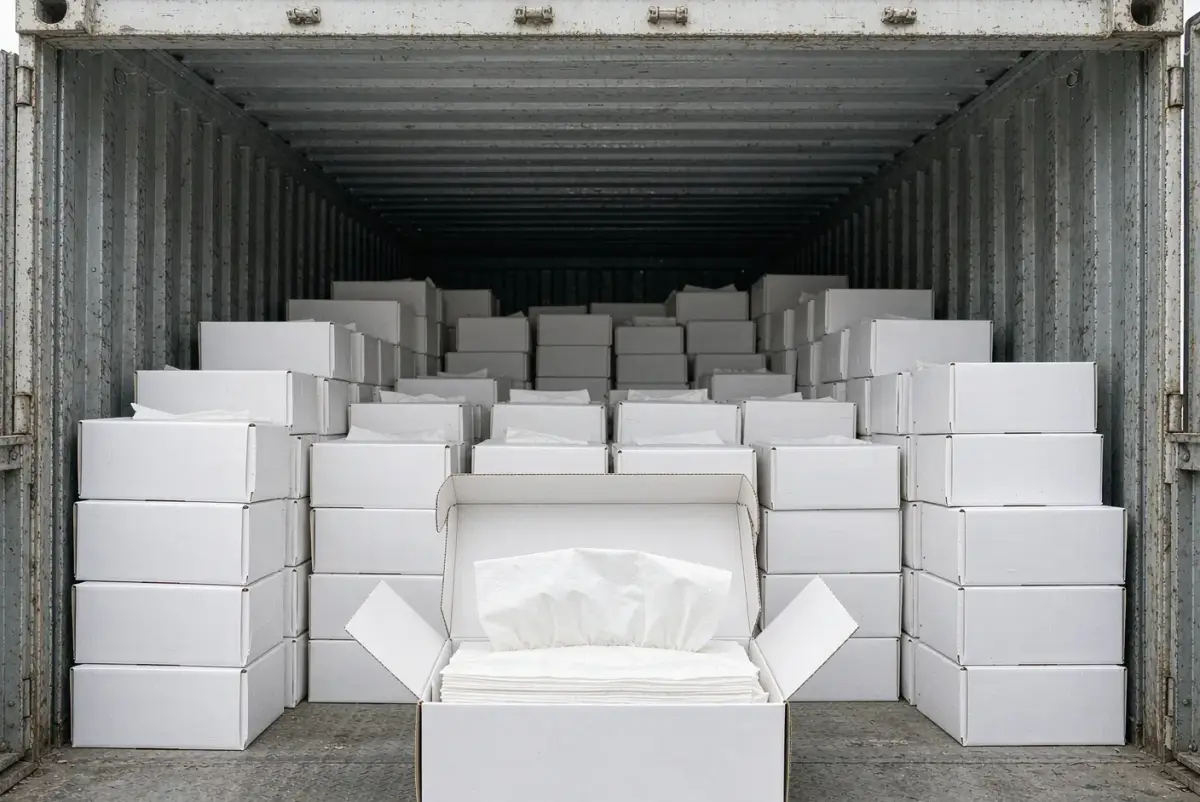
Because a facial tissue container runs out of space long before it runs out of weight. A 40-foot high cube holds roughly 65 to 68 cubic metres of usable volume and can legally carry around 26 tonnes, and a load of tissue cartons typically reaches the volume limit at roughly a quarter of that payload. Once the box is full, the only variable left is how many cartons fit inside it, which makes carton cube the single largest cost lever in the freight line.
This is the part of the quotation that buyers skim. The piece price looks like the price, the freight rate looks like a market number you cannot change, and the carton dimensions look like a detail the supplier decided. In practice the carton dimensions are the one part of the freight cost a buyer can still influence after the rate has been agreed.
Why does a tissue container fill up before it gets heavy?
Because tissue density is low and the product is packed with air for reasons of presentation rather than transport.
A cubic metre of packed facial tissue weighs a small fraction of a cubic metre of almost anything else on the same vessel, which is why the container fills at the ceiling rather than at the weight limit. The practical consequence is that a tissue shipment is priced as a volume shipment even when it moves as a full container, because the shipping line recovers its cost from the space the cargo occupies.
- Volume-limited cargo: the box is full at a fraction of the payload.
- Freight per carton: the container cost divided by the number of cartons inside it.
- The variable you control: cartons per container, which is a function of carton dimensions and how well the pack compresses.
Compare that with a shipment of baby diapers, which cubes out at a different ratio and carries a different piece value per cubic metre. The category sits on the same vessel at a very different freight per unit of value, and that is why a tissue line and a diaper line rarely share a sensible container plan.
What is chargeable weight and where does it bite?
It is the greater of actual weight and volume weight, and for tissue the volume figure always wins.
On a full container the concept matters less because the freight is a flat rate per box. On a part container it decides the invoice. Loose cargo is priced per revenue ton, where one cubic metre is treated as equal to one tonne, so a carton of tissue that weighs a few kilos but occupies a tenth of a cubic metre is charged as if it weighed a hundred kilos. That is a factor of ten, and it is why a part-container tissue order can be far more expensive per carton than the rate sheet suggests.
Air freight is worse. Chargeable weight there uses a volumetric divisor that makes a light carton several times heavier than it is, and tissue is one of the least suitable products for that mode. If a buyer is being pushed toward air freight to hit a launch date, the honest comparison is not freight cost against freight cost but landed cost per sheet against the cost of waiting four weeks.
How much does compression actually save per container?
A tenth off the carton volume is roughly a tenth more cartons at the same freight, which is the same as a tenth off the freight per carton.
Take a carton measuring 60 by 40 by 30 centimetres, which is 0.072 cubic metres. In a 40-foot high cube with about 65 cubic metres of usable space, that is roughly 900 cartons. If the same pack is compressed enough to bring the carton to 0.065 cubic metres, the container takes about 1,000 cartons. At a hypothetical $2,000 per container the freight per carton falls from about $2.22 to about $2.00, and every sheet in the shipment carries that reduction.
The saving is real but it is not free. Compression reduces loft, and loft is what a shopper reads as softness. A pack that has been squeezed to save cube may look flatter on the shelf than the sample the buyer approved, which is a commercial problem in a category where feel is the main differentiator. The correct approach is to agree the compression with the supplier and approve the pack at that compression, rather than approving a sample and discovering the shipping version later.
There is a second, quieter saving. Denser cartons stack better and crush less, so a compressed load usually arrives with fewer damaged units, which improves the saleable yield of the container without changing the freight rate at all.

Box or soft pack: which ships better?
The soft pack ships better and the box sells better, and most ranges need both.
A rigid box holds a fixed volume that cannot be reduced, and it protects the sheets inside it, which is why it survives handling and reads as premium on a shelf. A soft pack compresses, so more of them fit in the same container, and it costs less to make. In a market where the shelf is price-sensitive the soft pack wins on landed cost; in a gifting or premium position the box earns its freight.
The mistake is to treat the choice as a product decision made by the brand and a logistics decision made by the buyer. It is one decision. A buyer who takes the box format because it looks better and then discovers that the freight per carton is a third higher has made a margin decision on the brand's behalf. Ask for both configurations priced at the same container, converted to cost per thousand sheets, and choose with the whole number in view.
Pallet or floor-loaded?
Floor-loaded for cost, palletised for condition, and the answer changes with the destination warehouse.
A pallet occupies height and footprint that could hold cartons, and a palletised container typically carries noticeably fewer cartons than the same box floor-loaded. What the pallet buys is speed of handling at destination and less damage, because cartons are not passed by hand one at a time. In a market where labour is cheap and the warehouse is dry, floor loading usually wins on cost. In a market where the receiving bay is slow, or where the cartons will sit in a humid yard, the pallet earns its cube.
There is a third option that buyers often miss: floor-load the container and palletise at destination on a pallet the distributor already owns. It keeps the container cube, and it moves the pallet cost to a local line item that is far cheaper than the freight on the same volume.
How do I calculate freight per carton before quoting?
One division and one comparison, done before the price is agreed rather than after the invoice arrives.
- Get the carton dimensions in writing for the exact configuration being quoted, in centimetres, including any pallet overhang.
- Multiply to cubic metres per carton, and divide the usable container volume by that figure.
- Divide the container freight by the carton count to get freight per carton at that rate.
- Divide by the sheets per carton to express it per thousand sheets, which is the only figure that can be compared across pack formats.
Then run the same calculation for the alternative configuration the supplier has offered. In most negotiations the freight line is fixed by the market for that quarter; the carton is not. A supplier who can quote two carton configurations is giving you a real choice, and one who can only quote one is telling you that the packing line is not set up to change.
Why does this decide the minimum order?
Because below a container the freight curve turns against you, and the MOQ conversation is really a freight conversation.
Part-container cargo pays on revenue tons where volume is charged as weight, so the effective freight per carton rises steeply as the shipment shrinks. A first order of two hundred cartons can therefore carry a freight cost per carton several times the container rate, and that difference lands directly on the piece price. When a distributor asks why the trial order looks expensive, the answer is usually the ship, not the product.
The commercial conclusion is to set the minimum order at a container multiple rather than at a per-SKU minimum. Per-SKU minimums exist because the packing line has a setup cost, and they still apply, but the number that decides whether the order makes money is the container fill. If you are testing the facial tissue line and want the carton configuration and the container fill checked against the pack you intend to sell, apply as a partner and we will run the arithmetic with you. Partners in Malaysia and Thailand usually start with a part container and move to a full box once the pack format is settled.
Frequently asked questions
Does carton size affect the shelf price or only the freight?
Both. It changes freight per carton, and it changes how many cartons a store room can hold, which decides how much a retailer is willing to take in one delivery.
Can I mix tissue with another line in the same container?
Yes, and it is often the sensible route for a first order, because a mixed load fills the cube with more value per cubic metre. Check that the heavier line is not loaded on top of the tissue cartons.
What is a realistic carton weight for facial tissue?
Light, typically a small fraction of what the same volume of diapers weighs, which is exactly why weight-based thinking gives the wrong answer in this category. Ask the supplier for the gross weight per carton and compare it with the volume before modelling anything.
Should I buy on FOB or CIF for a volume-limited cargo?
FOB if you have a forwarder whose rates you trust, because the freight line is where the money is and you want to see it. CIF is simpler and hides the one number that matters most in this category.
Sources and further reading
- ISO 3394 - Dimensions of rigid rectangular packages, transport packages (ISO): the modular basis behind carton and pallet dimension planning.
- World Shipping Council (current): container weight verification and payload rules that set the upper limit a light cargo never reaches.
- Review of Maritime Transport (UNCTAD, annual): freight rate and container capacity context for the volumetric costing used here.
Bottom line
Facial tissue is charged for the space it occupies, not the weight it carries, so the freight per carton is decided by carton dimensions, pack compression and pallet height. A tenth less carton volume is roughly a tenth less freight per carton, and the same logic explains why a part container is so much more expensive per piece than a full one. Agree the compression with the supplier, price in cartons per container rather than in tonnes, and set the minimum order at a container fill.
Frequently Asked Questions
Does compression make the sheets worse?
It changes the hand feel. Compressing a pack reduces loft, and a flat pack reads as less soft on the shelf even when the sheet weight is identical. Test the pack at the compression you intend to ship rather than at the compression the sample was packed at.
Is a 40-foot container always cheaper per carton?
Usually, because the fixed costs of a sailing are spread over more cartons. It stops being cheaper when the volume forces you into stock you cannot sell in one season.
Do I pay freight on the pallet as well as the cartons?
Yes. Pallets occupy volume and add tare weight, so any palletised shipment carries less product than the same container floor-loaded. The pallet earns its cost back in damage prevention, not in freight.
How do I compare two quotations with different carton sizes?
Convert both to freight per carton at the same container and the same rate, then to cost per thousand sheets. A quotation that only states a piece price hides the difference the carton makes.
