
2026-11-01 · Moni Happy
Beyond the lab report: what else should a diaper wholesale buyer check on baby diapers?
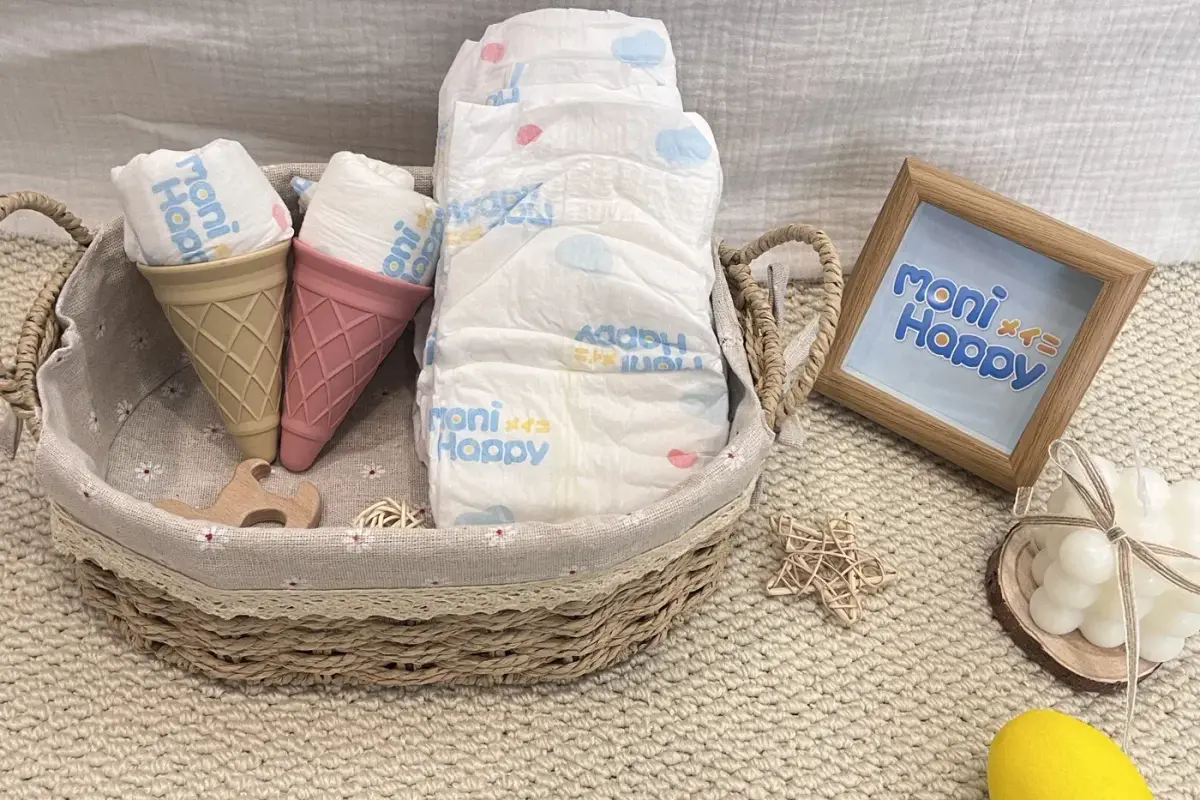
The absorption figure is the headline, not the whole specification. A diaper wholesale order also needs a structural check — surface layer, waistband, fasteners, wetness indicator, leak guards — and a packaging check covering date coding, pack count, carton print and pallet pattern. On baby diapers, those are the items a parent notices within a week and the items that fail quietly in a hot warehouse before anyone notices at all.
On baby diapers, rotational testing catches the first group; a warehouse inspection catches the second. Both are worth writing into the supply agreement, because neither is visible on the laboratory report you were sent.
What should you check on the skin-contact surface layer?
Look for a three-dimensional, hot-air bonded surface rather than a flat carded sheet, then test how it behaves when it is wet. A textured layer keeps less liquid in contact with skin and feels drier even when the core underneath is at the same saturation.
- Texture — a visible loft or dimple pattern, not a smooth film.
- Bonding — hot-air bonded surfaces resist fibre shedding better than glue-bonded ones.
- Wet feel — wet a sample and press it against the back of your hand; a well-built layer feels cool but not slick.
- Linting — rub a wet sample on dark cloth. Fibre transfer means the surface will pill against skin.
How do you test a waistband before you commit to a container?
Stretch and release it ten times, then check whether it returns to its original length. A high-elastic waistband should recover most of its stretch; a cheap one relaxes and starts to sag by mid-afternoon.
Two extra checks matter for the retail channel. First, does the waistband leave a mark on skin? Press it against your forearm for a minute and look. Second, does the elastic sit flat when the diaper is fastened, or does it roll? A rolled waistband is the most common fit complaint a distributor hears from a retail account, and it is visible before the container ships.
Why do fasteners and the wetness indicator decide repurchase?
Because both are used every single time the product is worn. A fastener that will not hold on the third refastening turns a premium pack into a frustrating one, and an indicator that does not change colour is worse than no indicator at all.
- Refasten ten times on the same landing zone and check that the hook material still grips.
- Check the landing zone for tearing — the film should not split when the fastener is peeled.
- Wet the indicator with saline and time how long the colour change takes, then check it is still visible through a vest or a babygrow.
- Look at the contrast in dim light, because night changes are made in dim light.
How tall should leak guards be, and how do you check them?
Measure them, then stress them, and write the height into the diaper specification rather than leaving it to the artwork. A double-layer three-dimensional guard of up to fifty millimetres gives a meaningful barrier against side leakage on a rolling baby; a short flat guard does not, whatever the pack says.
Measure the standing height with a ruler at three points along the leg opening, then fill the diaper and lay it on its side for ten minutes. A guard that collapses under the weight of the core is not doing the job its height suggests. Also check that the guard's elastic is continuous around the leg opening — a break at the seam is where leaks start.
Which packaging details cause the most chargebacks?
Date coding, pack count and carton print. Retailers reject on all three, and all three are cheap to get right at the factory and expensive to fix at the port.
- Date coding — legible production and expiry coding on every pack, in the position the retailer specified. Illegible or missing codes are an automatic rejection in modern trade.
- Pack count integrity — count three packs from the carton and confirm the printed count matches. Under-counting is the fastest route to a delisting.
- Carton print — registration, colour accuracy against the approved artwork, and the shipping marks the buyer specified.
- Pallet pattern — count and layer pattern as agreed, with corner protection and stretch wrap that survives a tropical transit.
Inspect all four on the pre-shipment inspection, not on arrival. Arrival is when you have the least leverage.
How do you check consistency between the sample and the production batch?
Keep a sealed, dated reference sample from the approval batch and open it beside a piece from the container. Compare surface texture, waistband stretch, guard height and print colour side by side and in daylight.
This single routine catches most silent downgrades, because cost reductions in this category usually show up as a thinner surface layer, a shorter guard or a lighter film, and the diaper specification is where you catch it, a shorter guard or a lighter film — all visible in a side-by-side comparison and all invisible on a specification sheet that was never updated. Photograph the pair and keep the photograph with the batch record.
What belongs in the supply agreement beyond the price?
Four clauses: the approved sample as the reference standard, a change-notification obligation, a claim window with an evidence requirement, and the right to inspect before shipment.
The change-notification clause is the one buyers forget in a diaper wholesale agreement. Without it, a supplier can alter the substrate or the SAP blend between batches and still meet the letter of a specification written a year earlier. With it, any change to materials or construction has to be notified and re-approved against the diaper specification — which is exactly the protection a distributor needs when a retail account has already approved the product on shelf.
How do these checks fit alongside the absorption tests?
They run in parallel, not afterwards. On baby diapers, absorption and rewet tell you whether the core performs; the structural and packaging checks tell you whether the product can be sold and repeated. A container that passes the first and fails the second is a container of returns.
The practical sequence for baby diapers on a first order is: approve a sample against the specification, run the absorption and thickness tests, run the structural checks above, then inspect the production batch against the sealed sample. Four steps, roughly a day of work, and it replaces most of the risk in a first diaper wholesale order. If you are still building the commercial model around that order, the price, MOQ and margin guide sets out how per-piece cost and container loading interact, and the pre-shipment inspection checklist covers what to require from the factory side of a diaper wholesale order.
Frequently asked questions
Which single check catches the most problems?
The sealed reference sample compared side by side with a piece from the shipping batch. It is cheap, it is fast, and it catches the silent downgrades that no diaper specification sheet records.
Are fifty millimetre leak guards necessary?
They matter most for overnight use and for babies who roll. Whether you need them at that height depends on your price position, but you should know the number rather than assume it.
What if the wetness indicator is a printed line rather than a strip?
Either construction works if it changes visibly and stays visible through clothing. Test the change time and the contrast rather than the format.
Do packaging checks apply to private-label orders too?
More so, because your brand is on the carton. Date coding, count accuracy and print registration are the three rejection reasons a private-label buyer can least afford.
Sources and further reading
- International Organization for Standardization, ISO 9001 quality management — the process baseline for batch consistency and change control.
- International Organization for Standardization, ISO 13485 medical devices — the quality-system model used by plants that also run sterile testing laboratories.
- EDANA, edana.org — absorbent hygiene product terminology and test methods.
Bottom line: the lab report covers the core, not the product. Put a caliper, a stopwatch and a sealed reference sample to work on the surface layer, waistband, fasteners, indicator, guards and packaging — then inspect the batch that actually ships. That routine is what separates a repeat order from a return.
Moni Happy's JSK01 line carries a 3D hot-air surface layer, pressure-free high-elastic waistband, hook-and-loop fasteners with a wetness indicator, and double-layer leak guards of up to 50 mm. Distributors in Malaysia, Singapore, Thailand, Vietnam and Laos can request a sample set and the full specification sheet, or review the diaper range and full product portfolio before shortlisting. Order quantities and pricing are confirmed per market, subject to formal quotation.
Frequently Asked Questions
Which single check catches the most problems?
The sealed reference sample compared side by side with a piece from the shipping batch. It is cheap, fast, and catches the silent downgrades that no specification sheet records.
Are fifty millimetre leak guards necessary?
They matter most for overnight use and for babies who roll. Whether you need them at that height depends on your price position, but you should know the number rather than assume it.
What if the wetness indicator is a printed line rather than a strip?
Either construction works if it changes visibly and stays visible through clothing. Test the change time and the contrast rather than the format.
Do these packaging checks differ by retail channel?
Yes, in detail rather than in principle. Modern trade specifies date coding position, carton marking and pallet pattern more tightly than traditional trade, so confirm the account requirement before the carton is printed.
Distributor resources
If you are evaluating suppliers for your market, these are the pages that answer the commercial questions — in the order buyers usually need them.