
2026-11-01 · Moni Happy
How do you test baby diapers for absorb speed and rewet before a diaper wholesale order?
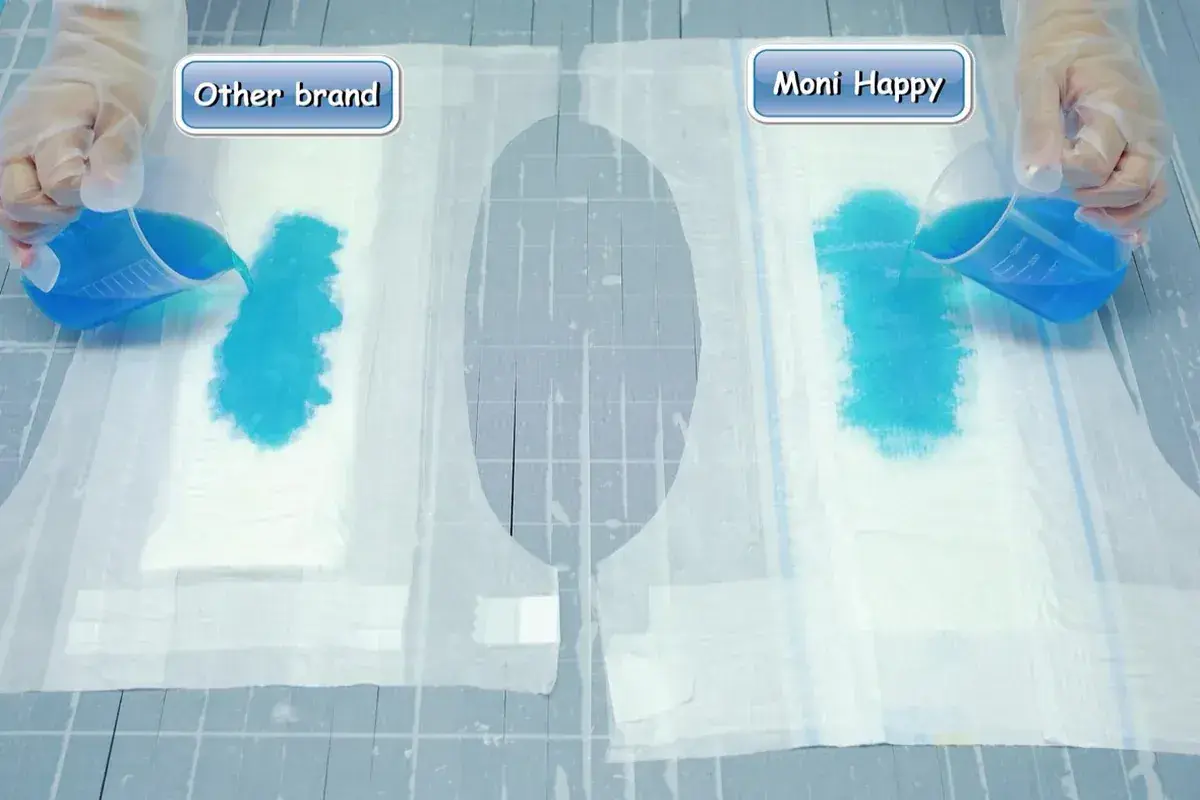
Two measurements settle most of the argument: how long a fixed dose of liquid takes to disappear from the surface, and how much of it comes back when you press. Both can be run in a warehouse in about twenty minutes per SKU with a stopwatch, a measuring cylinder, filter paper and a scale. Run them before a diaper wholesale order and you convert a supplier's adjective into a number you can hold in a purchase specification.
The method matters more than the equipment. On baby diapers, absorb speed and rewet are only comparable when the dose, the temperature, the waiting time and the applied load are identical between the sample and the reference. Change any one of those and you are measuring your own technique.
How do you run an absorb speed test without a laboratory?
Dose a fixed volume of saline onto the surface at the point of insult and time until the liquid stops pooling. A dose in the range of a heavy infant wetting, delivered through a short funnel to keep it repeatable, is enough to separate products.
- Condition the samples. Bring diapers and saline to room temperature for at least two hours; cold SAP behaves differently from warm SAP.
- Fix the geometry. Mark a dosing point about a third of the way from the front of the core, and use the same point on every sample.
- Dose and start the clock. Pour the same volume in the same time from the same height. A squeeze bottle and a funnel will give you different numbers; pick one and keep it.
- Stop the clock when the surface stops reflecting. That is the practical end point — the moment light no longer bounces off standing liquid.
- Record, then repeat. Three to five pieces per SKU, and report the median rather than the best run.
On a well-built core using Japanese superabsorbent polymer with a three-dimensional flow-guide structure, a dose of this size clears in the region of nine seconds. Ordinary cores hold the liquid at the surface visibly longer. The gap is the thing worth writing down, not the absolute number.
How do you measure rewet with filter paper and a weight?
Wait one minute after absorption, place filter paper of known dry weight on the surface, apply a fixed load for a fixed time, then weigh the paper again. The gain in grams is the rewet value.
- Weigh the dry filter paper to two decimal places and write the figure down. This is the only measurement that makes the test defensible. A rewet test is only as good as its weighing discipline, so write the dry weight down before the sample goes anywhere near liquid.
- Place it flat on the wetted area, centred on the dosing point, with no folding.
- Apply a fixed load — a weight you can reproduce, such as a stack of identical books or a calibrated plate — for a fixed time, typically a minute.
- Reweigh immediately and subtract the dry weight. Report grams, and report grams per the dose volume so different dose sizes remain comparable. Run the rewet test at the same dose you used for absorb speed, or the two numbers describe different experiments.
- Photograph the paper. A wet patch on filter paper is the most persuasive evidence in a claim conversation, and it costs nothing to capture.
A core with a dual water-lock structure and high SAP loading will leave the paper almost dry; a weak core leaves a visible mark. In a side-by-side comparison this is the difference a buyer can show a retail account without any technical explanation at all.
Which numbers belong in the purchase specification?
Write four: median absorb time at a stated dose, median rewet in grams at that dose, the dose volume itself, and the number of pieces tested. Without the last two the first two are not reproducible and cannot be enforced.
Set the acceptance limit from your own reference sample rather than from a published standard, because published standards for urine-absorbing products describe whole-product capacity under laboratory conditions and do not map directly to a retail diaper at a shelf price. Your reference sample — approved, sealed, dated — is the only benchmark the supplier has already agreed to meet, and the one a diaper wholesale agreement should name.
Why does SAP loading decide both numbers at once?
Because the superabsorbent polymer is doing the holding and the core structure is doing the routing. SAP absorbs and locks liquid under pressure; the flow-guide layer spreads the dose across the core so the SAP is used efficiently instead of being saturated in one spot.
That is why a heavy diaper with poor distribution can lose to a thinner one with good distribution. Grammage alone is a poor predictor — which is exactly why absorb speed and rewet are worth measuring rather than inferring from the pack.
How many samples do you need before you trust a result?
Five baby diapers per SKU is a sensible minimum for a purchase decision, and thirty is the point at which the numbers start behaving like statistics. For a first order, five is enough to catch the failure modes that matter: a core that splits, SAP that clumps to one side, or a surface that stays wet under load.
Test at least two baby diapers SKUs from the same supplier, not one. Consistency between SKUs is the cheapest available signal that the process is controlled, and inconsistency is the cheapest available warning that it is not.
What do these two tests not tell you?
They do not measure breathability, thickness, fit, or how the core behaves after repeated folding. Those need separate checks — a caliper reading and a water-bubble breathability rig cover thickness and airflow, and a simple fold-and-inspect routine covers delamination.
They also do not measure what happens in a real cot at three in the morning. Absorb speed and rewet are proxies, and honest ones, but pair them with a wear trial in your own market before you commit a second container.
How should a buyer document the test for a supplier conversation?
One page per SKU: product name and batch, dose volume, median absorb time, median rewet in grams, number of pieces, and photographs of the filter paper. Send it with the claim, not instead of it.
A diaper wholesale supplier responds to this because it is the same language the factory quality team already uses. A buyer who arrives with a documented protocol and a sealed reference sample is treated as a professional account rather than a price shopper — and in a category where freight is a large share of landed cost, that positioning is worth more than the last two cents on the invoice. If you are still assembling the commercial side of the order, the wholesale price and margin guide covers how per-piece cost, container loading and distributor margin fit together, and the onboarding guide sets out the sequence from sample approval to first purchase order.
Frequently asked questions
What dose volume should I use for a comparison test?
Pick one dose that represents a heavy single wetting for the size you are buying and keep it constant across every sample. Consistency of dose matters far more than the exact millilitre figure.
Is nine seconds a standard absorb speed?
No. It is a reference result from a specific core design under a specific dose. Published standards do not set a universal seconds target, so compare like for like against your own approved sample.
Can I test diapers without saline?
Water works but behaves slightly differently from saline, which is closer to urine in ionic strength. If you switch liquids between suppliers, you lose comparability — so choose one and stay with it.
Do these tests replace a factory audit?
No. They tell you what the product does; an audit tells you whether the plant can repeat it. Use the tests to decide what to audit and what to ask about.
Sources and further reading
- EDANA, edana.org — nonwoven and absorbent hygiene product test methods and industry terminology.
- International Organization for Standardization, ISO catalogue — including ISO 11948-1 for whole-product absorption testing of urine-absorbing aids.
- International Organization for Standardization, ISO 9001 quality management — the process baseline that makes a repeatable result plausible.
Bottom line: time the dose, then run the rewet test on weighed filter paper. Two numbers, one sealed reference sample and a photograph will settle more supplier conversations than any brochure. Test five pieces per SKU, write the dose into the record, and hold the next container to the same protocol.
Moni Happy's JSK01 core uses Japanese-imported superabsorbent polymer with a patented flow-guide structure (patent ZL 2023 2 3249865.5). Distributors in Malaysia, Singapore, Thailand, Vietnam and Laos can request a sample set and test protocol, or review the tape diaper range before shortlisting. Order quantities and pricing are confirmed per market, subject to formal quotation.
Frequently Asked Questions
What dose volume should I use for a comparison test?
Pick one dose that represents a heavy single wetting for the size you are buying and keep it constant across every sample. Consistency of dose matters far more than the exact millilitre figure.
Is nine seconds a standard absorb speed?
No. It is a reference result from a specific core design under a specific dose. Published standards do not set a universal seconds target, so compare like for like against your own approved sample.
Can I test diapers without saline?
Water works, but behaves slightly differently from saline, which is closer to urine in ionic strength. Switching liquids between suppliers destroys comparability, so choose one and stay with it.
Do these tests replace a factory audit?
No. They tell you what the product does; an audit tells you whether the plant can repeat it. Use the tests to decide what to audit and what to ask about.
Distributor resources
If you are evaluating suppliers for your market, these are the pages that answer the commercial questions — in the order buyers usually need them.
