
2026-10-10 · Moni Happy
How to Choose a Baby Diaper Manufacturer: Due Diligence Checklist
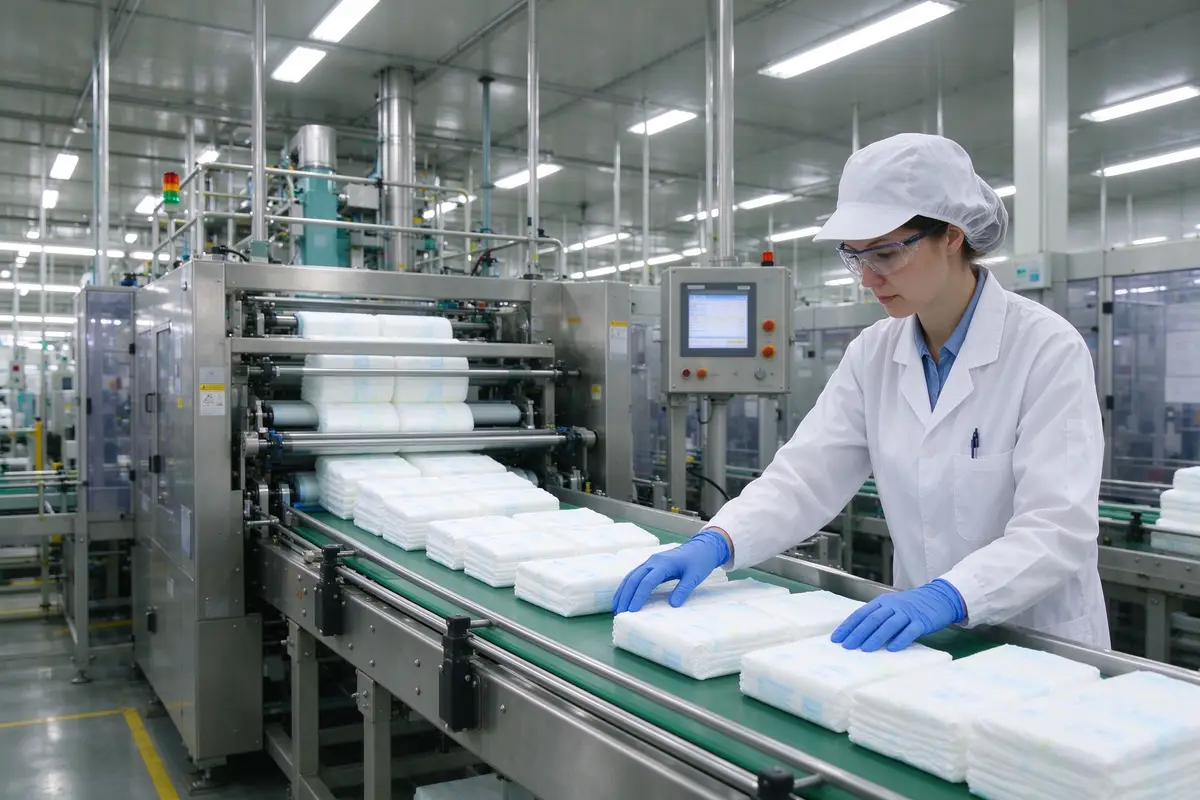
To choose a baby diaper manufacturer, run a structured 12-point due diligence rather than comparing price lists: verify ISO 9001 and dermatological certifications, audit the factory (in person or via a third-party inspector), confirm annual capacity and a 30-45 day production lead time, check the MOQ (usually one 20GP), review batch quality-control records and defect rates, confirm IP and trademark ownership, call 2-3 existing customer references, and put exclusivity, MOQ, rebates and defect-replacement terms in a written contract. Never choose a manufacturer on price alone — a US$0.01 cheaper per-piece price that comes with a 5% defect rate or a 60-day lead delay costs far more than it saves.
- 12-point due diligence: certifications, factory audit, capacity, lead time, MOQ, quality control, IP/trademarks, references, contract terms, payment, logistics, after-sales.
- Minimum certifications: ISO 9001; premium: Dermatest or equivalent independent dermatological testing; SGS/Intertek test reports.
- Production lead time: 30-45 days for a standard 20GP is reliable; over 60 days is a red flag.
- MOQ: typically one 20GP for branded distribution; OEM/private label MOQ may be higher (2-3 containers per SKU).
- Defect rate: a well-run factory should report under 1% AQL critical defects and under 2.5% major defects per batch.
- Third-party audit: SGS, Bureau Veritas or Intertek can conduct factory audits and pre-shipment inspections if you cannot visit.
- Moni Happy operates an ISO 9001-certified supply chain with Dermatest-tested products; request the audit summary at moni-happy.com/partner.

This is the supplier-selection chapter of the how to become a baby diaper distributor; when researching how to choose baby diaper manufacturer, run this checklist before paying any deposit. After choosing a manufacturer, use the distribution agreement key terms for contract terms and the import documents and certification checklist for import documentation.
What certifications should a baby diaper manufacturer have?
Start with the documents that prove the factory can consistently produce safe product, not the marketing brochure. The minimum certification is ISO 9001 (ISO 9001 quality management system), which demonstrates that the factory has documented quality processes. For premium diaper positioning, also require independent dermatological certification such as Dermatest (the 5-Star Excellent rating is the highest tier), plus product safety test reports from a recognized laboratory such as SGS or Intertek covering absorbency, pH, formaldehyde, heavy metals and microbiological safety. When learning how to choose baby diaper manufacturer, the certificate documents — not just logos on a website — are what matter. If a manufacturer cannot provide the actual certificate documents (not just a logo on a website), treat that as a disqualification — certificates can be verified directly with the issuing body.
Should I audit the factory in person?
An in-person factory audit is the gold standard for a first order, because it lets you see the production line, raw material storage, quality-control lab and warehouse conditions directly. If travel is not feasible or cost-effective for a first container, hire a reputable third-party inspection company — SGS, Bureau Veritas, Intertek or TÜV — to conduct a factory audit (typically US$300-800) and a pre-shipment inspection (typically US$150-300 per shipment) on your behalf. A factory that refuses a third-party audit or insists on 'trust us' is not a factory you should wire a deposit to. During the audit, check: clean and organized production lines, raw material storage with FIFO rotation, an in-house QC lab with testing equipment, trained workers in uniforms and hairnets, and finished-goods storage that protects cartons from moisture and dust.
What production capacity and lead time should I expect?
Ask for the factory's annual production capacity in pieces (not 'we have many machines') and their current utilization rate — a factory running at 95% capacity cannot guarantee your lead time during peak season. A reliable manufacturer should produce a standard 20GP order in 30-45 days from deposit confirmation and artwork approval. Lead times consistently over 60 days, or vague answers like 'about 2 months, depends on the schedule', indicate capacity constraints or poor production planning. Also ask about peak-season capacity: diaper demand spikes before major shopping festivals (11.11, 12.12, Ramadan, Tet), and a factory that cannot reserve capacity for your order during these periods will cause stock-outs. See the factory-to-Southeast-Asia lead time guide for the full factory-to-delivery timeline.
What MOQ and pricing structure should I look for?
The standard MOQ for branded distribution is one 20GP container (about 48,000 diapers), but OEM or private-label orders often require 2-3 containers per SKU because the factory must set up custom printing plates and produce dedicated packaging. When comparing pricing, always ask for the price breakdown: FOB unit price per piece, packaging cost per carton, printing plate fee (for OEM), and whether the price includes any free replacement for defective goods. A quote that is US$0.01 cheaper per piece but charges a US$2,000 printing plate fee and offers no defect replacement is more expensive than a slightly higher quote with plates included and a 1% free-replacement allowance. Use the wholesale price, MOQ and margin guide to model the total landed cost, not just the FOB unit price.
How do I evaluate the manufacturer's quality control?
Ask for three specific QC documents before placing an order: (1) the factory's AQL (Acceptable Quality Limit) standard — a well-run factory uses AQL 2.5 for major defects and AQL 4.0 for minor defects, with critical defects at AQL 0; (2) the batch inspection records for the last 3-6 months, showing defect rates by category; and (3) the incoming raw material inspection procedure, including how often SAP (superabsorbent polymer), nonwoven fabric and adhesive are tested. A factory that cannot produce these documents is relying on luck, not process. Also ask about the defect-replacement policy: will they replace defective goods free of charge in the next container, issue a credit note, or require you to ship the defects back? Get this in writing — see the damaged shipment claims guide.
What IP and trademark issues should I check?
If you are distributing an existing brand (such as Moni Happy), confirm that the manufacturer owns the trademark in your target country and that you receive a written authorization letter naming your company as the authorized distributor for that territory. If you are doing OEM or private label, confirm that the factory will not use your design, artwork or brand for other customers, and that the contract includes an IP ownership clause and a non-compete period. Trademark squatting is a real risk in Southeast Asia — search the national trademark registry (for example the Philippine IPOPHL or the Thailand DIP) before you invest in marketing a brand. The distribution agreement key terms covers the IP and exclusivity clauses that should be in every distribution contract.
Should I ask for customer references?
Yes — always ask for 2-3 existing customer references in your region or a comparable market, and call them. Ask specific questions: Does the factory meet lead times? What is the actual defect rate? How does the factory handle complaints and replacements? Is the pricing stable or does it change every quarter? Would they order again? A manufacturer that cannot provide references, or only provides references that are clearly friends or family, is a risk. Also check online reviews and B2B platform ratings (Alibaba, Global Sources) — but treat these as supplementary, not definitive, because reviews can be manipulated.
Which model is right for me: OEM, private label or branded distribution?
Three models exist, and the choice depends on your capital, marketing capability and risk tolerance:
- Branded distribution: you sell an existing manufacturer's brand as an authorized distributor. Lowest MOQ (one 20GP), fastest launch, existing certifications and marketing materials, but you share the brand with other distributors and your margin is set by the supplier. Best for first-time distributors.
- Private label: the factory offers stock designs you brand as your own. Medium MOQ (2-3 containers per SKU), you own the brand and set the retail price, but you must fund all marketing and certification. Best for distributors with existing channel relationships.
- OEM / custom: you supply the full design, formulation and artwork, and the factory produces it. Highest MOQ and setup cost, maximum control and margin, but also maximum risk — you own every quality issue. Best for established brands with in-house product development.
Most first-time distributors should start with branded distribution, prove sell-through in their market, and then consider private label once they have 6-12 months of sales data and channel relationships.
Moni Happy operates an ISO 9001-certified supply chain with Dermatest 5-Star Excellent tested products, full NB-XXL size ladders for tape diapers and pull-up pants, and a written authorized-distributor program with exclusivity, rebates and defect-replacement terms. If you are evaluating how to choose baby diaper manufacturer, request the factory audit summary, certification documents and distributor agreement at moni-happy.com/partner.
Frequently asked questions
Sources and further reading
- ISO — ISO 9001 quality management systems standard
- Dermatest — independent dermatological product certification
- GS1 — global supply chain and product identification standards
Commercial figures are indicative planning ranges and subject to a formal quotation; statutory rates must be confirmed with a licensed customs broker.
Bottom line: When deciding how to choose baby diaper manufacturer, run a 12-point due diligence — certifications (ISO 9001 + Dermatest), third-party factory audit, capacity and 30-45 day lead time, one-20GP MOQ, AQL-based QC records under 1% critical defects, IP and trademark verification, 2-3 customer references, and a written contract covering exclusivity, rebates and defect replacement. Start with branded distribution for the lowest risk, and never choose on price alone.
Frequently Asked Questions
What certifications should a baby diaper manufacturer have?
At minimum ISO 9001 for quality management; for premium positioning also look for independent dermatological certification such as Dermatest, plus relevant food-contact or skin-safety test reports from SGS or Intertek.
Should I visit the factory in person before placing a first order?
An in-person audit is ideal for a first order, but if travel is not feasible, hire a reputable third-party inspection company (such as SGS or Bureau Veritas) to conduct a factory audit and pre-shipment inspection on your behalf.
What is a good production lead time for a baby diaper manufacturer?
A reliable manufacturer should produce a standard 20GP order in 30-45 days from deposit confirmation; lead times consistently over 60 days or vague 'about 2 months' answers indicate capacity or scheduling problems.
What is the difference between OEM, private label and branded distribution?
OEM means you supply the design and brand; private label means the factory offers stock designs you brand; branded distribution means you sell an existing manufacturer's brand as an authorized distributor. Each has different MOQ, cost and IP implications.
