
2026-11-15 · Moni Happy
Which size chart lines does a diaper wholesale buyer renumber for pull up pants?

Renumber five lines, not one: weight band, rise, core offset, leg opening and pieces per pack. A tape diaper in L and a pull up pants in L are not the same garment worn two ways, and a diaper wholesale buyer who treats them as one will reprint the film twice. The pant has an elastic waist instead of tapes, the absorbent core sits 20mm to 30mm further forward to sit under a standing child, and the same printed letter covers a different weight bracket. Buyers who copy the tape chart onto a pants order see the mistake as a return in week three, when the first mothers bring packs back.
Why does a pull up pants chart need its own numbering?
Because the fit reference point moves. A tape diaper is sized on the waist circumference, and the tapes let an adult close it anywhere in a 6cm range. A pant is sized on the hip and the rise, and the waistband does the closing on its own. Two garments with identical waist measurements can fit completely differently once one has to be pulled over a hip.
That single difference changes what the letter on the pack means. It also changes how a diaper wholesale buyer should read a supplier's size sheet, because most sheets were built for the tape line first and the pants column added later.
Which measurements move when the pant replaces the tape?
Measure these five on your own sample, not from a PDF.
- Waist, relaxed and stretched. Both numbers matter. A pant that stretches to 52cm but relaxes to 38cm will slide down on a slim child, and no chart shows that unless you write both.
- Rise, front and back. Pants carry a higher back rise than the tape equivalent, because nothing holds the front up except the waistband.
- Core offset. The absorbent pad sits forward of centre. If a buyer reuses a tape diaper core position, the pad ends up under the wrong part of the child.
- Leg opening at rest. Pants rely on a snug cuff, not on tapes pulling the whole garment tight. A 3mm difference here is a leak complaint.
- Pieces per pack at the same weight band. Pants are bulkier, so a pack that held 68 tape diapers will hold fewer pants at the same shelf footprint.
What do the printed letters on a pack actually promise?
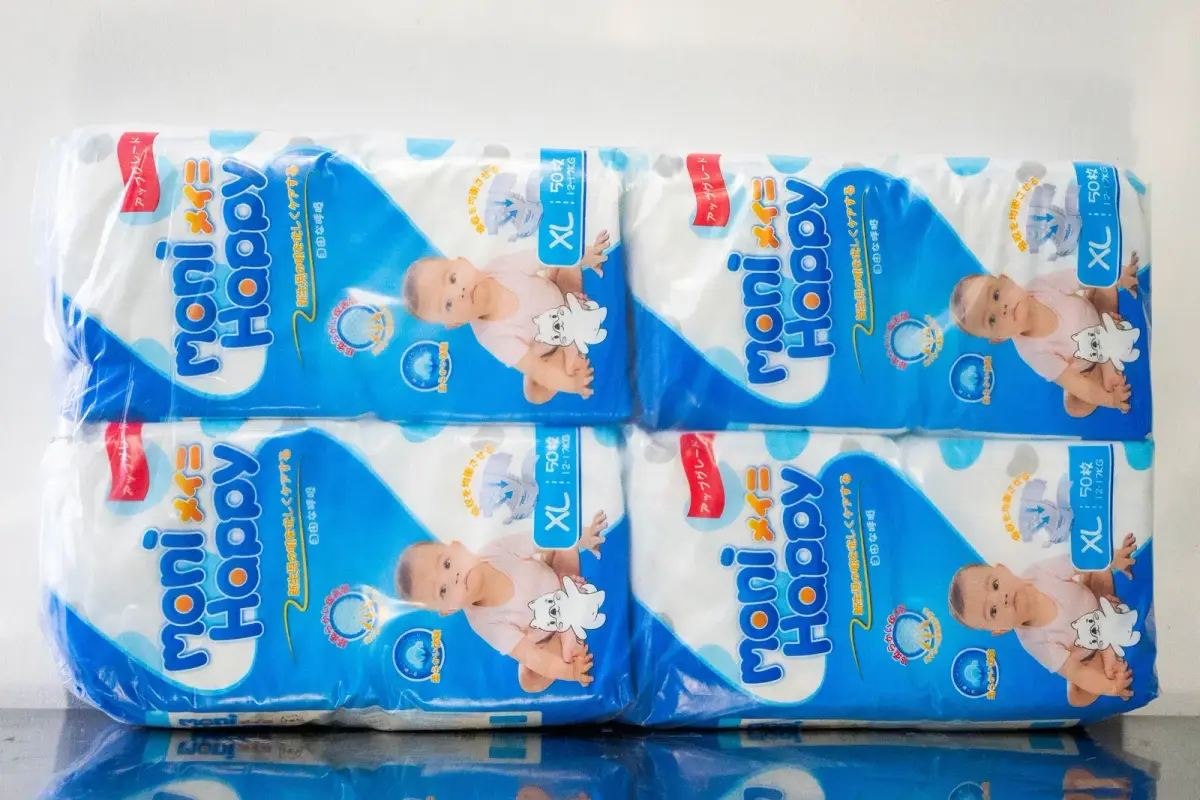
A weight band and a piece count, and both are contractual once the buyer approves the artwork. On the packs we ship, the small sizes run at 68 pieces for 2 kg to 8 kg, the XL runs at 50 pieces for 12 kg to 17 kg, and the XXXL runs at 40 pieces from 17 kg upward. Those three numbers are the ones a store buyer checks against a competitor pack on the same shelf, and they are the ones a printer file has to carry exactly.
A diaper wholesale buyer who keeps the letters but changes the underlying band has created a pack that cannot be compared, which is the fastest route to a listing rejection.
How much of a size chart error reaches the returns desk?
Enough to notice. A fit complaint is not a defect claim, so it rarely shows up in a quality report, and that is what makes it expensive. The store takes the pack back, the distributor credits it, and the cost lands in the gap between two accounting lines.
Three signals tell you the chart is wrong rather than the product: returns cluster in one size letter, complaints mention leaking at the leg rather than at the waist, and the same complaint arrives from two different accounts within a month. If all three appear, stop the reprint and re-measure. A pant that leaks at the leg on a 9 kg child is usually an opening measurement problem, not a core problem.
What test run proves the new chart before a full container?
Fifty pieces, ten children, four weeks. Recruit through two stores in the target market, hand out free packs in the disputed size, and collect a photo and a weight at the end of each week. Do not run the trial on a single child, and do not run it in one household with siblings of different ages, because the waistband will be blamed for everything.
Two outcomes end the trial early: a red mark that lasts more than two hours after removal, or a leg leak that repeats on three children. Either one sends the chart back for rework before a 20GP is committed. A 20GP of pants carries 40,000 to 46,000 pieces against roughly 48,000 tape pieces, so the reprint is cheaper than the container.
How should a first order split across pant sizes?
Weight the split toward the middle sizes, not the newborn end. A first pants order that mirrors a tape split will over-buy the smallest size, because parents move a child into pants later than they move into tape.
- Small sizes, 15% of the order.
- Middle sizes, 55% of the order, split across two letters.
- Large and extra large, 30% of the order.
Hold the top size at a low piece count per pack, and keep the pull up pants chart in a separate document from the tape one, with its own sign-off. It sells slowly and it takes shelf space that the middle sizes need. If you want the version of this split that includes carton configuration, the sizes and MOQ walkthrough takes it further.
What has to change on the printer file before the second run?
Three things, and only three: the weight band, the piece count, and the size row on the side panel. Everything else on the artwork should stay frozen, because every change costs a plate and a proof cycle.
Ask for a printed proof on the actual film, not a PDF. The size row is small type, often 6pt, and it is the first thing to smear. A buyer who approves the size row on a PDF has approved something the printer has not yet proven it can print.
If you are moving a tape diaper line into pants for the first time, request pricing and free samples and specify the weight bands you intend to sell, not just the letters. We will send the sample set matched to those bands, and the onboarding guide covers the artwork approval step in sequence.
Frequently asked questions
Can a distributor use one size chart for tape diapers and pants?
No. The waist is elastic on one and taped on the other, so the reference measurement differs. Keep two charts and print the weight band on both.
Is it cheaper to print one size row across both lines?
It looks cheaper and it is not. A shared row forces one line to carry a band it does not fit, and the cost comes back as fit returns that no quality report captures.
How many sizes should a first pants order carry?
Four to five, weighted to the middle. Carrying six sizes in a first container spreads the volume too thin to hold a shelf position.
Does piece count per pack change between tape and pants at the same weight?
Yes, it drops. Pants take more volume per piece, so the same pack format holds fewer units, and the pack price has to reflect the lower count.
Sources and further reading
- International Organization for Standardization, ISO 2859-1:1999, attribute sampling for pre-shipment inspection of a pants order, iso.org.
- Dermatest, skin compatibility testing methodology, the 24, 48 and 72 hour patch protocol behind the seal on our packs, dermatest.de.
- ASEAN Secretariat, ASEAN Tariff Finder, duty classification differences between diaper and pants lines, tariff-finder.asean.org.
Bottom line: treat the pants chart as a new document with five lines to sign off, measure the sample instead of the PDF, and run 50 pieces through ten children before the container. The letter is marketing; the weight band and the piece count are the contract.
Frequently Asked Questions
Which lines change when a tape diaper chart becomes a pull up pants chart?
Five: weight band, rise, core offset, leg opening and pieces per pack. The printed letter usually stays, which is why the error is easy to miss.
Where does the core sit on a pull up pant?
Further forward than on a tape diaper, because the child is standing when the pant goes on. Reusing a tape core position puts the pad under the wrong part of the body.
How many pieces go into a fit trial before a container order?
Fifty pieces across ten children for four weeks. Stop early if a red mark lasts more than two hours or a leg leak repeats on three children.
Does the piece count per pack drop on pants?
Yes. Pants take more volume per piece, so the same pack format carries fewer units and the pack price follows the lower count.
Distributor resources
If you are evaluating suppliers for your market, these are the pages that answer the commercial questions — in the order buyers usually need them.
