
2026-08-28 · Moni Happy Editorial Team
Complete Newborn Care Guide: Feeding, Diapering, Bath & Sleep Tips
Newborn Care Basics: What Every Parent Should Know
Bringing a newborn home is one of the most exciting - and overwhelming - moments in a parent's life. In the first few weeks, your baby will seem to do little more than eat, sleep, and cry, but these early days are crucial for their growth and development. This complete newborn care guide covers everything you need to know to care for your baby with confidence, from feeding and diapering to bathing, sleep, and developmental milestones.
Every baby is unique, and there's no single "right" way to care for a newborn. Trust your instincts, ask for help when you need it, and remember that it's okay to make mistakes - you're learning together with your baby. If you ever have concerns about your baby's health or development, don't hesitate to contact your pediatrician.
In Southeast Asia's tropical climate, newborn care comes with unique considerations - from keeping your baby cool and comfortable in hot weather to protecting them from strong sun and mosquitoes. This guide includes region-specific tips to help you navigate newborn care in a warm, humid climate.
Feeding Your Newborn: Breastfeeding, Formula & Combo
Feeding is one of the most important aspects of newborn care - and often one of the most challenging. Whether you choose to breastfeed, formula-feed, or combine both, the most important thing is that your baby is getting enough nutrition to grow and thrive.
Breastfeeding Basics
Breast milk is the ideal nutrition for most babies, providing antibodies, enzymes, and hormones that formula cannot replicate. For the first few weeks, breastfed babies typically feed 8-12 times per day (every 2-3 hours). Watch for feeding cues: rooting (turning the head toward the breast), lip smacking, hand sucking, and fussiness. Crying is a late hunger cue - try to feed before your baby gets to that point.
A proper latch is essential for effective breastfeeding and preventing sore nipples. Your baby should take in a large mouthful of breast tissue, not just the nipple. If you're experiencing pain or difficulty latching, contact a lactation consultant - most breastfeeding challenges can be overcome with the right support.
Formula Feeding
Formula feeding is a safe and healthy alternative to breastfeeding. Choose an iron-fortified infant formula appropriate for your baby's age. Newborns typically drink 60-90ml (2-3 ounces) per feeding, every 3-4 hours. Always follow the manufacturer's instructions for mixing formula - never dilute or concentrate it beyond the recommended ratio. Use clean, boiled water cooled to room temperature, and discard any unused formula within 1-2 hours of preparation.
Combination Feeding
Many parents choose to combine breastfeeding and formula feeding. This can be a practical solution for working parents, mothers with low milk supply, or families who want the flexibility of both methods. If you're combination feeding, introduce formula gradually to allow your baby's digestive system to adjust. Continue breastfeeding as often as possible to maintain your milk supply.
Signs your baby is getting enough to eat: At least 6 wet diapers per day after the first week, regular bowel movements, steady weight gain (about 15-30g per day after the first week), and your baby seems satisfied after feeding. If you're concerned about your baby's weight gain or feeding patterns, consult your pediatrician.
Diapering 101: Tape Diapers, Sizes & Changing Routine
Newborns go through a lot of diapers - 8-12 per day is normal in the first few months. Choosing the right diaper and establishing a changing routine is essential for your baby's comfort and for preventing diaper rash.
Choosing the Right Diaper
For newborns, tape-style diapers are generally preferred over pull-up pants. Tape diapers are easier to put on a newborn who can't stand yet, and they allow for a more customized fit. Look for diapers with a soft, breathable topsheet, an absorbent core, and a wetness indicator. Moni Happy baby diapers feature a 3D cloud-soft topsheet, an ultra-thin 0.1cm breathable core, and premium Japanese SAP for 9-second instant absorption - perfect for keeping your newborn's delicate skin dry and comfortable.
Diaper Sizes
Diaper sizes are based on weight, not age. Newborn (NB) size typically fits babies 2-5kg (4-11 lbs), Size 1 fits 4-6kg (8-14 lbs), and so on. Always check the weight range on the package, and don't be afraid to size up if the diaper seems too tight or your baby is between sizes. A properly fitting diaper should fit snugly around the waist and thighs without leaving red marks, and the top of the diaper should sit just below your baby's belly button (especially important until the umbilical cord stump falls off).
Changing Routine
Change your baby's diaper frequently - at least every 2-3 hours, and immediately after bowel movements. Before each change, gather all supplies within arm's reach: clean diaper, wipes, diaper cream (if needed), and a changing mat or towel. Never leave your baby unattended on a changing table - even newborns can wiggle and fall. Use Moni Happy baby wet wipes for gentle, effective cleaning - made with 99% pure water and 8-stage EDI filtration, they're gentle enough for newborn skin.
Bathing Your Newborn: Sponge Bath to Tub Bath
Bathing a newborn can be intimidating at first, but with practice, it becomes an enjoyable bonding experience. Until your baby's umbilical cord stump falls off (usually 1-3 weeks after birth), stick to sponge baths. Once the stump is gone and the navel is healed, you can transition to tub baths.
The ideal bath temperature is 37-38°C (98.6-100.4°F) - test with your elbow or a bath thermometer. The room should be warm and free of drafts. Gather all supplies before you start, and never leave your baby unattended in the bath, even for a second. Keep baths short - 5-10 minutes is plenty for a newborn, as prolonged exposure to water can dry out their delicate skin.
For a detailed step-by-step guide to bathing your newborn, including sponge bath techniques, tub bath transition, and post-bath care, read our complete newborn bathing guide.
Newborn Sleep: How Much, Schedules & Safe Sleep
Newborns sleep a lot - 14-17 hours per day is typical - but not in long stretches. Most newborns wake every 2-4 hours to feed, and their sleep cycles are much shorter than adults'. It's normal for newborns to have their days and nights mixed up initially - this usually resolves by 6-8 weeks of age.
Safe Sleep Guidelines
Following safe sleep guidelines is crucial for reducing the risk of SIDS (Sudden Infant Death Syndrome):
- Always place your baby on their back to sleep
- Use a firm, flat sleep surface (crib, bassinet, or play yard with a tight-fitting sheet)
- Keep the crib free of loose bedding, pillows, bumper pads, and stuffed animals
- Consider using a wearable blanket or sleep sack instead of loose blankets
- Room-share (keep your baby's crib in your room) for the first 6-12 months
- Avoid overheating - dress your baby in no more than one layer more than an adult would wear
- Don't let your baby sleep in car seats, swings, or bouncers for prolonged periods
Establishing a Bedtime Routine
While newborns don't have a set schedule, you can start establishing a calming bedtime routine from the beginning. A typical routine might include: a warm bath, a gentle massage, fresh diaper and pajamas, a feeding in a dimly lit room, and a lullaby or white noise. Keep the routine consistent and calm - this signals to your baby that it's time to sleep. In hot weather, use a fan to circulate air (not blowing directly on the baby) and keep the room well-ventilated.
Umbilical Cord Care & Healing Timeline
The umbilical cord stump is the remaining piece of the cord that connected your baby to the placenta during pregnancy. It will dry out, turn black, and fall off on its own - usually within 1-3 weeks after birth. Until it falls off and the navel is completely healed, proper care is essential to prevent infection.
Cord Care Tips
- Keep the stump clean and dry - expose it to air as much as possible
- Fold the top of your baby's diaper down below the stump to keep it dry and prevent irritation
- Sponge bathe your baby until the stump falls off - don't submerge it in water
- Don't pull or pick at the stump - let it fall off naturally
- Watch for signs of infection: redness, swelling, foul-smelling discharge, bleeding, or your baby seems to be in pain when the area is touched
After the stump falls off, the navel may have a small amount of blood or clear discharge - this is normal. Continue to keep the area clean and dry for a few more days until it's completely healed. If you notice any signs of infection or if the stump hasn't fallen off after 3 weeks, contact your pediatrician.
Baby Skin Care: Preventing Diaper Rash & Eczema
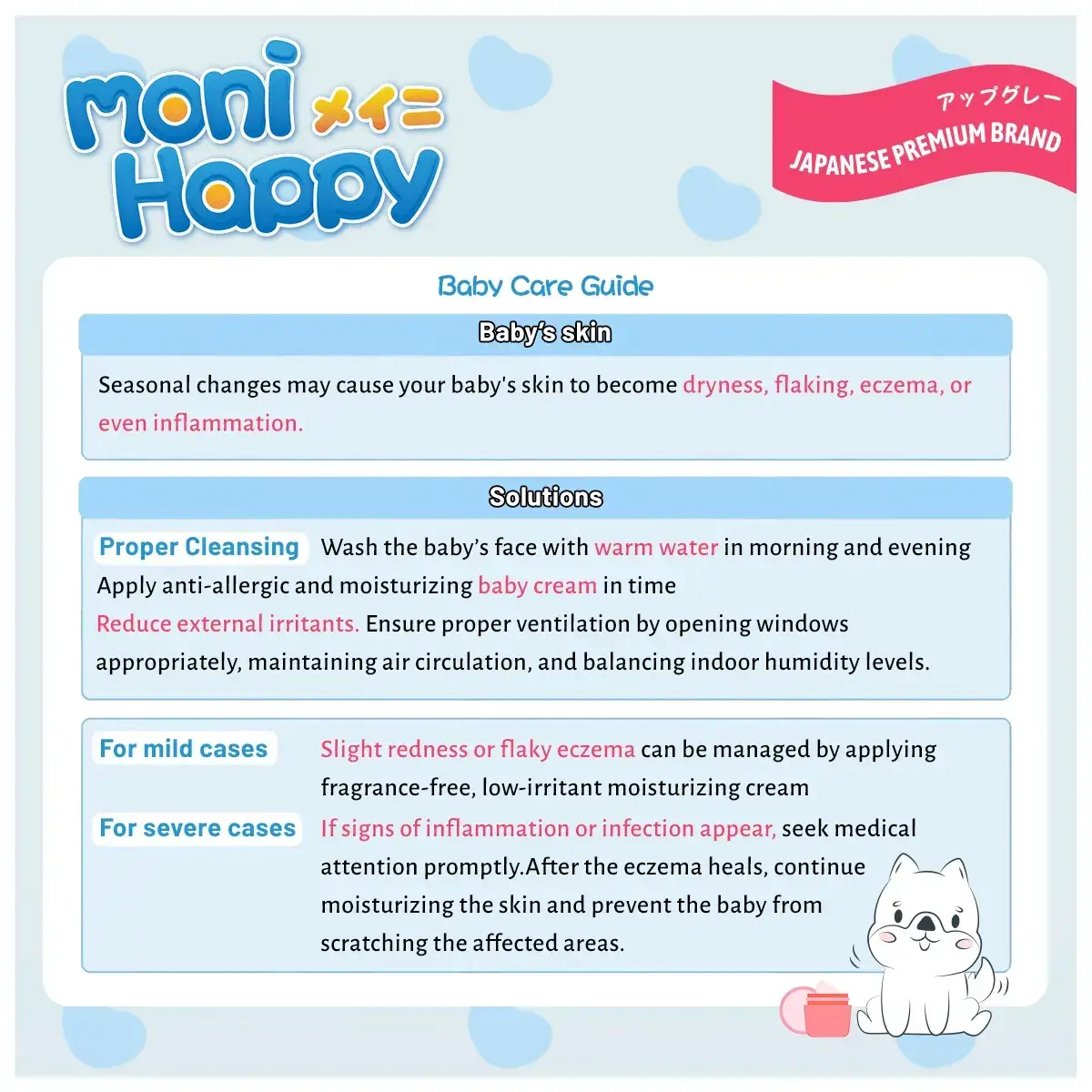
Newborn skin is incredibly delicate - it's thinner, more porous, and more sensitive than adult skin. Proper skin care can help prevent common issues like diaper rash, eczema, and dry skin.
Preventing Diaper Rash
Diaper rash is one of the most common newborn skin issues. It's usually caused by prolonged exposure to wetness, friction, or irritation from urine and stool. To prevent diaper rash:
- Change diapers frequently - at least every 2-3 hours and immediately after bowel movements
- Clean the diaper area gently with warm water or fragrance-free wipes
- Make sure the area is completely dry before putting on a clean diaper - pat dry, don't rub
- Use a breathable diaper that allows air circulation - Moni Happy diapers feature millions of breathable micro-pores to help prevent diaper rash
- Give your baby some diaper-free time each day to let the skin breathe
- If rash develops, apply a thin layer of zinc oxide diaper cream at each change
Eczema and Dry Skin
Eczema (atopic dermatitis) is common in babies, especially those with a family history of allergies or asthma. It appears as red, itchy, dry patches on the skin. To manage eczema and prevent dry skin:
- Keep baths short (5-10 minutes) and use lukewarm, not hot, water
- Use mild, fragrance-free, hypoallergenic baby soap and shampoo
- Pat skin dry gently - don't rub
- Apply a gentle, fragrance-free moisturizer within 3 minutes of bathing to lock in moisture
- Dress your baby in soft, breathable fabrics like cotton - avoid wool and synthetic fabrics that can irritate
- Wash new clothes before wearing, and use fragrance-free detergent
- If eczema is severe or persistent, consult your pediatrician - they may recommend a medicated cream
Gas, Colic & Soothing Techniques
Gas is a common discomfort for newborns - their immature digestive systems and tendency to swallow air during feeding can lead to trapped gas. Signs of gas include squirming, pulling legs up to the chest, clenching fists, fussiness, and a hard or bloated belly.
Simple techniques like bicycle legs, tummy massage, the colic hold, and knee-to-chest presses can help relieve gas. Burping your baby frequently during feeding (after every 2-3 ounces or every 5-10 minutes of breastfeeding) can prevent gas before it starts. Keeping your baby upright for 20-30 minutes after feeding also helps.
If your baby cries inconsolably for more than 3 hours a day, more than 3 days a week, for more than 3 weeks, they may have colic. Colic usually peaks at 6-8 weeks and resolves by 3-4 months. While colic can be exhausting for parents, it's not harmful to your baby. For detailed gas relief exercises and soothing techniques, read our 7 proven baby gas relief exercises.
Newborn Health: Temperature, Vaccines & When to Call Doctor
Knowing when to call the doctor is an important part of newborn care. While many newborn behaviors are normal, certain signs require immediate medical attention.
Temperature
A normal newborn temperature is between 36.5-37.5°C (97.7-99.5°F) when taken rectally. For babies under 3 months, a fever (temperature over 38°C or 100.4°F) is considered a medical emergency - call your pediatrician immediately, as it could indicate a serious infection. Always use a digital thermometer for the most accurate reading. If your baby feels hot or cold, check their temperature rather than relying on touch alone.
Vaccinations
Vaccinations are one of the most important ways to protect your baby from serious diseases. Follow your country's recommended vaccination schedule, and keep a record of all vaccinations. In Southeast Asia, the initial vaccines are typically given at birth (BCG and Hepatitis B), then at 6, 10, and 14 weeks (DPT, polio, Hib, Hepatitis B, pneumococcal, and rotavirus). If you have questions about vaccines, talk to your pediatrician - they can provide personalized guidance based on your baby's health and your location.
When to Call the Doctor
Contact your pediatrician immediately if you notice any of these signs in your newborn:
- Fever (temperature over 38°C / 100.4°F) in a baby under 3 months
- Difficulty breathing or rapid breathing (more than 60 breaths per minute)
- Blue lips, tongue, or skin
- Refusal to eat or poor feeding for more than 2 feedings
- No wet diapers for 6+ hours (signs of dehydration)
- Blood in stool or vomit, or persistent vomiting (projectile vomiting)
- Yellowing of the skin or eyes (jaundice) that worsens or doesn't improve
- Lethargy, extreme fussiness, or difficulty waking your baby
- Any injury or fall, especially if your baby loses consciousness or vomits afterward
- Signs of infection around the umbilical cord or circumcision site (redness, swelling, pus, foul smell)
Weekly Development Milestones: Week 1 to Week 8
While every baby develops at their own pace, here's a general overview of what to expect in the first 8 weeks:
Week 1
Your newborn is adjusting to life outside the womb. They sleep 16-18 hours a day, wake frequently to feed, and have limited vision (can only see 8-12 inches away). They have strong reflexes: rooting, sucking, grasping, and the startle (Moro) reflex. Their movements are jerky and uncoordinated.
Week 2
Your baby may start to regain their birth weight (most babies lose 5-10% of birth weight in the first week, then regain it by 2 weeks). They may begin to focus on your face during feeding and may make small cooing sounds. Their sleep patterns are still irregular, but you may start to notice slightly longer awake periods.
Weeks 3-4
By 1 month, your baby can lift their head briefly when on their tummy. They may start to smile socially (not just gas smiles) and respond to loud sounds. Their vision is improving - they can track moving objects and may prefer high-contrast patterns. They may begin to coo and make vowel sounds. This is often when colic peaks, if it's going to occur.
Weeks 5-6
Your baby's neck strength is improving - they can hold their head up for longer periods during tummy time. They may start to roll from side to back (though rolling from tummy to back usually comes later). Their social smile is more consistent, and they may laugh or giggle. They're more alert and interactive, and may enjoy looking at themselves in a mirror.
Weeks 7-8
By 2 months, your baby can lift their head and chest up when on their tummy, supporting themselves on their forearms. They can track objects 180 degrees and may reach for toys (though grasping is still developing). They coo and babble more, and may respond to your voice by turning their head. Their sleep patterns are becoming more regular, and they may have longer stretches of sleep at night (though waking to feed is still normal).
Remember, these are general guidelines - every baby develops at their own pace. If you have concerns about your baby's development, talk to your pediatrician. Early intervention can make a big difference for developmental delays, so don't hesitate to ask questions.
Newborn Care Essentials Checklist
Here's a quick checklist of everything you need for newborn care:
- Feeding: Breastfeeding supplies (nursing bras, nursing pads, nipple cream, breast pump if needed) or formula and bottles (6-8 bottles, various nipples, bottle brush, sterilizer)
- Diapering: Newborn diapers (stock up - you'll go through 8-12 per day!), baby wipes, diaper cream, changing mat, diaper bag
- Bathing: Baby bathtub or basin, mild baby soap and shampoo, soft washcloths, hooded baby towels, brush and comb
- Sleep: Crib or bassinet with firm mattress and fitted sheets, wearable blankets or sleep sacks, swaddle blankets (muslin is great for tropical climates), white noise machine
- Clothing: 7-10 short-sleeved onesies, 3-5 long-sleeved onesies, 3-4 rompers/sleepsuits, 3-4 pairs of pants, 4-5 muslin swaddle blankets, 2-3 hats, 4-5 pairs of socks, 2 lightweight cardigans
- Health & Safety: Digital thermometer, baby first aid kit, nasal aspirator, baby nail clippers, humidifier (for dry air-conditioned rooms), sun hat for outdoors
- Play & Development: High-contrast toys and books, play mat, baby mirror, rattle, soft stuffed animals (for supervised play, not for crib)
Frequently Asked Questions About Newborn Care
How often should I feed my newborn?
Newborns typically feed 8-12 times per day (every 2-3 hours), both breastfed and formula-fed. Watch for hunger cues rather than sticking to a strict schedule. By 2-3 months, most babies feed every 3-4 hours and may start to sleep longer stretches at night.
How many wet and dirty diapers should my newborn have?
After the first week, your baby should have at least 6 wet diapers per day. Bowel movements vary - breastfed babies may have several per day (sometimes after every feeding), while formula-fed babies may have 1-2 per day. By 6 weeks, some breastfed babies may go several days without a bowel movement - this is normal as long as the stool is soft and your baby seems comfortable.
When can my baby sleep through the night?
Most babies don't sleep through the night (6-8 hours) until 4-6 months of age. Newborns need to wake frequently to feed, as their stomachs are small and they need frequent nutrition for growth. You can start establishing a bedtime routine from birth, but don't expect consistent nighttime sleep until your baby is older. Always follow safe sleep guidelines.
Should I wake my baby to feed?
For the first few weeks, or until your baby regains their birth weight and is gaining weight steadily, you should wake them to feed if they sleep longer than 4 hours. After that, if your baby is healthy and gaining weight well, you can let them sleep - but most newborns will wake on their own to feed. If you're concerned about your baby's weight gain or feeding patterns, consult your pediatrician.
How do I know if my baby is getting enough breast milk?
Signs your baby is getting enough breast milk include: at least 6 wet diapers per day after the first week, regular bowel movements, steady weight gain (about 15-30g per day after the first week), your baby seems satisfied after feeding, and you can hear them swallowing during feeding. If you're concerned about your milk supply or your baby's weight gain, contact a lactation consultant or your pediatrician.
When should I start tummy time?
You can start tummy time from day one, as long as your baby is awake and supervised. Start with short sessions (2-3 minutes, 2-3 times per day) and gradually increase as your baby gets stronger. Tummy time is important for developing neck, shoulder, and core strength, and for preventing flat spots on the back of the head. Always place your baby on their back to sleep - tummy time is only for when they're awake and supervised.
How do I care for my baby's skin in hot, humid weather?
In tropical climates, keep your baby cool and dry to prevent heat rash and skin irritation. Dress them in lightweight, breathable fabrics like cotton or muslin. Use a fan to circulate air (not blowing directly on the baby) and keep the room well-ventilated. Bathe your baby with lukewarm (not hot) water and apply a gentle moisturizer if the skin is dry. Change diapers frequently and use breathable diapers to prevent diaper rash. Avoid going outside during peak sun hours (10 AM-4 PM), and use a wide-brimmed hat and shade when outdoors.
This guide is a starting point for your newborn care journey. For more detailed guidance on specific topics, explore our other articles: How to Bathe a Newborn, Baby Gas Relief Exercises, and Baby Clothing Guide for Tropical Climates. And for premium baby care products you can trust, explore the full Moni Happy product lineup - from diapers and wipes to cotton towels and facial tissue, all designed with your baby's delicate skin in mind.
Frequently Asked Questions
How often should I feed my newborn?
Newborns typically feed 8-12 times per day (every 2-3 hours), both breastfed and formula-fed. Watch for hunger cues rather than sticking to a strict schedule. By 2-3 months, most babies feed every 3-4 hours.
How many wet and dirty diapers should my newborn have?
After the first week, your baby should have at least 6 wet diapers per day. Bowel movements vary. Breastfed babies may have several per day, while formula-fed babies may have 1-2 per day. By 6 weeks, some breastfed babies may go several days without a bowel movement, which is normal if stool is soft.
When can my baby sleep through the night?
Most babies don't sleep through the night (6-8 hours) until 4-6 months of age. Newborns need to wake frequently to feed, as their stomachs are small. You can start establishing a bedtime routine from birth, but don't expect consistent nighttime sleep until your baby is older.
Should I wake my baby to feed?
For the first few weeks, or until your baby regains birth weight and gains steadily, wake them to feed if they sleep longer than 4 hours. After that, if your baby is healthy and gaining weight well, you can let them sleep. Most newborns will wake on their own to feed.
How do I know if my baby is getting enough breast milk?
Signs include: at least 6 wet diapers per day after the first week, regular bowel movements, steady weight gain (about 15-30g per day), your baby seems satisfied after feeding, and you can hear them swallowing during feeding. If concerned, contact a lactation consultant or pediatrician.
When should I start tummy time?
You can start tummy time from day one, as long as your baby is awake and supervised. Start with short sessions (2-3 minutes, 2-3 times per day) and gradually increase. Tummy time develops neck, shoulder, and core strength, and prevents flat spots on the head.
How do I care for my baby's skin in hot, humid weather?
Keep your baby cool and dry. Dress in lightweight, breathable fabrics like cotton or muslin. Use a fan to circulate air. Bathe with lukewarm water and apply gentle moisturizer if dry. Change diapers frequently and use breathable diapers. Avoid peak sun hours (10AM-4PM) and use a wide-brimmed hat and shade outdoors.