
2026-11-20 · Moni Happy
How does substrate roll width decide the wipes wholesale cost per pack?
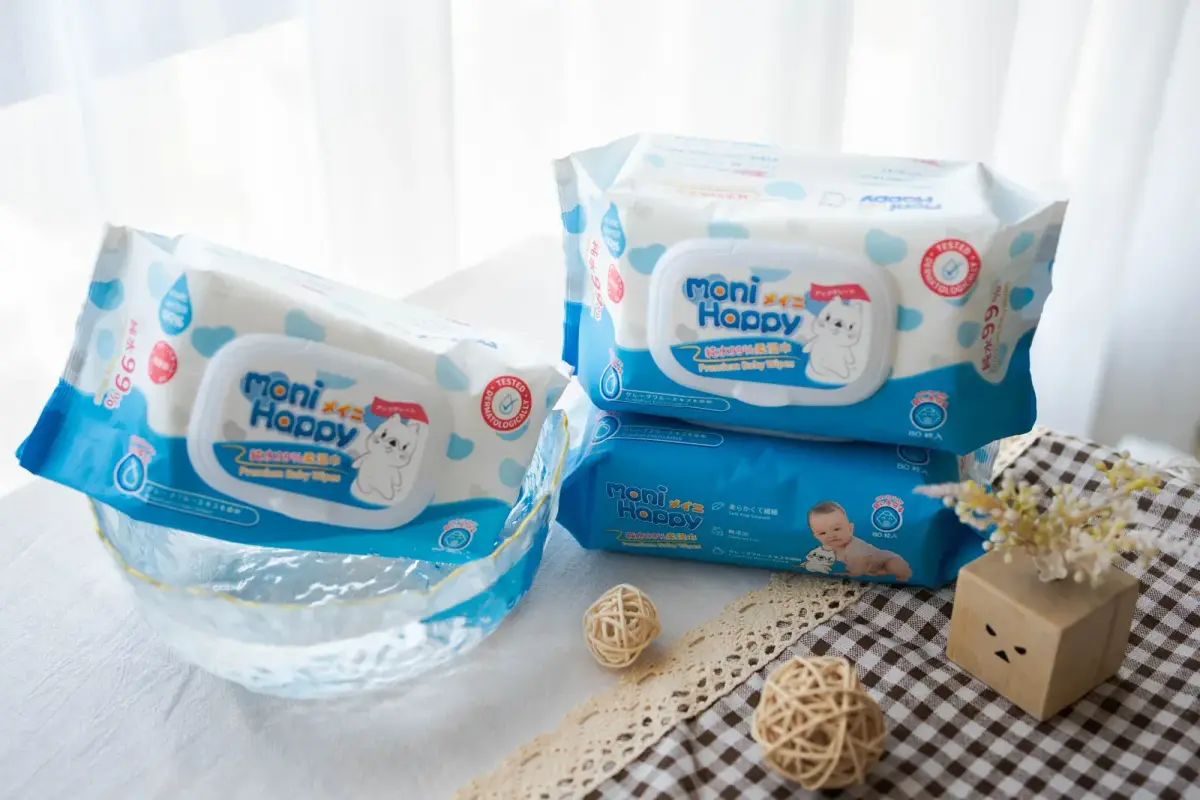
A 1,600 millimetre spunlace roll cuts eight 200 millimetre wipes across with nothing left over. Change the sheet to 210 millimetres and the same roll yields seven lanes plus 130 millimetres of edge trim, which is 8.1 percent of the substrate turned into waste. That waste is paid for at full material price and disappears into the pack cost, where no buyer ever sees it. On a wipes wholesale line the sheet dimension is not a design preference. It is a lane count, and the lane count sets how much of every tonne of substrate becomes product.
How many wipes come off one metre of substrate?
Width gives the lanes, the cutter gives the length, and the two multiply into yield per running metre.
Substrate arrives as a jumbo roll, usually 1,600, 2,000 or 2,400 millimetres wide, wound at 40 to 60 grams per square metre. The converting line unwinds it, wets it, cuts it into lanes across the width and chops it to sheet length. A 200 by 150 millimetre sheet on a 1,600 millimetre roll gives eight lanes and nothing wasted at the edges. One running metre then produces 8 sheets of 0.03 square metres each, which is 0.24 square metres of finished product. At 50 gsm that is 12 grams of substrate per metre, and a roll of 500 kilograms yields about 41,600 sheets before any loss.
Now do the same arithmetic for a 210 millimetre sheet. Seven lanes, 1,470 millimetres used, 130 millimetres trimmed away at full cost. The same roll produces 7 sheets per metre instead of 8, and the substrate cost of each sheet rises by 8.1 percent before a single sheet is packed. Nothing about the product changed except the front panel dimension.
Why does a 10mm wider sheet cost more than 10mm of material?
Because the loss is not proportional, it is a step.
Material cost per sheet is width times length times grammage times price per kilo. Going from 200 to 210 millimetres should raise substrate cost by 5 percent on that arithmetic alone. The lane step adds another 8 percent of waste on top, because the eighth lane is gone and the remainder cannot be sold. Two effects compound in the same direction, and the second one is invisible in any quotation that shows only a finished price.
This is also why a factory will sometimes refuse a sheet size that looks trivial. A 195 millimetre sheet on a 1,600 millimetre roll gives eight lanes with 40 millimetres spare, and the spare is small enough to be absorbed at the edge. A 215 millimetre sheet gives seven lanes and 95 millimetres to throw away. Between those two specs, 20 millimetres of width swings the substrate cost of the pack by more than 10 percent.

How do you check the lane arithmetic on a quotation?
Three numbers, and a supplier who will not give them is pricing a spec they have not run.
Ask for the roll width in millimetres, the finished sheet width, and the trim percentage. Divide the roll width by the sheet width and take the integer: that is the lane count. Multiply the lane count by the sheet width and subtract from the roll width: that is trim per lane set. Divide trim by roll width and you have the loss percentage. A quote that assumes 1,600 millimetres and an 8-lane layout should show zero trim. A quote that assumes the same roll with a 7-lane sheet should show 8.1 percent, and if it does not, the loss is buried somewhere else in the price.
Run the same check across the pack count. A pack of 80 sheets at 200 by 150 needs 2.4 square metres of substrate; at 50 gsm that is 120 grams, plus liquid at roughly 3.5 times the substrate weight for a 99 percent water wipe. Liquid is cheap, substrate is not, so the grammage and the lane count together decide more of the pack cost than the film or the carton do.
What does the converter do with the trim?
Sells it, incinerates it, or builds it into the price. Rarely recycles it into the same product.
Spunlace edge trim is clean and dry, and some converters bale it for industrial wipes or filling material at a fraction of substrate value. The recovery rate is low enough that a buyer should assume the trim is a straight loss unless the supplier says otherwise. Ask what happens to it. A factory that sells the trim back at 15 to 20 percent of substrate value is recovering a fifth of the loss, which is worth knowing when you compare two quotes that differ by 6 percent.
Where does roll width collide with the packing line?
At the folder and at the film, both of which have their own fixed widths.
A Z-fold pack needs the sheet folded twice before it enters the film, and the fold geometry is set for a narrow range of sheet sizes. Push the sheet 10 millimetres wider and the folder needs a new plate, which is a tooling cost paid once but quoted per order if the run is small. The film itself is printed on a web with a fixed repeat, so a wider pack means fewer packs per film metre and a new plate for the print. Two tooling charges and one lane loss all arrive from the same 10 millimetres.
This is where a first order gets expensive. The per-pack price on a 20,000-pack trial often carries tooling amortised over that single run, which makes the price look uncompetitive against a competitor quoting a standard 200 millimetre sheet on a long run. Comparing the two without asking what is amortised is comparing a one-off with a steady state.
Which spec changes cut cost without touching grammage?
Sheet width to fit the roll, pack count to fit the carton, and fold to fit the folder.
- Fit the roll. A 200 millimetre sheet on 1,600 millimetres, or a 200 millimetre sheet on 2,000 millimetres with ten lanes, both run trim-free. Choose the sheet to suit the roll the factory already buys, not the other way round.
- Fit the carton. A pack count that fills a carton in whole layers avoids the half layer that ends up as void space in the container.
- Fit the folder. Staying inside the folder's existing plate range avoids a tooling charge that can add several cents per pack on a first run.
None of these touch the number a parent reads on the front panel, which is why they are the first things to raise in a specification meeting rather than the last. A wipes wholesale buyer who opens with grammage usually ends up arguing about quality; one who opens with lane count ends up arguing about money, which is the more productive conversation.
What should the sampling brief say?
Give the factory the roll width you expect them to run, not just the sheet size you want.
State sheet dimensions to the millimetre, grammage with a tolerance of plus or minus 3 grams, pack count, fold type and the film format. Add one line asking for the lane calculation and the trim percentage on the roll width quoted. That line does two things: it forces the factory to price the actual layout, and it gives you a document to compare when a second supplier quotes 5 percent lower on the same brief. For buyers building a first range, the pack-format decisions that sit around this arithmetic are covered in our wet wipes range and in the distributor onboarding guide.
Frequently asked questions
Is a 60gsm substrate always better than 50gsm?
It feels better and costs 20 percent more in material. Whether that converts depends on the price band, not on the substrate.
Do all factories run 1,600mm rolls?
Most Asian converters standardise on 1,600 or 2,000 millimetres. Ask before you design a pack, because a 2,400 millimetre line changes the lane maths entirely.
Can trim be avoided by buying pre-cut sheets?
Rarely worth it. Pre-cut sheets carry their own cutting cost and usually a wider tolerance than an inline cutter.
How much does the film add to pack cost?
Less than the substrate in a 99 percent water wipe, more than most buyers assume. Get it quoted separately so the substrate number stays visible.
Sources and further reading
- EDANA — nonwovens industry data and spunlace process references, accessed 2026.
- TAPPI — web handling and converting technical resources.
- ISO standards catalogue — test methods for nonwoven tensile strength and mass per unit area.
Bottom line
Sheet width is a lane decision before it is a design decision. Eight lanes on a 1,600 millimetre roll wastes nothing; seven lanes wastes 8 percent of the substrate and nobody sees it in the price. Ask for the roll width, the lane count and the trim percentage on every quotation, then compare suppliers on the same layout instead of on the same sheet size.
Frequently Asked Questions
Why does a 10mm change in sheet width matter so much?
Because roll widths are fixed at 1,600, 2,000 or 2,400mm. A sheet that no longer divides evenly into the roll turns the remainder into trim, and trim is billed at full substrate price.
Is trim loss visible on a quotation?
Rarely. Most quotes show a per-pack price only. Ask for the lane count, the trim percentage and the roll width the price assumes, and the number becomes checkable.
Can the factory reuse the trim?
Not in a wet wipe line. Edge trim from a spunlace roll is off-spec for food-contact or skin-contact use unless it goes back through a full reclamation process, which most converters do not run.
Does a wider roll always lower cost?
Only if the sheet divides into it cleanly. A 2,400mm roll with a 200mm sheet gives twelve lanes and no trim, but the minimum order for that width is usually measured in tonnes.
Distributor resources
If you are evaluating suppliers for your market, these are the pages that answer the commercial questions — in the order buyers usually need them.
