
2026-11-24 · Moni Happy
What happens to a diaper wholesale line at a Lotus's Malaysia range review?

A Lotus's Malaysia range review decides whether a diaper wholesale line keeps its facings, and it is settled on sales per linear metre rather than on brand story. The chain operates 69 stores, 64 malls and three distribution centres across Peninsular Malaysia, with around 8,000 staff, and its own brand already includes a Cute+Care baby care range. A supplier who arrives with rate-of-sale data by store, a delisting plan for weak sizes and a promotion calendar keeps the slot more often than one with a better product.
Range review is the least documented part of modern trade and the part that ends most supplier relationships. The meeting is short, the data is already on the buyer's screen, and the supplier's job is to explain the numbers rather than to introduce the range.
What actually gets decided at a range review?
Four things: how many facings, which SKUs, which promotions, and whether the line stays at all.
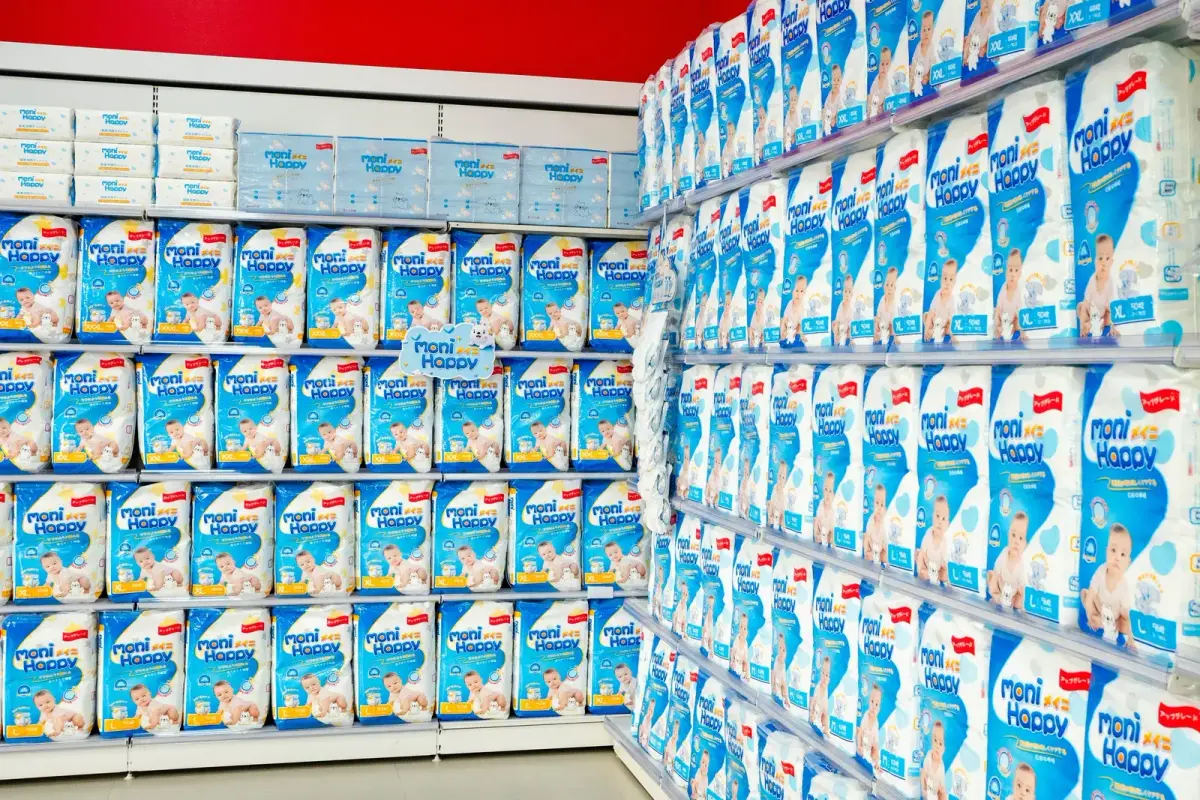
The buyer starts with a planogram of the baby care bay and a target for sales per linear metre. Every SKU in the category is ranked against that target. A line that clears it keeps its space; one that does not is either cut or reduced to a single facing while the buyer tests a replacement. The review is not a negotiation about brand support in the abstract, it is an allocation of a fixed number of shelf slots measured in centimetres.
For a diaper wholesale supplier this means the useful preparation is a one-page table: SKU, facings held, sales per store per week, rate of sale per facing per week, and stock cover. Anything that does not fit on the page tends not to be read.
How is sales per linear metre calculated for diapers?
Store sales divided by the shelf length the range occupies, usually on a 13-week or 26-week basis.
Take a bay where the diaper range holds 1.8 metres of shelf across four shelves, so 7.2 linear metres of selling space. If the range turns over RM 180,000 in 13 weeks across the chain, the figure is about RM 25,000 per linear metre per quarter. The buyer compares that with the tissue bay next door and with the previous year. A range below the category average is the one that gets compressed, regardless of how well individual stores perform.
The trap for a new supplier is averaging. A line that sells RM 9,000 a month in a Subang Jaya hypermarket and RM 400 in a smaller format store still produces a respectable chain total. When the buyer divides by 69 stores the number collapses, and the fix is to propose a store cluster rather than a national listing: stock the 20 stores that work, and keep the rest of the estate on a two-SKU core.
What does the own brand change about the conversation?
It sets the price ceiling at the value end and leaves the mid and upper tiers open.
Lotus's Malaysia runs its own brand across grocery and household categories, and the baby care entry is Cute+Care. An own brand line is priced to be the cheapest credible option in the bay, which means a national brand cannot win the value argument. What a diaper wholesale line can win is a specific claim: an absorbency figure, a skin certification, a size range the own brand does not cover, or a pack format the own brand does not stock.
Practically, the supplier should walk in with one claim and the evidence behind it, in writing. A five-star skin compatibility test report, a stated absorbency time, or a size ladder that runs to XXL when the own brand stops at XL are all defensible. A general statement about Japanese quality is not, because the buyer has heard it from three suppliers that morning.
What does the buyer ask about supply reliability?
Stock cover, lead time and what happened the last time a promotion ran dry.
Lotus's Malaysia receives through three distribution centres, and a missed delivery does not just empty one store, it disrupts a DC slot that other suppliers are queuing for. The buyer will ask for the production lead time, the shipping schedule, and the safety stock the supplier holds locally. A supplier shipping from China on a 25 to 35 day production cycle plus 7 to 10 days of sea freight needs either a local consignment stock or a very clear replenishment calendar to answer that question.
Ownership of the risk sits with the supplier in most Malaysian modern trade terms. If the promotion is booked and the stock does not arrive, the retailer deducts the lost margin from the next invoice and notes it in the supplier scorecard. That note is what the range review reads first.
How should a supplier prepare for the meeting?
Six documents, one page each, and a decision already made about which SKU to sacrifice.
- Rate of sale by store cluster. Three clusters rather than 69 rows, with the top 20 stores named.
- Sales per linear metre against the category average. The number the buyer will compute anyway, computed first.
- A proposed SKU cut. Offering to drop the weakest two sizes is stronger than defending all eight.
- Promotion calendar with stock cover. Weeks, mechanics, and the units committed per store.
- Supply plan. Production lead time, sailing schedule, local stock position, and the buffer held for promoted weeks.
- One claim with evidence. A test report or a certification, not a slogan.
Bringing a cut proposal is counter-intuitive and it works. A buyer who has to remove SKUs from a planogram will remove the ones the supplier did not defend, and a supplier who names the weak sizes first keeps control of which ones go.
What happens after the review?
A planogram reset, a purchase order revision, and about six weeks before the shelf reflects either.
Once the review closes, the planogram is reissued to stores, the DC adjusts its slotting, and the sales team executes the reset store by store. Suppliers who ship against the old planogram in that window create overstock in the stores that lost facings and stockouts in the ones that gained them. The practical move is to ask for the reset date in writing and to time the last delivery of a delisted SKU to land before it.
New listings work the other way. A first order for a newly listed line usually needs to arrive at the DC two to three weeks before the reset date, which means the purchase order has to be raised six to eight weeks before the shelf changes. Suppliers who wait for the order confirmation before booking production routinely miss the first reset and spend a quarter with no facings at all. Our partner programme sets the launch calendar against the retailer's reset date, and the distribution channels guide covers how the other Malaysian channels compare.
Frequently asked questions
How often does Lotus's Malaysia review a baby care range?
Most Malaysian modern trade retailers run one or two reviews a year, tied to the calendar and the festive periods. The cycle is set by the category manager, so assume six months and keep two quarters of store-level data ready.
Does a distributor or the brand attend the review?
Whoever holds the account. In Malaysia that is usually the local distributor, with the brand present for product claims and pricing. The distributor answers the supply questions, the brand answers the technical ones, and both should be working from the same data sheet.
Can a new line get in outside the review cycle?
Yes, through a store cluster trial or a seasonal promotion, and both are worth taking. A 20-store trial with a defined exit date is easier for a buyer to approve than a national listing and it generates the data the next review needs.
What margin does the retailer expect on diapers?
Malaysian hypermarkets typically work on a lower front margin for baby care than for general merchandise and recover the rest through supplier-funded promotions and rebates. A supplier planning on front margin alone will usually find the promotion calendar eats the difference.
Sources and further reading
- Lotus's Malaysia corporate site — store network, own brand ranges and promotional calendar published by the retailer.
- The Sun Malaysia, Lotus's Melaka Cheng reopens — 69 stores, 64 malls, three distribution centres and 8,000 employees, reported November 2025.
- Suruhanjaya Syarikat Malaysia (SSM) — company and business registration checks a supplier should complete before signing a trading agreement.
Bottom line. A range review is a data meeting, and the supplier who brings store-level rate of sale, a voluntary SKU cut and a credible supply plan keeps the facings. The own brand sets the value ceiling, so the argument has to be a specific claim with a test report behind it. Prepare the six pages before the invitation arrives, not after.
Frequently Asked Questions
How often does Lotus's Malaysia review a baby care range?
Most modern trade retailers in Malaysia work on one or two reviews a year, usually tied to the calendar year and to the festive periods. The exact cycle is set by the category manager and is not published, so the practical answer is to assume a review every six months and keep the data ready.
What data does the buyer want first?
Sales per linear metre per store, by SKU, for the last two quarters. Not total sales. A line that sells well only in three Klang Valley stores looks weak when the number is divided across 69 stores, and a supplier who brings that split survives the conversation.
Does the own brand block a national brand?
It sets the price ceiling on the value end rather than blocking the category. Lotus's Malaysia carries a Cute+Care baby care range inside its own brand, which means a new diaper line has to justify its price gap with a claim the own brand cannot make, such as a specific absorbency or a certification.
What is the biggest reason a line gets delisted?
Stockouts during a promoted week. A promotion that runs out of stock on day three costs the retailer the margin it planned and signals that the supplier cannot hold inventory. Two missed promotions in a year usually ends the listing before the sales data is even discussed.
Distributor resources
If you are evaluating suppliers for your market, these are the pages that answer the commercial questions — in the order buyers usually need them.
