
2026-11-24 · Moni Happy
Which diaper wholesale category earns the most gross profit per cubic metre?
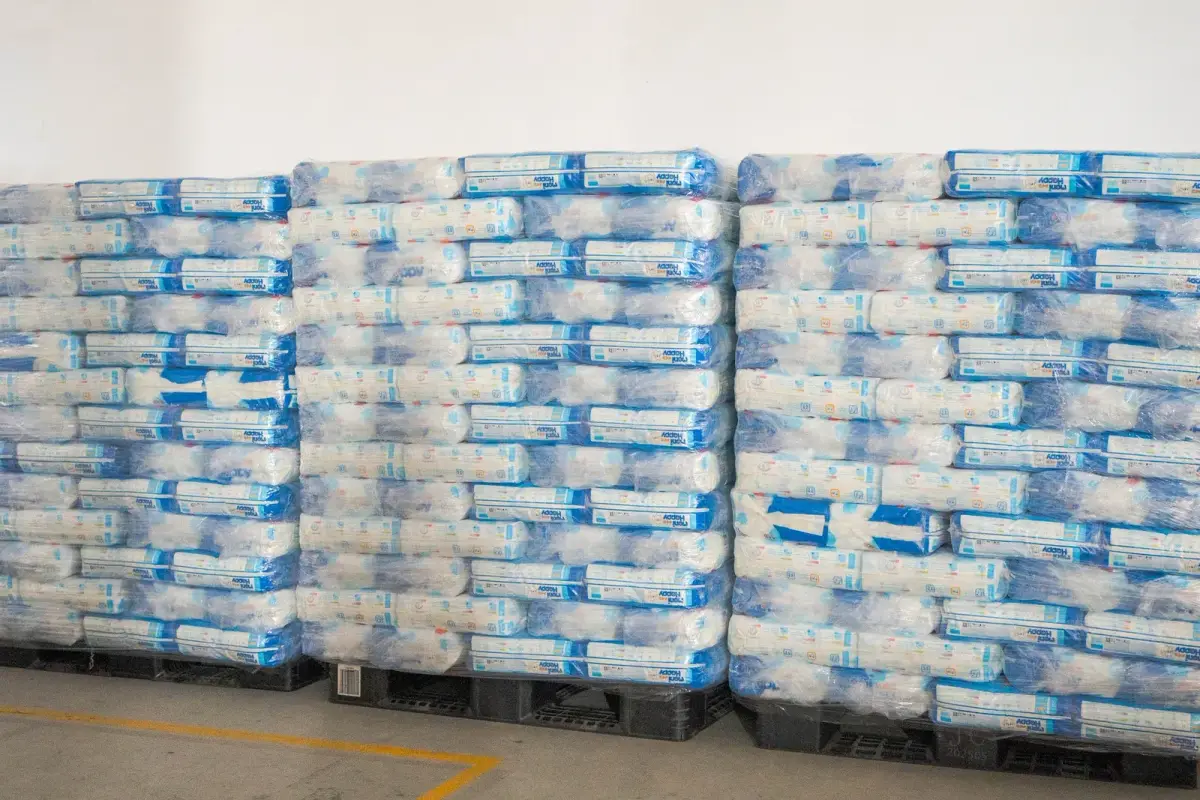
Ranked by gross profit per cubic metre of container space, 99% water wipes lead, tape diapers sit second, and facial tissue trails. A 20GP of 80-piece wipes holds about 738 cartons and carries roughly USD 1,900 to 2,600 of gross profit. A 20GP of diapers holds about 48,000 pieces and carries USD 720 to 2,640, a range five times wider because size mix decides it. Tissue lands near USD 900. Rank the same three by gross profit per year of shelf space and the diaper wholesale order reverses the result.
Container space is the only input every importer buys at the same price. A 20GP costs what it costs whether it carries diapers, wipes or cotton towels, so the question of what earns most per cubic metre is answerable with arithmetic rather than opinion.
Which category earns the most gross profit per cubic metre?
Wet wipes, and the margin is not small.
Start with what a cubic metre holds. Take the wipes carton we ship at 430 x 360 x 245 mm, which is 0.0379 cbm, 24 bags of 80 pieces, 14.2 kg gross. One cubic metre takes 26.4 of those cartons, or 633 bags. A cubic metre of tape diapers takes about 1,714 pieces, since a 20GP loads roughly 28 usable cubic metres and 48,000 pieces. Now put a value on each. At an indicative FOB of USD 0.55 to 0.75 per 80-piece wipes bag, the cubic metre carries USD 348 to 475 of goods. At the USD 0.10 to 0.22 per piece that tape diapers trade at, the cubic metre carries USD 171 to 377. Wipes win on value density, and value density is what a cubic metre is really renting.
Apply a margin and the ranking holds. Twenty percent on the wipes cubic metre is about USD 70 to 95. Fifteen to 25 percent on the diaper cubic metre is USD 26 to 94. The wipes number is more predictable because the pack is standardised. The diaper number swings with how much of the box is small sizes, which take more space per piece than the large ones.
How much gross profit does a 20GP of diapers actually carry?
Between USD 720 and USD 2,640, and the spread comes from size mix, not from price negotiation.
Take the station range first. FOB USD 0.10 to 0.22 per piece on 48,000 pieces gives a container value of USD 4,800 to 10,560. Landed cost runs USD 0.18 to 0.28 per piece once freight, duty and port charges are in, so the container costs USD 8,640 to 13,440 landed. At a 15 to 25 percent gross margin the profit per box is USD 720 to 2,640, or USD 26 to 94 per cubic metre.
Why the fourfold spread? A 20GP loaded with newborn and size S packs carries fewer pieces per cubic metre than one loaded with L and XL, because each piece is smaller and the pack count per carton is higher. A newborn pack of 30 pieces occupies a similar carton to an L pack of 20. Load a box entirely with small sizes and the piece count climbs while the value per piece falls. Load it with large sizes and the opposite happens. Two buyers paying the same FOB can therefore see different gross profit per cubic metre from the same product, and neither is wrong.
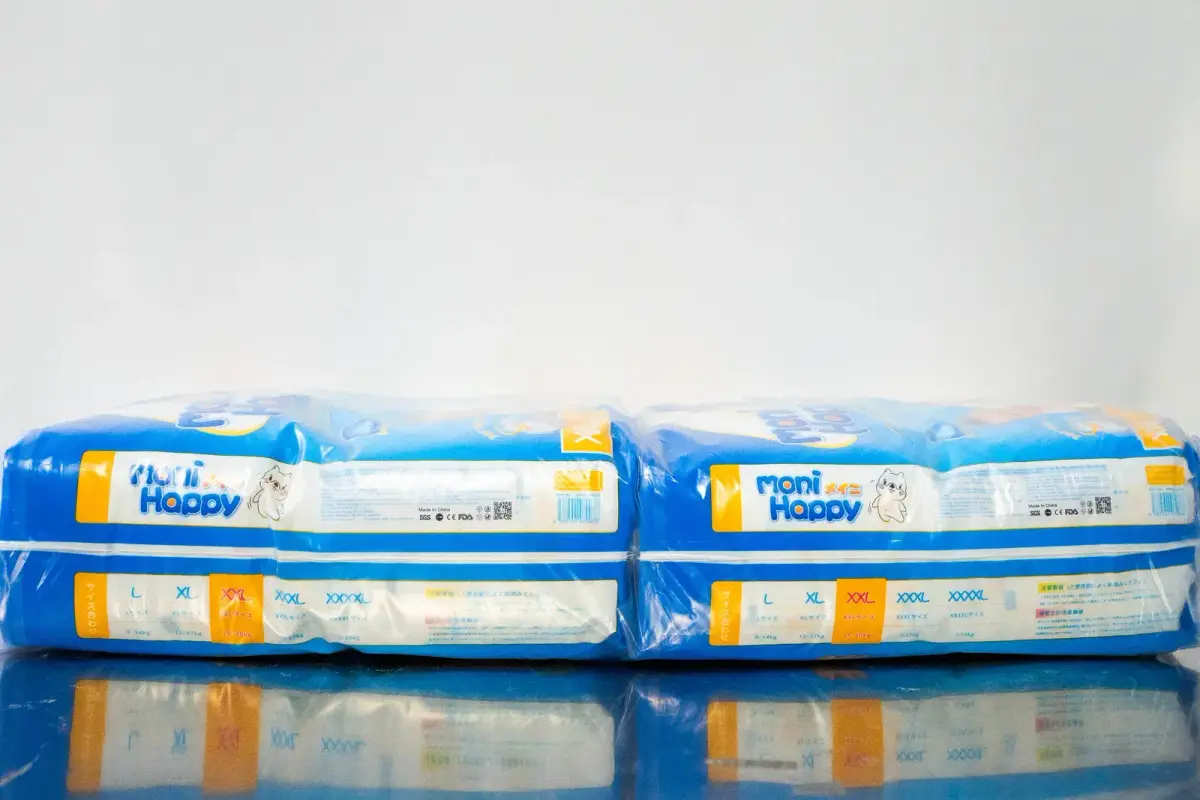
Why do wet wipes beat diapers on that measure?
Because liquid and film add invoice value without adding much volume.
A wipes bag is heavy for its size. The 80-piece bag runs 0.59 kg gross including the film and the liquid, so a carton of 24 weighs 14.2 kg in 0.0379 cbm. A diaper carton of comparable volume weighs far less because most of it is fluff pulp and air. Weight per cubic metre is the tell: wipes run near 375 kg per cbm, diapers nearer 110 kg. Dense cargo carries more invoice value per cubic metre, and freight is charged on volume for both.
That is the mechanical reason wipes earn more per cubic metre. It is also why the carton cube matters more on a wipes line than on a diaper line. Shave 20 mm off the height of a wipes carton and the same pallet holds more bags, but the carton must still protect a bag under 15 kg of compression in a container that reaches 55 degrees in the sun.
Where do facial tissue and cotton towels sit?
Below diapers per cubic metre, and there is no packaging change that fixes it.
Facial tissue is the lightest of the five categories per unit of volume and it is sold at a low price point, so the gross profit per cubic metre lands nearer USD 35 than USD 70. Cotton towels behave the same way, with the added problem of a soft pack that compresses under load. Neither is a bad line for a distributor, because both bring store traffic and repeat purchase, but neither should be the reason a container is booked. A tissue line earns its place as a range filler on a container that already carries wipes or diapers.
Why does per-cubic-metre profit mislead on its own?
Because it says nothing about how many times a year the cubic metre is refilled.
Diapers turn 8 to 12 times a year in a working distributor's warehouse, since a baby consumes roughly 6 to 8 pieces a day and a retailer reorders weekly. Wipes turn 4 to 6 times, and tissue slower still in most markets because households buy it in smaller quantities per trip. Multiply the gross profit per container by turns and the ranking changes: USD 55 per cubic metre turning 10 times beats USD 70 turning 5. That is the whole case for a diaper wholesale line leading a distributor's range even though it loses the per-cubic-metre test.
Cash matters too. A 20GP of diapers at USD 8,640 to 13,440 landed with T/T 30/70 terms ties up 30 percent before shipment and the balance before documents release. A wipes container of the same value ties up the same, but it sells through more slowly, so the money sits longer. Two categories with identical gross profit per cubic metre can have very different cash cycles.
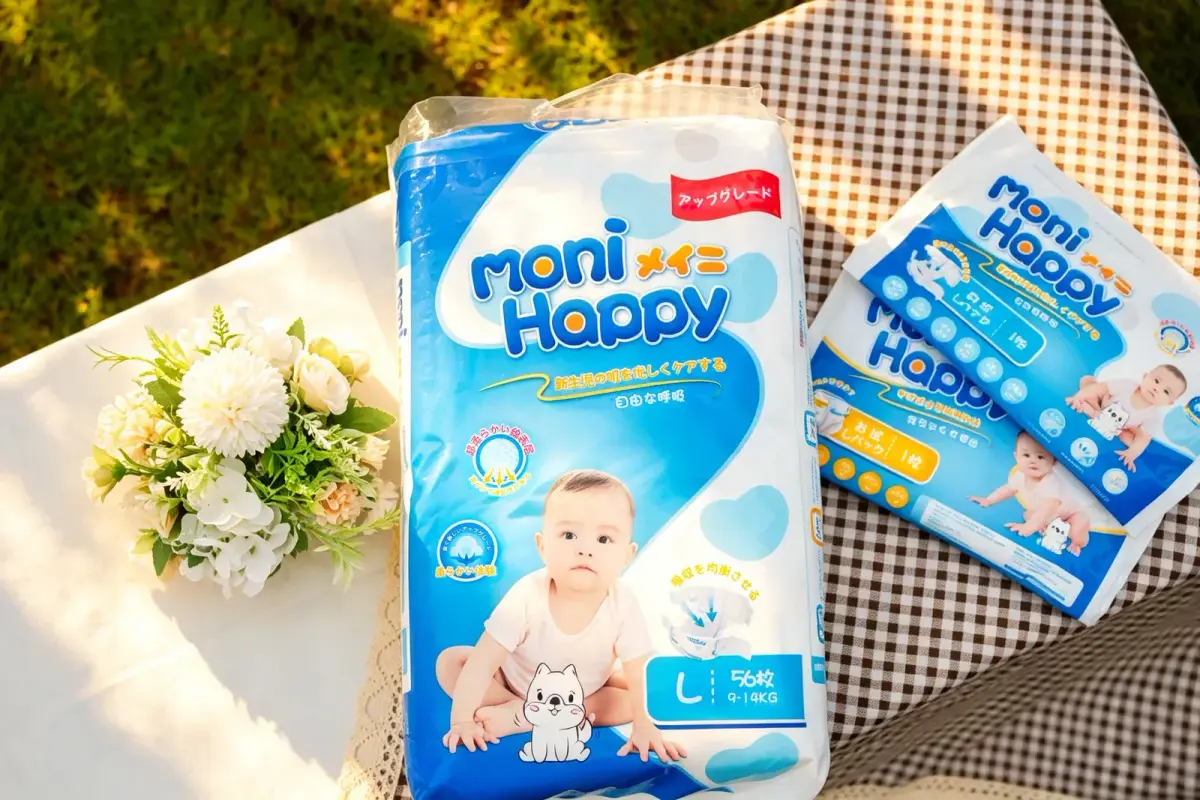
What does a mixed container do to the blended number?
It usually beats both extremes for a first order, and this is where most new distributors get it wrong.
- Four categories at 6 to 8 cbm each. Diapers, pull-up pants, wipes and tissue in one 20GP. Blended gross profit per cubic metre lands between the wipes and the tissue figure, and the retailer sees a range rather than one line.
- Six to eight diaper SKUs inside the diaper block. Newborn, S, M, L, XL and one pants size gives a store something to merchandise without forcing the buyer to commit to a size that may not move.
- One carton cube approved per category, not per SKU. Carton cube is the specification that decides how much fits, and three cubes across eight SKUs is a loading problem nobody needs on a first order.
- Leave 8 to 12 percent of the box empty. A container loaded to the roof arrives with crushed cartons and rejected claims, and the saving on the last 3 cbm is smaller than the cost of a damaged pallet.
Check the blended number against the retailer's shelf plan before committing. If the buyer gives 1.2 metres of shelf to diapers and 0.6 to wipes, a container weighted 70 percent to wipes will sit in the warehouse. Blended gross profit per cubic metre is a target, and the shelf plan decides whether the target is reachable in the first 90 days.
What should a first order weight toward?
Diapers on volume, wipes and tissue on range, and the split decided by what the retailer will actually shelve.
A distributor who wants one container to prove a market should put roughly half the cube into diaper wholesale stock in the sizes the local birth rate supports, a quarter into pull-up pants for the walking child, and the rest split between wipes and tissue. That mix pays freight once, gives the store a full bay, and leaves the fastest-turning category with enough depth to survive a month of reorders. The brands and prices behind that mix are quoted per market, so the working habit is to ask for a formal quotation against a defined cube rather than a price per piece in isolation.
The five categories we ship cover the whole bay, and the cube arithmetic above is what our partner team works through with a new distributor before a first container is booked. If the shelf plan is unclear, start with the partner programme and the wholesale price, MOQ and margin guide before choosing a mix.
Frequently asked questions
Is gross profit per cubic metre the right metric?
It answers one question well: which category pays best for the container space it occupies. It ignores turn rate, cash cycle and shelf allocation, so it belongs beside gross margin return on inventory rather than in place of it.
Does a mixed container raise or lower the blended margin?
It lowers the blended percentage and usually raises the blended cash per box, because the fast-turning diaper block pays for the slow-turning tissue block. A first order is better judged on cash returned within 90 days than on percentage.
Can carton cube be changed after the first order?
Yes, but not for free. A new dieline needs a print plate change, a packing trial and a fresh carton drop test, and the factory will usually want a minimum run for the new size. Fix the cube at specification stage.
Where does pull-up pants fit in the ranking?
Between diapers and wipes. A pants carton holds fewer pieces than a tape diaper carton of the same volume because each pant is thicker at the waist, so the value per cubic metre sits closer to wipes while the turn rate stays close to diapers.
Sources and further reading
- UNCTAD, Review of Maritime Transport 2025 — container freight cost structure and per-TEU rate movements used for the freight assumptions.
- ISO 13485:2016, Medical devices — Quality management systems — the certification a diaper or wipes factory is audited against when a distributor asks for quality documentation.
- ASEAN Tariff Finder — landed-cost duty rates by product code for intra-ASEAN shipments, updated by member customs authorities.
Bottom line. Wipes earn the most gross profit per cubic metre and diapers earn the most per year of shelf space, so neither number settles a range decision alone. Price the container by cube, then price the year by turns. A distributor who does both will order a mixed first container and a diaper-led second one.
Frequently Asked Questions
Is gross profit per cubic metre the right metric?
It answers one question well: which category pays the best for the container space it occupies. It ignores how fast the stock leaves the shelf, how much cash sits in the bank, and how much shelf space the retailer gives you. Use it beside gross margin return on inventory, never instead of it.
Why do wet wipes beat diapers per cubic metre?
Because a cubic metre of wipes is worth more at FOB. One cubic metre takes 26 cartons of 24 bags and 1,920 pieces, so about 633 bags, while a cubic metre of diapers holds roughly 1,714 pieces. At typical FOB levels the wipes cubic metre carries close to twice the invoice value of the diaper cubic metre, and the same percentage margin on a larger base is a larger number.
Does a mixed container help a first order?
Yes, if the goal is to learn which category sells. A mixed container of four categories at 6 to 8 cbm each spreads freight, gives the retailer a range rather than a single line, and still clears the point where less-than-container freight stops paying. The cost is a slower loading day at the factory and more carton specifications to approve.
What margin should a new distributor expect?
On diapers, 15 to 25 percent gross is the working band once landed cost is included, and that band is set by the retailer as much as by the supplier. Wipes and tissue often carry a higher percentage but a smaller absolute margin per order. Any figure quoted before landed cost, duty and shelf fees are known is an opening number, not a plan.
Distributor resources
If you are evaluating suppliers for your market, these are the pages that answer the commercial questions — in the order buyers usually need them.
