
2026-11-24 · Moni Happy
What barcode and shipping-mark detail does a wipes wholesale carton need?
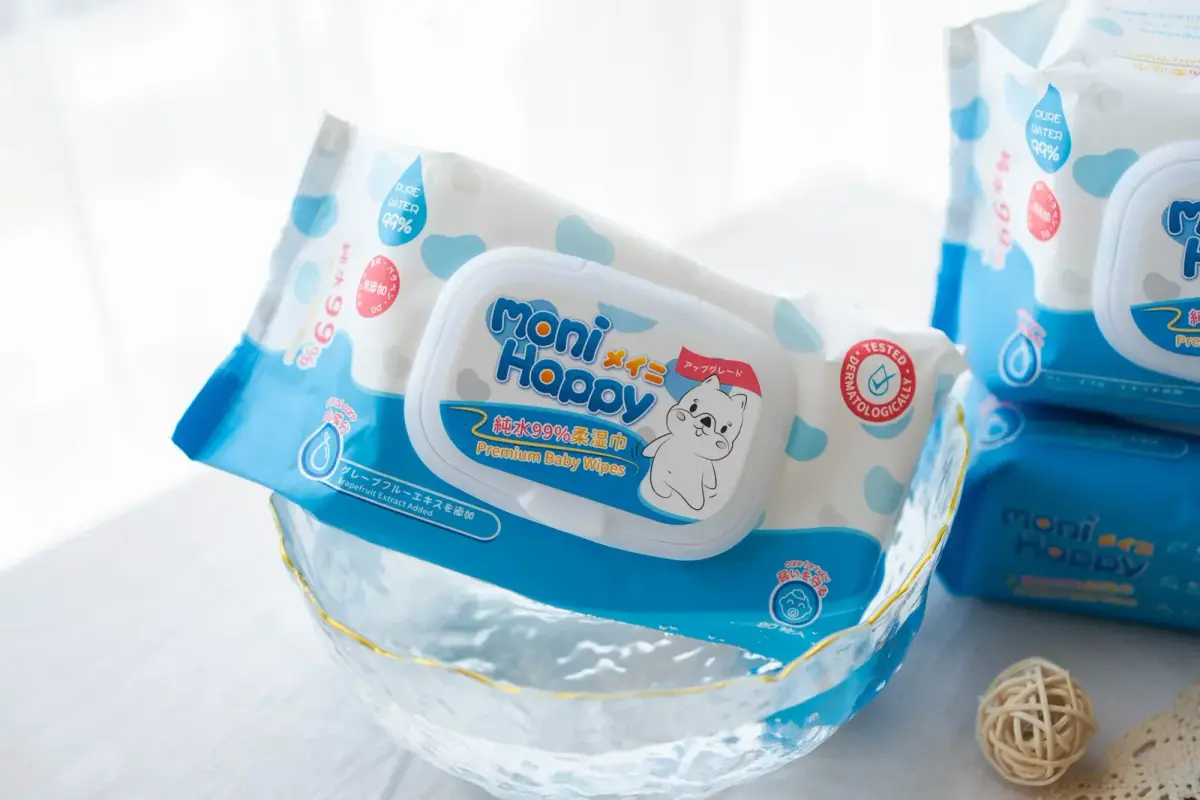
A wipes wholesale carton needs three barcode levels and six printed fields. The pack carries an EAN-13 built on a 13-digit GTIN; the carton carries an ITF-14 using the same GTIN with a packaging indicator; the pallet carries an SSCC-18 in a GS1-128 label. Alongside them the carton must show quantity, net weight, gross weight, measurements, country of origin and a lot code. Our own carton states 80 pieces per bag and 24 bags per carton, measures 430 x 360 x 245 mm, and runs 13.4 kg net against 14.2 kg gross.
Most scan failures at a retail distribution centre are traced to one of four causes, and only one of them is a printer fault. The other three are decided months earlier, in artwork and in the filling line. One of them is a quiet zone eaten by a background graphic, which fails a symbol that is otherwise printed perfectly.
Which barcode belongs on the pack, the carton and the pallet?
Three different symbols at three levels, and each one is read by a different scanner.
- Pack level, EAN-13. A 13-digit GTIN in the standard retail symbol, printed on the film with a nominal X-dimension of 0.33 mm for a pack of this size. This is what the checkout reads.
- Carton level, ITF-14. The same GTIN with a packaging indicator in the fourteenth digit, printed as an Interleaved 2 of 5 symbol inside a bearer bar. The bearer bar exists to survive scuffing on corrugated board. This is what the distribution centre reads when it receives the pallet.
- Pallet level, SSCC-18. A serial shipping container code in a GS1-128 label, one per pallet, used for the despatch advice. Without it the DC cannot match the pallet to the advance ship notice.
Two practical rules follow. The carton barcode must never repeat the pack barcode, because the DC will then treat the carton as a sellable unit and count 24 bags as one. And the packaging indicator in the fourteenth digit must change when the pack count changes, so a 12-bag carton and a 24-bag carton of the same product cannot carry the same ITF-14. A wipes wholesale order that ships in two case counts therefore needs two carton barcodes, and the buyer has to approve both before the print run rather than after.
Why do barcodes printed on film fail scan tests?
Because the film moves after the ink dries.
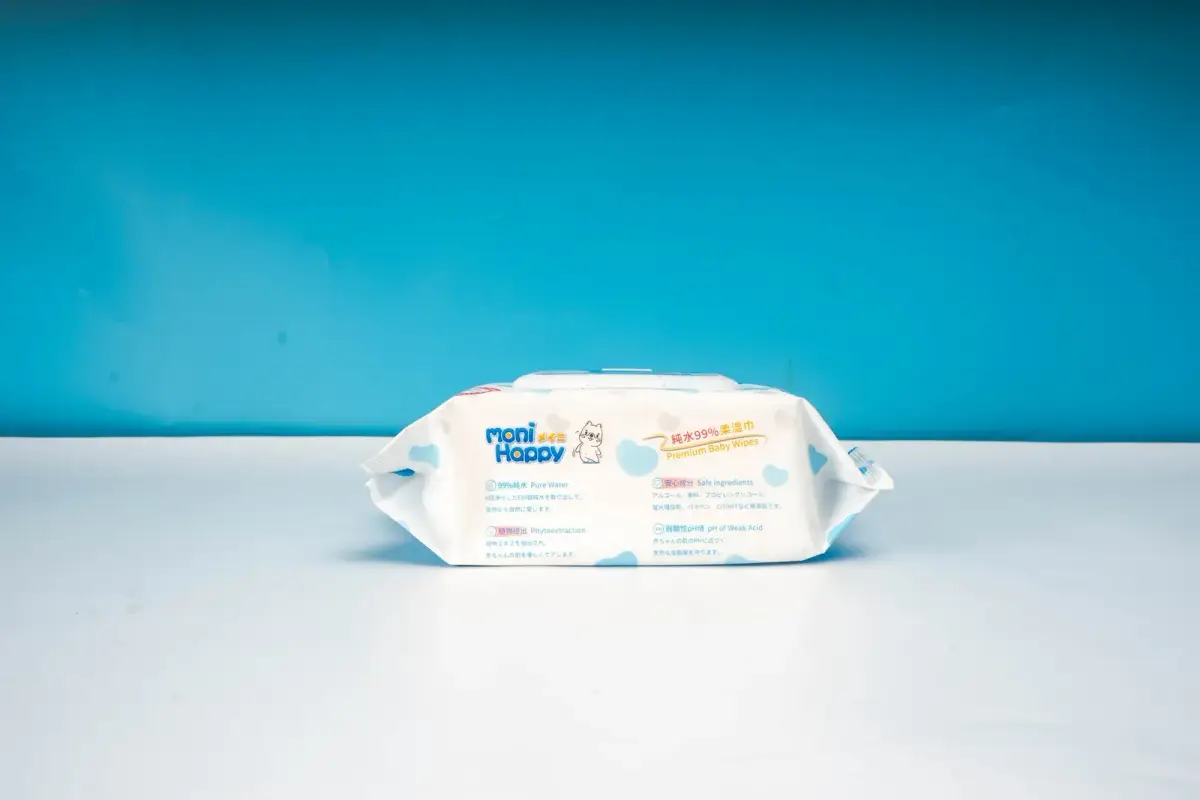
A soft pack is filled, sealed and then passed through a shrink tunnel. The film relaxes in one direction and tightens in the other, so the printed bars change width by 5 to 15 percent depending on where they sit on the panel. A symbol specified at 0.33 mm X-dimension can end up with a 0.28 mm average bar width and uneven ratios, which is enough to drop a verification grade below the 1.5 that most retail groups demand. Gloss film makes it worse by throwing a specular reflection into the scanner.
The fixes cost almost nothing at the design stage. Specify a matte or low-gloss film for the panel that carries the symbol. Keep a quiet zone of at least 3 mm on each side of the bars, because artwork that runs a graphic up to the symbol will fail on that quiet zone alone even when every bar is perfect. Place the barcode away from the seal edge, where the film distorts most. Increase the X-dimension to 0.36 mm or more so there is margin for shrinkage. Then verify on a filled, shrunk bag rather than on a flat artwork proof, because the flat proof will always pass.
What has to appear on the carton besides the barcode?
Six text fields, and the DC checks them before it checks the barcode.
- Quantity. Pieces per bag and bags per carton, both spelled out. On our carton that reads 80 pieces per bag and 24 bags per carton, which is 1,920 pieces.
- Net and gross weight. 13.4 kg and 14.2 kg. A 0.8 kg delta is normal for film plus carton; a delta above 1.5 kg usually means the fill weight has drifted.
- Measurements. Length, width and height in millimetres, in the order the market expects. This is the field that decides the storage charge in a automated warehouse.
- Country of origin. Printed, not stickered, in most ASEAN markets. A sticker over a printed origin is a customs question waiting to happen.
- Lot or batch code and production date. Tied to the date code on the pack, so a recall can trace a carton back to a shift.
- Handling marks. This way up, keep dry, and a stack limit. Wipes cartons stack six high at 14.2 kg and deform at eight.
A shipping mark is read as a set, not as a list of fields. A carton with a perfect ITF-14 and no net weight will still be held at the gate, because the receiving clerk cannot check the pallet weight against the paperwork. The same shipping mark has to match the advance ship notice line for line, including the case count and the lot, or the pallet is set aside for manual reconciliation. Print the shipping mark from the same template that feeds the ASN and the queue disappears; build the template once and it costs nothing after that.

Who owns the GTIN, the brand or the importer?
The party whose name is on the pack, and that is usually the importer rather than the factory.
A GTIN is issued under a GS1 member prefix, and prefixes are licensed per country. A factory in China cannot allocate a Malaysian retail barcode on its own account; the Malaysian brand owner or importer registers with GS1 Malaysia and passes the number to the factory. When a wipes wholesale buyer sells under its own label, the buyer registers the prefix, and the artwork carries the buyer's number, not the factory's.
This trips up first orders constantly. A buyer asks for samples, likes the pack, and only discovers at artwork approval that the barcode on the sample belongs to another customer's prefix, which means the whole wipes wholesale order has to be reprinted with a new number. Reprinting film costs a plate change plus a minimum run, and on a 24-bag carton that can be several thousand bags of waste. Ask for the GTIN allocation before the artwork is finalised, not after.
How do you verify a symbol before the cartons are printed?
By grading a real sample, to a published standard, with a verifier rather than a phone.
ISO/IEC 15416 defines the verification method: a calibrated verifier scans the symbol at a defined aperture and light angle and returns a grade from 0 to 4 for each of several parameters, plus an overall grade. Most retail groups require 1.5 or better, often written as 1.5/06/670, meaning grade 1.5 at a 0.15 mm aperture and 670 nm light. A smartphone app reads a symbol; it does not grade one.
Ask for the verification report with the artwork proof, and keep it on file with the approved carton barcode for every wipes wholesale order. If the supplier cannot produce one, the practical alternative is to have the first carton verified at a local GS1 member organisation or a packaging lab before the full run. On a first order the test costs less than a single chargeback.
What goes wrong at the distribution centre when marks are wrong?
Three costs, and only one of them shows up on an invoice.
The visible cost is a handling charge for re-labelling, commonly USD 30 to 150 per pallet, and it is invoiced against the shipping mark that failed rather than against the supplier's whole delivery. The hidden cost is time: a rejected pallet can sit for a week while the paperwork is corrected, and the shelf goes empty in the meantime. The third cost is the listing itself. A supplier with two chargebacks in a year is the first name removed at the next range review, and no one tells the supplier why.
For a wipes wholesale buyer placing a first order, the cheap insurance is a pre-production check of five things, and a sixth if the delivery is going to a cross-dock: whether the shipping mark includes the store or region code the buyer's own warehouse needs. the GTIN allocation letter, the verification grade on a filled bag, the carton artwork with all six fields, the pallet label sample, and the packaging indicator that matches the pack count. That is a morning of emails against a week of lost shelf time. Our partner team sends the carton artwork and the GTIN allocation together with the price quotation, and the wipes range page lists the pack formats and case counts that the marks have to match.
Frequently asked questions
Can one barcode cover the pack and the carton?
No. The pack needs an EAN-13 and the carton needs an ITF-14, both built on the same GTIN with a packaging indicator in the fourteenth digit. Reusing the pack symbol on the carton makes the DC treat 24 bags as one sellable unit.
Is a QR code a substitute for the EAN-13?
Not at the checkout in most ASEAN retail groups today. QR codes are being added for consumer information, and GS1 Digital Link allows one symbol to carry both, but the retail scanner still expects the EAN-13 during the transition. Print both if a customer asks for the QR.
Does the carton need the expiry date as well as the production date?
Where the market regulates it, yes. Cosmetics-style wipes are usually labelled with a production date and a shelf life in months, so the carton shows both. Printing the derived expiry date as well removes a calculation at the receiving dock.
What X-dimension should the carton symbol use?
Between 0.495 mm and 1.016 mm for an ITF-14 on corrugated board, with the larger end preferred when the board is recycled and the print is flexographic. Smaller symbols on rough board are the second most common cause of DC scan failures after film distortion.
Sources and further reading
- GS1, EAN/UPC barcodes — symbol specifications, X-dimension ranges and quiet zone rules for retail units.
- GS1, GTIN and packaging indicators — how a carton GTIN is derived from the pack GTIN, and why the fourteenth digit changes with pack count.
- ISO/IEC 15416:2016, Bar code print quality test specification — the grading method behind a 1.5/06/670 verification report.
Bottom line. A wipes wholesale carton is judged twice: once by the scanner at the checkout and once by the clerk at the receiving dock. Grade the symbol on a filled bag, print the six text fields on the box, and let the importer own the GTIN. The cost of doing it at artwork stage is a few emails; the cost of doing it late is a reprint and a lost listing.
Frequently Asked Questions
Can one barcode cover the pack and the carton?
No. The pack needs an EAN-13 for the retail scanner and the carton needs an ITF-14 for the distribution centre, and both are built on the same GTIN with a packaging indicator in the fourteenth digit. Using the pack barcode on the carton forces the DC to break the case to count it, which is the fastest way to a handling charge.
Why does a barcode printed on film fail verification?
Shrink film stretches during filling and shrinks during the tunnel, so the printed bars distort in both directions. A symbol that measures 100 percent on the artwork can measure 80 percent on the finished bag. The fix is a bigger X-dimension at the design stage, matte film rather than gloss, and a verification check on a filled bag rather than a flat print.
Who owns the GTIN, the brand or the importer?
The brand owner normally, through a GS1 member prefix in the country where the product is sold. When an importer brings goods under its own name, the importer registers the prefix locally and the factory prints the importer's number. Two owners printing the same GTIN for different products is the mistake that creates duplicate listings.
What happens if a carton mark is missing?
The distribution centre either rejects the pallet or repacks it and invoices the supplier. Common charges run from USD 30 to 150 per pallet for re-labelling, and a rejected delivery can cost a full week of shelf time because the line goes out of stock while the goods sit at the gate.
Distributor resources
If you are evaluating suppliers for your market, these are the pages that answer the commercial questions — in the order buyers usually need them.
