
2026-11-22 · Moni Happy
Which shelf block should a diaper wholesale planogram give a pull-up pants range?
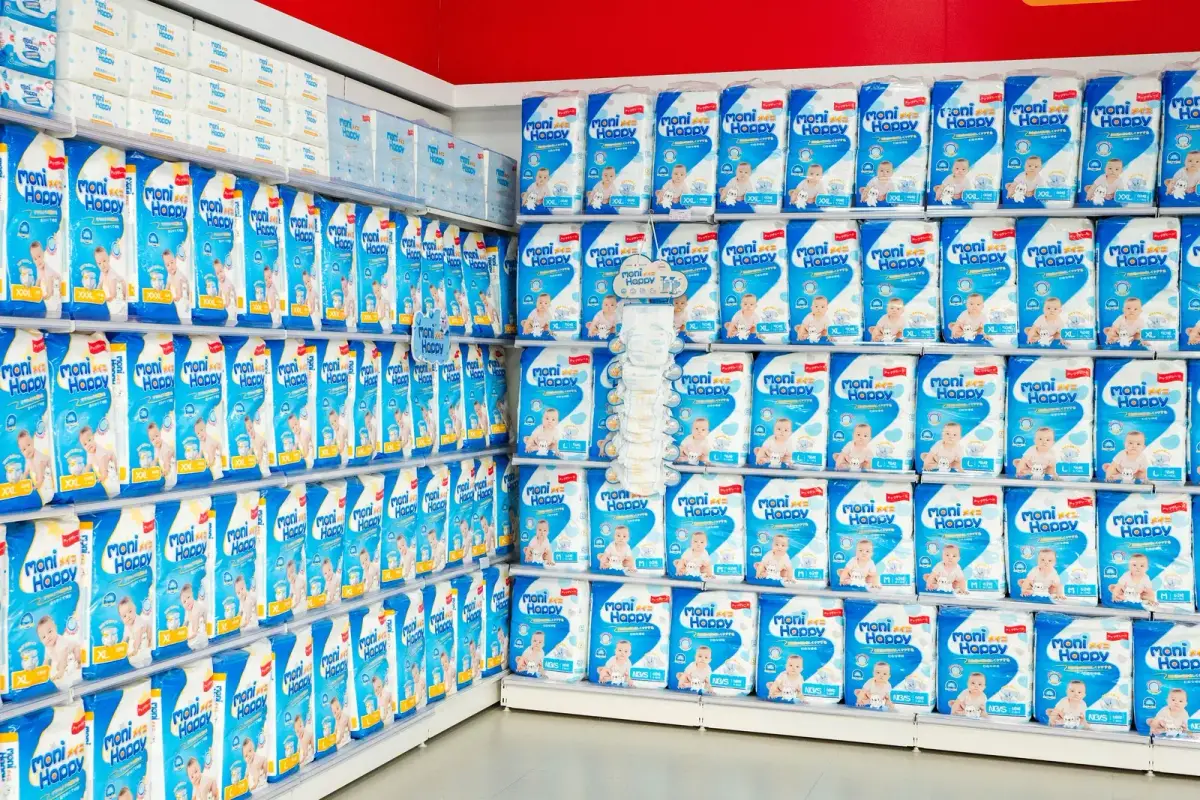
Give a pull-up pants range its own block of four facings at the end of the diaper aisle, not a slot inside the tape diaper block. The packs are shorter and deeper than tape packs, so the same shelf width holds more of them, and a shopper who is switching a toddler out of tape diapers will not find a range that is filed between two tape sizes.
The argument is not aesthetic, and it applies to any diaper wholesale supplier asking for a block on a planogram. Shelf space in a supermarket is allocated by sales per metre per week, and a pants range placed inside a tape block loses between a third and a half of the rate it achieves in its own position. Once that number is on record, the range is cut at the next reset and the distributor loses the only shelf position it had.
How does pack geometry change what fits on a shelf?
A pants pack is a different shape, and the difference is large enough to change the facing count.
A pull up pants pack is sold on a different shopper mission from a tape pack, and that difference is what the planogram has to show. A tape diaper pack in the large size typically measures 30 to 34 centimetres wide, 20 to 24 centimetres tall and 12 to 14 centimetres deep, because the product is folded flat and compressed into a rectangular block. A pants pack of the same size band is usually 22 to 26 centimetres wide, 26 to 30 centimetres tall in the hanging format, and 18 to 22 centimetres deep, because the product is a continuous tube that does not compress the same way. On a standard 1.2 metre shelf with a 30 centimetre depth, that means four tape facings or five pants facings per shelf, and one fewer row of pants because the packs stand taller.
None of this matters to a shopper. It matters to a buyer, because the planogram software allocates facings by width and depth, and a pants pack mixed into a tape run creates a gap at the back of the shelf where the pack does not reach the front rail. Stock falls behind, staff do not see it, and the shelf reads empty while the stockroom holds three cartons.
Why does the shopper not find pants inside the tape block?
Because the two products answer different questions, and the shopper is looking for a step rather than a variant.
Tape diaper shoppers are buying for an infant who lies down to be changed. Pants shoppers are buying for a toddler who stands, and the decision is usually triggered by a change in behaviour rather than by a price comparison. When pants are filed between a tape medium and a tape large, the shelf presents them as a third size option, and the shopper who came for the next step reads the block as more of what she already has.
Position fixes most of it, and it is the part of the argument a buyer can act on without changing the range. Pull up pants bought by a shopper walking the aisle from newborn to toddler need to be visible before she reaches the toddler sizes. The end of the diaper aisle, at knee to waist height, catches the shopper walking the category from newborn to toddler without requiring her to search. In stores with a training or toddler section, the block can sit there instead, but only where the section is large enough that a shopper would walk to it. In a 200 square metre store there is no such section, and the diaper aisle is the only correct location.
How do you prove the case with numbers?
With three numbers the buyer already has: rate per facing, price per piece, and the size ladder.
Take a hypothetical bay. A tape pack of 64 pieces at a shelf price of 18.90 dollars yields 0.295 dollars per piece. A pants pack of 44 pieces at 14.90 dollars yields 0.339 dollars per piece, which is 15 percent more per piece and 13 percent more value per facing when the smaller pack is counted against the wider facing. A four-facing block selling at the category average rate produces more revenue per metre than six facings of the same product filed inside a tape run at two thirds of the rate.
The size ladder is the second argument. Pants are bought by weight band, and a block that runs medium, large and extra large in one vertical column lets a shopper move up without leaving the position. A block split across three tape shelves destroys that column, and the shopper who needs the next size up cannot see that it exists.
What does the distributor have to supply to hold the block?
Four things, and the first two cost almost nothing.
- A shelf strip with the size ladder, printed with weight bands in the local language and a price-per-piece conversion. Staff use it, and so do shoppers.
- A piece-count table for the range, so a buyer comparing two pack counts can see which is cheaper per piece without a calculator.
- Stock discipline. A four-facing block with two empty facings loses the position faster than a two-facing block that is always full. The distributor's own reorder point has to match the block, not the carton.
- A reset calendar. Planograms are revised at fixed points in the year, and the argument for keeping the block has to be made six weeks before the reset with sell-through data attached.
The stock discipline point is the one that decides the outcome. A diaper wholesale supplier that ships a pants range in cartons of 24 packs can keep a four-facing block full in a store selling six packs a week. A supplier shipping in cartons of 60 will either overstock the store or leave the block empty, and both endings lose the position.
When is a separate block the wrong answer?
When the store is too small to carry two sizes, or when the pants range is one SKU dressed up as a range.
Below roughly 150 square metres of selling space, the diaper section may be one metre wide, and a separate block is impossible. In that case the correct play is a vertical column inside the tape block, with the pants packs stacked in the same size band next to their tape equivalent, so the shopper sees both formats at the same weight. It is a compromise, and it still beats a horizontal mix that hides the pants at ankle height.
The single-SKU case is simpler. One pull up pants pack in a two-size market is not a range, and a buyer will treat a request for a block as a request for space without a return. Two sizes and two pack counts is the smallest configuration that can hold a block, and it is also the smallest that can be replenished economically from a factory that runs in cartons.
How does the block interact with the tape diaper range?
It pulls volume upward, and the tape range keeps the newborn and night business.
Households with a toddler commonly keep one tape pack for night use and one pants pack for daytime, so the block adds a pack rather than replacing one. In markets where pants already take most of the large and extra large volume, which is the case in Japan, the block becomes the primary position and the tape range shrinks to newborn and small. In Southeast Asia the shift is earlier in Singapore and later in Vietnam and Laos, and the planogram should follow the local pattern rather than the Japanese one.
That difference is worth raising with a buyer explicitly, because it makes the block a growth argument rather than a space grab. A pants block in a store where pants are 20 percent of the large-size volume is a bet on the next two years; the same block where pants are already half the volume is a correction of a planogram that has fallen behind the shopper.
The full set of channel requirements by market is in the distribution channel guide, and the cost structure behind the price per piece is in the margin guide.
Frequently asked questions
How many facings does a pants range need to justify its own block?
Four facings across two sizes is the practical minimum, because fewer than that reads as a token presence and cannot hold a size ladder. A four-facing block in a 1.2 metre bay takes about 400 millimetres of shelf width, roughly a third of one shelf.
Does a separate block cannibalise tape diaper sales?
It shifts them upward rather than removing them. A household that moves a toddler into pants usually still buys a tape pack for night use, and the pants pack carries a higher price per piece, so category value rises even when the unit count stays flat.
Should pants sit with potty training products instead?
Only in a store large enough to carry a training section. In a small format the diaper aisle is where the shopper looks, so the block belongs at the end of that aisle rather than in another part of the store that the shopper will not walk to.
What does the supplier have to provide for the block?
A shelf strip with the size ladder and weight bands, a piece-count conversion so the shopper can compare price per piece, and stock discipline, because a block with two of four facings empty looks worse than no block at all.
Sources and further reading
- Pampers Japan, product range and pack formats for tape diapers and pants, accessed November 2026 for the format split in a mature pants market.
- ISO 11948-1, absorbent products for incontinence, measurement of absorption capacity, relevant to how pack formats are specified and compared.
- ASEAN Cosmetic Directive, labelling requirements that decide what must be printed on a pack face in member states.
- GS1 GTIN standards, the barcode rules that determine whether a pack can be ranged as a separate SKU on a planogram.
Bottom line. A pants range needs its own block for reasons a buyer can check: the packs are a different shape, the shopper is buying a step rather than a size, and the price per piece supports the space. Four facings, two sizes, a shelf strip and stock that stays full is the configuration that survives a reset.
Our pants range ships in carton counts that keep a four-facing block full, with a size ladder designed for Southeast Asian weight bands. Request pricing and free samples, or see the pants range for pack counts by size.
Frequently Asked Questions
How many facings does a pants range need to justify its own block?
Four facings across two sizes is the practical minimum, because fewer than that reads as a token presence and cannot hold a size ladder. A four-facing block in a 1.2 metre bay takes about 400 millimetres of shelf width, which is roughly a third of one shelf.
Does a separate block cannibalise tape diaper sales?
It shifts them upward rather than removing them. A household that moves a toddler into pants still buys a tape pack for night use in most cases, and the pants pack carries a higher price per piece, so the category value rises even when the unit count stays flat.
Should pants sit with potty training products instead?
Only in a store large enough to carry a training section. In a small format the diaper aisle is where the shopper looks, so the block belongs at the end of that aisle rather than in another part of the store, which the shopper will not walk to.
What does the supplier have to provide for the block?
A shelf strip with the size ladder and weight bands, a piece-count conversion so the shopper can compare price per piece, and stock discipline, because a block with two of four facings empty looks worse than no block at all.
Distributor resources
If you are evaluating suppliers for your market, these are the pages that answer the commercial questions — in the order buyers usually need them.
