
2026-11-21 · Moni Happy
How does a diaper wholesale line get listed at WinMart+ in Vietnam?
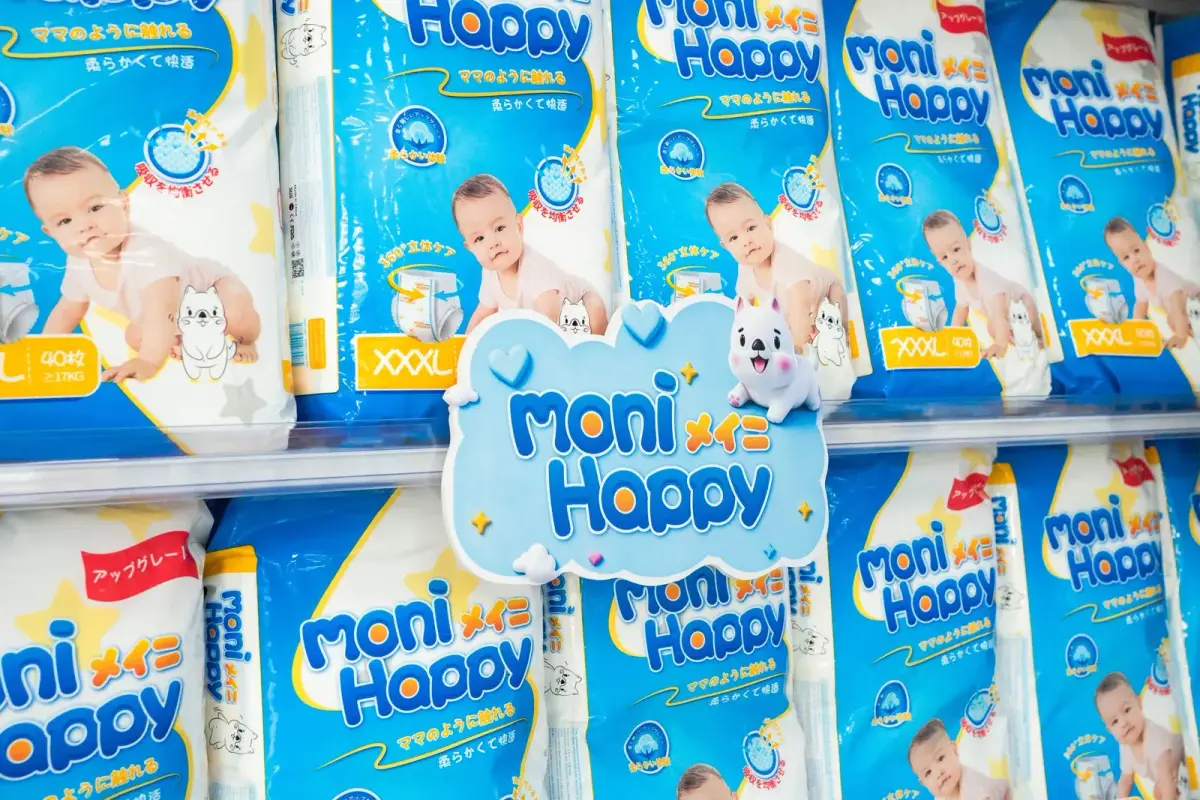
WinMart+ is a minimart network of roughly 4,600 outlets run by WinCommerce under Masan Group, and it decides a listing one SKU at a time. Trade estimates published in 2026 put the listing fee at 10 to 30 million dong per SKU, with total first-year investment including launch support at 30 to 100 million.
That number is small next to the cost of getting it wrong. A diaper wholesale line that lists six SKUs, misses the quarterly sell-through test and gets delisted in month four has spent the fee, the promotional support and the label artwork for nothing, and the chain remembers. The format rewards a narrow entry with stock behind it, and the entry is decided by three things: the label, the size curve and the promotional plan.
Who actually decides a WinMart+ listing?
The category buyer decides, the regional operation confirms, and the shelf decides whether it lasts.
WinCommerce runs several formats under one buying organisation, from large supermarkets to the WinMart+ minimarts that make up most of the estate. The category buyer owns the assortment decision and the commercial terms. The regional operation confirms that the store cluster can carry the facing and the delivery route. Store-level execution then determines whether the SKU survives the next review, which is why a supplier who wins the buyer and loses the store loses the listing anyway.
Approach it as a category conversation rather than a brand conversation. The buyer is comparing your pack against an incumbent on price per piece, shelf yield and promotional contribution, and a supplier who arrives with those three numbers already worked out has a shorter meeting and a better outcome.
What does the listing cost per SKU?
A fee, a launch commitment, and a promotional line that is negotiated rather than published.
The published trade estimates for 2026 put the fee at 10 to 30 million dong per SKU, varying with category and with whether the listing is Ho Chi Minh City only or national. Beyond the fee sits the launch programme: end-cap or gondola-end placement, a promotional price for the first cycle, and the cost of a brand representative visiting stores. Together those are estimated at 30 to 100 million dong for a first-year entry.
Treat all of it as negotiable and quote-dependent. The fee structure changes by category and by season, and any figure in this article is an order of magnitude for planning, not a quotation. What does not change is the arithmetic a supplier should run before the meeting: fee plus launch support divided by the units the listing is expected to move in twelve months, compared against the gross margin those units carry. If the sum does not clear, the listing is a marketing expense and should be budgeted as one.
Why must the Vietnamese label be printed before the container leaves?
Because customs can refuse an unlabelled shipment, and the chain will not accept one.
Vietnamese rules require a Vietnamese-language label carrying the product name, ingredients or composition, net content, batch and expiry date, storage instructions, origin, and the name and address of the importer. For imported goods the label has to be in place before clearance, and the practical reading is that it should be printed at origin rather than applied on arrival. A sticker applied in a warehouse in Binh Duong is legal if it is done properly, and it is still a cost, a delay and a quality risk on every subsequent order.

The label also has to match the artwork the buyer approved, which is why the artwork sign-off belongs before the print run and not after. A size band printed with the wrong weight range is not a labelling technicality in this category; it is a product that gets returned.
Which two or three SKUs should the first order carry?
The two size bands that cover the local birth-weight distribution, plus one pull-up pants line as the trade-up.
Vietnam's birth weight distribution clusters around 2.8 to 3.4 kilograms, which puts most newborns in the newborn and small bands for the first six to eight weeks and then into medium. A first listing built on that curve carries newborn or small, medium, and one pull-up pants size for the 9 to 14 kilogram child. The larger bands are where the volume sits for a family already buying, and where the shelf competition is worst.
Wet wipes are worth considering as an attached SKU rather than a standalone entry, because the pack sits next to the diapers and the buyer sees it as a basket builder rather than a new category decision. Two diaper SKUs and one wipes SKU is a cleaner first conversation than five diaper SKUs.
How does the quarterly sell-through review work?
Reported practice is a review each quarter against a sell-through threshold, with delisting or markdown pressure below it.
The threshold quoted in trade reporting for 2026 is 60 percent quarterly sell-through, below which the SKU faces delisting or a markdown request. Whether the exact figure applies to a given category is a negotiation, but the mechanism is real and it runs on a calendar. That means the first ninety days are the whole game, and the plan for them has to be built before the listing is signed.
Three elements belong in that plan. A launch promotion funded from the listing budget rather than from the unit price. Store coverage in the clusters with the highest birth rates, because a minimart in a district with young families sells diapers and one in a business district does not. And a replenishment rhythm that keeps the facing full, since an out-of-stock week is a week of lost sell-through that the quarterly number still counts.
What payment terms and deductions should a supplier expect?
Sixty to ninety days on the invoice, with promotional and logistics deductions on top.
Reported modern trade terms in Vietnam run from 60 to 90 days, and the deductions are where the margin actually goes: promotional support, display rental, and a logistics or distribution charge that trade reporting puts around 7 percent of contract value in some programmes. None of those is hidden, and all of them should be capped in writing as an annual percentage of contract value before the first purchase order.
For a first container the working capital maths is unforgiving. Goods are paid for at the factory, sit in transit for two to three weeks, clear customs, sit in the chain's warehouse, sell through over a quarter, and are paid for ninety days after invoice. A supplier who plans on 45 days is planning to run out of cash in month four.
How do you stop traditional trade from undercutting the shelf price?
By giving modern trade its own pack size, and by not fighting a price war the format cannot win.
A WinMart+ shelf sits a few hundred metres from a tạp hóa that sells the same brand cheaper, because the traditional shop has no listing fee, no promotional contribution and no 90-day receivable to fund. Trying to match that price on the modern trade shelf destroys the margin that pays for the listing. The workable answer is a pack size that exists only in modern trade: a different piece count, a different format, a bundle that cannot be compared unit for unit.
This is standard practice in the market and buyers expect it. A supplier who proposes it in the first meeting is signalling that the price architecture has been thought through, which is a better opening than a discount.
Frequently asked questions
Does WinMart+ buy the stock or take it on consignment?
It buys. Vietnamese modern trade runs on a wholesale relationship with agreed payment terms, so the supplier invoices the chain and carries the receivable rather than settling per unit sold.
Can the Vietnamese label be applied in the warehouse?
It should not be relied on. Customs can block a shipment that arrives without a compliant Vietnamese label, and relabelling after clearance is a cost and a delay on every future order.
How many SKUs should a first listing carry?
Two or three. Each SKU carries its own fee and its own delisting risk, and a minimart shelf will not hold eight size bands of one brand.
What payment terms are normal in Vietnamese modern trade?
Reported terms run from 60 to 90 days. Model the working capital on 90 days, because the first order is paid for at the factory long before the chain pays you.
Sources and further reading
- WinMart, store network and format information, accessed November 2026.
- Vietnam Ministry of Finance, customs valuation and import duty guidance for consumer goods.
- ASEAN Tariff Finder, checked November 2026 for HS 9619.00 duty treatment into Vietnam under ACFTA.
- Trade reporting on Vietnamese modern trade listing costs and sell-through reviews, 2026, used here as order-of-magnitude estimates rather than quotations.
Bottom line. A WinMart+ listing is a ninety-day test with an upfront fee attached, so the entry has to be narrow, labelled correctly and funded for the launch. Print the Vietnamese label at origin, bring two diaper size bands and one wipes SKU, cap the deductions before signing, and plan the cash on 90 days. A diaper wholesale line that does those four things has a quarter to prove itself; one that lists six SKUs to look complete usually does not get the second quarter.
We prepare Vietnam-bound orders with the Vietnamese label printed at origin and a size curve built for the local birth-weight distribution. Request pricing and free samples, or read the distributor onboarding guide before the first buyer meeting.
Frequently Asked Questions
Does WinMart+ buy the stock or take it on consignment?
It buys. Modern trade in Vietnam operates on a wholesale relationship with agreed payment terms, so the supplier invoices the chain and carries the receivable, rather than settling per unit sold.
Can the Vietnamese label be applied in the warehouse?
It should not be relied on. Customs can block a shipment that arrives without a compliant Vietnamese label, and a label applied after clearance is a cost and a delay on every future order.
How many SKUs should a first listing carry?
Two or three. Each SKU carries its own fee and its own delisting risk, and a minimart shelf will not carry eight size bands of one brand. Pick the two size bands that match the local birth-weight distribution and add one pull-up pants line.
What payment terms are normal in Vietnamese modern trade?
Reported terms run from 60 to 90 days for modern trade suppliers. Model the working capital on 90 days, because the first order is paid for at the factory long before the chain pays you.
Distributor resources
If you are evaluating suppliers for your market, these are the pages that answer the commercial questions — in the order buyers usually need them.
