
2026-11-21 · Moni Happy
How does a diaper wholesale line win a RedMart vendor slot in Singapore?

RedMart is two doors, not one. Either RedMart buys your stock at an agreed wholesale price and resells it, in which case there is no commission, or you sell as a Lazada marketplace seller and pay a category commission. Both routes require the goods to be sitting in Singapore, and both are decided on pack size before they are decided on price.
Singapore is a small market with an unusually concentrated grocery trade, and the online slice of it behaves like a convenience channel rather than a discount channel. A shopper ordering at 7pm for a two-hour slot is buying one pack, not a case. A diaper wholesale line that arrives with only jumbo cartons has nothing to sell into that basket, however good the per-piece price looks on the quotation.
Which of RedMart's two doors should a diaper wholesale line knock on?
Start with the retail door if you can carry the stock, and use the marketplace door to test pack sizes.
The retail model is a straightforward wholesale relationship. RedMart buys, owns the inventory and sets the shelf price, so your commercial conversation is about the wholesale price, the delivery terms into their warehouse and the promotional calendar. There is no commission line and no marketplace fee, and the price you agree is the price you get, less any agreed promotional funding.
The marketplace model is a Lazada seller account with RedMart as the fulfilment and delivery promise behind it. You keep control of price and content, you pay a category commission, and you carry the returns. Reported commission rates on LazMall sit at 3 to 5 percent depending on category, which on a pack retailing at 12 Singapore dollars is 36 to 60 cents, comparable to a mid-single-digit wholesale discount. The two models converge on cost more than the headline suggests, and they differ on who carries the inventory risk.
What does seven-day fulfilment actually require?
Stock in the country, a barcode that scans first time, and a cut-off you can hit every day.
RedMart's operating promise is delivery in a chosen two-hour window, seven days a week. That promise is only possible if the inventory is already inside a Singapore fulfilment operation when the order drops, which rules out the ship-on-demand model that works for cross-border sellers. In practice the supplier either holds stock in a third-party warehouse or ships into the platform's own facility, and either way the requirement is the same: units available, labelled, and replenished before the sell-through curve runs down.
Availability is measured, not assumed. A line that goes out of stock twice in a quarter loses its search placement and usually its promotional slot with it. For a diaper wholesale brand entering with three SKUs, the honest calculation is whether four weeks of cover can be held in Singapore without turning the working capital into a problem. If the answer is no, the marketplace door with a narrower range is the better first step.
Why does pack size decide the slot more than price?
Because the delivery economics are volumetric, and the basket is small.
A diaper carton takes shelf space in a picking centre and cubic space in a delivery bag or tote. A jumbo pack of 80 pieces is roughly a third of a tote on its own, so a shopper adding one pack and a litre of milk fills the bag. The platform would rather sell two smaller packs at a higher price per piece than one pack that consumes the whole delivery slot. This is the opposite of the hypermarket logic, where the jumbo pack wins on shelf yield.
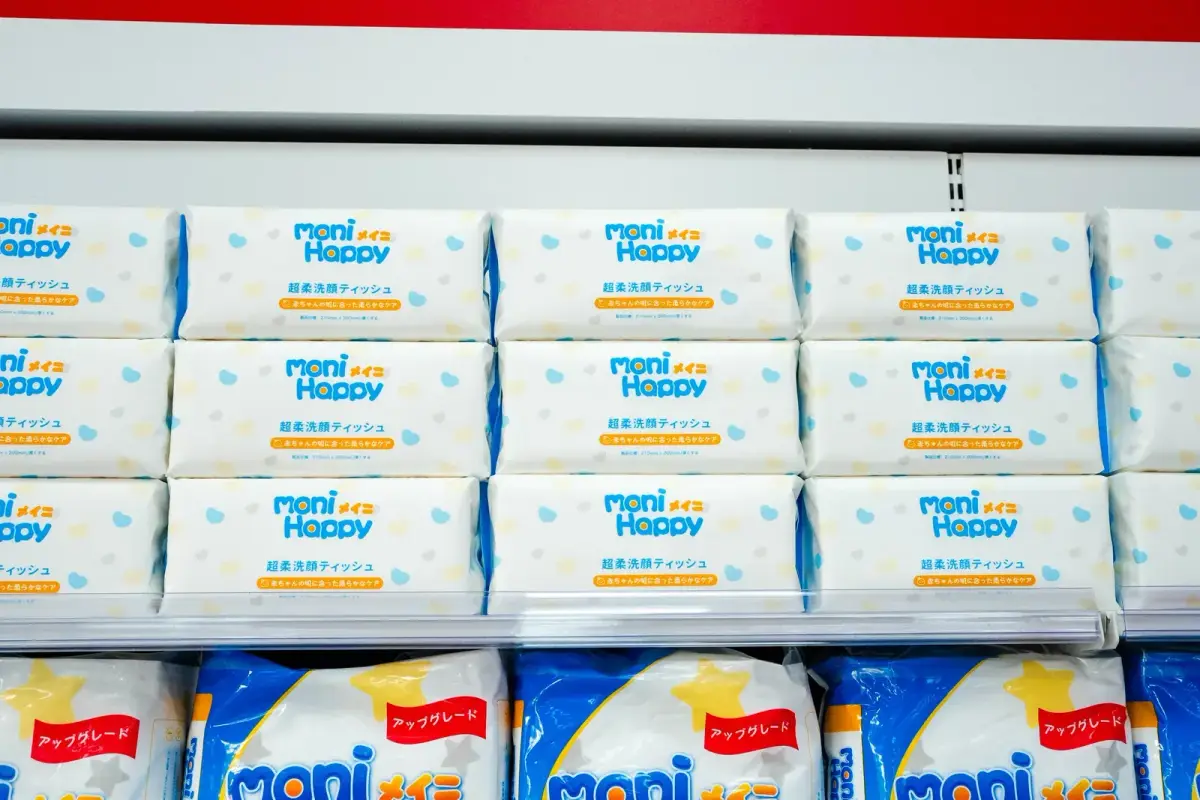
The practical answer is a channel-specific range. Two or three pack sizes, one of them small enough to be an add-on, with a price per piece that reads well on a comparison screen. Shoppers on a grocery app compare per-piece prices in a way they rarely do in a store aisle, because the app shows them all at once.
Which labels and paperwork does a Singapore grocery buyer check?
Six items, and a missing one stops the listing rather than delaying it.
- English labelling with product name, size band, piece count, batch code and expiry or best-before date.
- Importer name and address, printed on the pack. A sticker applied in the warehouse is a red flag for a grocery buyer.
- Country of origin, stated on the pack.
- A barcode that scans against the platform's catalogue entry, with the carton barcode matching the unit barcode hierarchy.
- Company registration and a GST registration number once turnover crosses the threshold.
- Product safety documentation for the category, kept on file rather than submitted with every order.
None of this is exotic. The failure mode is timing: a buyer who approves a range in week two and finds the packs cannot be scanned in week six has lost the season, and the next review is a quarter away.
How is GST handled on the invoice?
At 9 percent, charged on the supply, and it is a cash flow item rather than a cost for a registered business.
GST registration is compulsory once taxable turnover exceeds one million Singapore dollars, and voluntary registration is possible below that. A registered supplier charges 9 percent on the invoice and recovers the input tax on its own purchases, so the net effect on margin is close to neutral, but the cash timing is not: the tax is collected and remitted on a quarterly cycle while the receivable from the platform may take longer to arrive. On a first order of 30,000 Singapore dollars, that is 2,700 dollars of tax to fund before the money comes back.
How fast does the money come back?
Weekly on the marketplace side, and on negotiated terms on the retail side.
Lazada settles marketplace sellers on a weekly cycle, which is fast by regional standards, and it is one of the real advantages of the online channel over a supermarket listing that pays in 60 to 90 days. The retail model with RedMart follows the wholesale relationship instead, so terms are negotiated and usually land between 30 and 60 days. Either way, the number that matters for a first container is the cash conversion cycle: goods paid for at the factory, in transit for two to three weeks, in stock for four, then collected.
What kills a listing after three months?
Three things, and none of them is price.
Stockouts top the list, because the platform measures availability and demotes what it cannot ship. Slow sell-through comes second: a line that does not move in its first quarter loses its second order, and a diaper wholesale range with four size bands usually has one band doing most of the work. Returns come third, and for diapers the returns are mostly fit complaints, which trace back to a size band that does not match the local birth-weight distribution.
The fix is unglamorous. Launch with two or three SKUs, keep four weeks of cover on the fastest mover, and review the size mix at eight weeks rather than at the end of the first quarter. A narrow range that stays in stock outperforms a broad range that flickers in and out.
Frequently asked questions
Does RedMart charge a listing fee?
On the retail model there is no commission, because RedMart buys and resells the stock, so the margin sits in the agreed wholesale price. On the marketplace model you pay a category commission, reported at 3 to 5 percent for most fast-moving categories on LazMall.
Can I ship directly from China to a Singapore shopper?
Not through this channel. The two-hour delivery promise requires stock in a Singapore fulfilment set-up before the order arrives, and cross-border parcels run on a different timeline.
Do diaper packs need a Chinese label in Singapore?
English labelling with an importer name and address is what is required. Bilingual English and Chinese text helps in heartland stores, but for this category it is a commercial choice rather than a legal one.
How long does onboarding take?
Four to eight weeks from first contact to first purchase order is realistic, provided the product is already in Singapore and the pack sizes are agreed. Missing stock or relabelling stretches it to a quarter.
Sources and further reading
- Sell on RedMart, Lazada Singapore seller page, accessed November 2026 for the seller model and delivery proposition.
- Inland Revenue Authority of Singapore, current GST rates, 9 percent from 1 January 2024.
- Enterprise Singapore, company registration and GST registration thresholds.
- ASEAN Tariff Finder, checked November 2026 for import duty on HS 9619.00 into Singapore.
Bottom line. The Singapore online grocery channel rewards a narrow range that stays in stock over a broad range that looks complete on paper. Pick the door that matches your ability to hold stock locally, build the assortment around the delivery basket rather than the shelf, and get the barcode and importer label right before the buyer meeting. A diaper wholesale line that does those three things gets a second order; one that does not gets a delisting email in week ten.
We supply Singapore and Malaysia accounts with channel-specific pack sizes and English plus Japanese labelling already printed, so the listing conversation starts with the assortment rather than with a relabelling job. Request pricing and free samples, or read the distribution channel guide for the rest of the market.
Frequently Asked Questions
Does RedMart charge a listing fee?
On the retail model there is no commission, because RedMart buys the stock and resells it, so the margin sits in the wholesale price you agree. On the marketplace model you pay a category commission instead, reported at 3 to 5 percent for most fast-moving categories on LazMall.
Can I ship directly from China to a Singapore shopper?
Not through this channel. RedMart's promise is a two-hour delivery slot, which requires the stock to be in a Singapore fulfilment set-up before the order arrives. Cross-border parcels run on a different timeline entirely.
Do diaper packs need a Chinese label in Singapore?
English is the working language for labelling, and an importer name and address is required. Bilingual English and Chinese text helps in heartland stores, but it is a commercial choice, not a legal one for this category.
How long does onboarding take?
Four to eight weeks is realistic from first contact to first purchase order, provided the product is already in Singapore and the pack sizes are agreed. Missing stock or a relabelling job is what stretches it to a quarter.
Distributor resources
If you are evaluating suppliers for your market, these are the pages that answer the commercial questions — in the order buyers usually need them.
