
2026-11-23 · Moni Happy
How many open-close cycles should a wipes wholesale lid sticker survive?
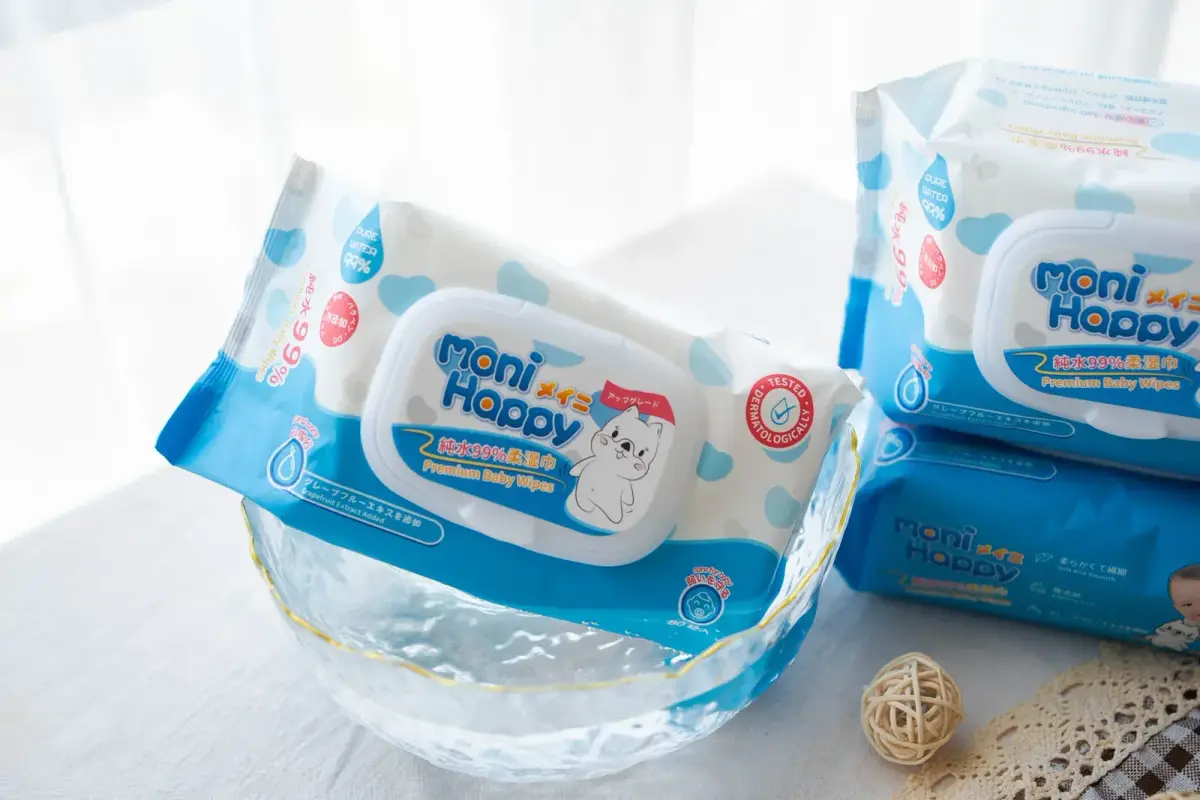
Two hundred open-close cycles, with at least 70 percent of the original peel strength left at the end, tested at 30 degrees Celsius and 75 percent relative humidity. That is the number to put in the purchase order. A sticker rated at 300 cycles in a 23 degree laboratory can lose its tack at 80 cycles on a shop shelf at 35 degrees, and the pack dries from the top down long before the date code arrives.
Wet wipes fail in public in a specific way. The top three wipes go crisp, the customer opens the next pack on the shelf to check, and the retailer returns the whole outer carton. None of that appears in a specification that only mentions grams per square metre and liquid load.
Why does the lid sticker decide whether a pack sells through?
Because it is the only part of the pack the shopper touches before buying, and the only part that has to work after.
A soft pack of 80 pieces will take 60 to 80 open-close cycles in a household, spread over three to five weeks. In a shop, the same pack may be opened by ten different shoppers before it is bought, each one lifting the sticker, pulling a wipe, and pressing it back with fingers that may be damp or dusty. Add a stockroom that reaches 38 degrees in the afternoon and a delivery truck with no climate control, and the adhesive is being asked to do more than the laboratory tested. For a wipes wholesale buyer the lid sticker is the one component that has to work after the sale, and it is the one most often left out of the specification.
What should an open-close cycles specification contain?
Four fields, and a supplier who cannot state all four is guessing.
- Cycle count. 200 open-close cycles is far beyond normal use, leaving margin for stockroom handling. Below 150 the failure rate in hot climates climbs sharply; above 300 the adhesive cost rises without a visible benefit.
- Peel retention. The peel adhesion needed to lift the lid sticker after 200 cycles, expressed as a percentage of the first lift. Seventy percent is a working floor. Under 50 percent the sticker lifts at the corner and never reseals flat.
- Test condition. 30 degrees and 75 percent relative humidity, not the standard laboratory 23 degrees and 50 percent. This single line explains most of the difference between a pack that works in Fukuoka and one that fails in Bangkok.
- Drying rate. Weight loss of an opened pack left face up for 30 minutes. Under 2 percent of pack weight is a reasonable gate, and it catches edge-seal faults that a peel test misses.
Where does a lid sticker fail first?
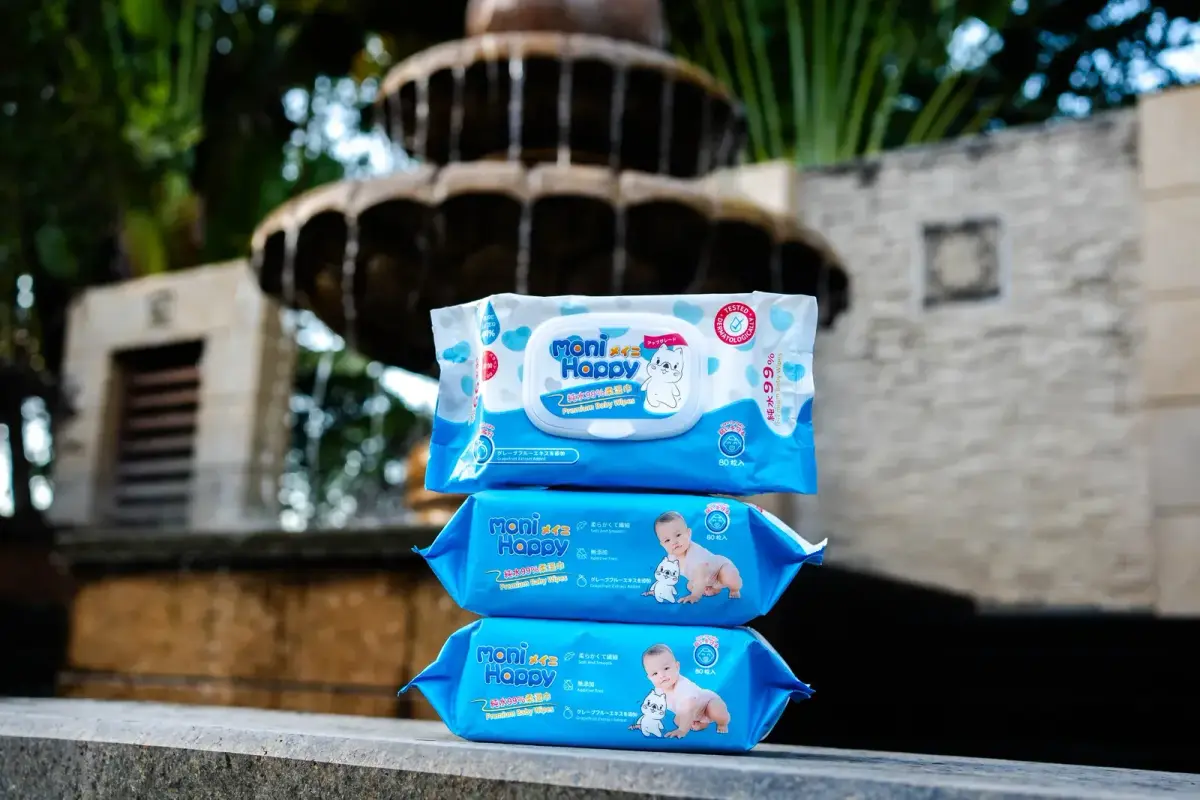
At the corners, and usually within the first twenty cycles.
Peel adhesion holds best in the middle of a flat surface. The corners of a soft pack are where the film flexes, and flexing lifts the edge by a fraction of a millimetre each time. Once a corner lifts, dust collects under it, the seal never closes fully, and the top wipes lose moisture at a rate the customer can feel. Suppliers who test only the centre peel adhesion will report a passing result on a sticker that has already failed at the corner.
Two design changes reduce this without adding material. A lid sticker with rounded corners rather than square ones removes the point where lifting starts. A slight overhang on the lift tab, 8 to 10 mm, means the shopper pulls the tab instead of picking at the corner with a fingernail, which is where most mechanical damage happens.
Does a hard flip-top lid beat a lid sticker over a pack life?
It does when the pack will be opened daily for more than a month, and it does not on a small pack.
A moulded polypropylene lid with a hinged cap costs roughly USD 0.008 to 0.015 more per pack than a printed lid sticker, and it holds its shape through 500 open-close cycles. On an 80-piece pack retailing at the equivalent of USD 1.50 to 2.50, that is under 1 percent of the retail price and it removes the drying complaint almost entirely. On a 10-piece sample pack the same lid is 5 percent of the pack cost and the customer will finish the pack in four days, so the sticker is the right choice.
The decision also depends on how the pack is merchandised. Packs that hang on a strip in a hot aisle need the harder lid, because the sticker is being compressed by the pack above it and lifted by every shopper. Packs that sit on a shelf in a carton display, protected from compression, do fine with a good sticker. The wet wipes range is produced in both formats for this reason.
How does the lid interact with the liquid load?
A wetter pack hides a bad lid for a while, then fails harder.
Liquid load, the ratio of solution to substrate weight, usually sits between 2.5 and 3.5 grams of liquid per gram of dry substrate for a baby wipe. A pack at the top of that range has more water to lose before the top wipe feels dry, so a weak sticker passes the first month and fails in the second. A pack at the bottom of the range feels dry within a week of a corner lifting, which is why a wipes wholesale spec has to name the load ratio and the lid together.
Neither number is right on its own. The pair has to be specified together: load ratio, pack count, film thickness and lid type. Film below 60 microns thick flexes more at the corners, which accelerates the lift described above. A 70 to 90 micron printed film with a rounded sticker and a 3.0 load ratio is the combination that survives a Southeast Asian shelf, and it is also the combination that keeps the pack feeling full at the halfway point.
What should a distributor do when packs come back dry?
Weigh three packs from the same carton before calling the supplier.
Record the weight of a sealed pack, then the weight after 30 minutes open, then the weight after 200 manual cycles. A sealed pack that is already 4 to 6 grams under its declared weight was underfilled at the line, and no lid design will fix that. A pack that holds its sealed weight but loses 5 grams in 30 minutes has a lid or edge-seal fault. A pack that passes both tests but still feels dry to customers has a load ratio set too low for the climate.
Those three tests let a wipes wholesale buyer separate a production fault from a specification fault, and they decide who pays. Suppliers will replace a carton with an underfill; they will argue about a specification they were never given. Put the cycle count, the retention figure and the test condition into the purchase order, and the argument becomes a measurement. Buyers who want the specification reviewed against their market can send the requirement through the partner desk.
Frequently asked questions
Should the cycle test use one pack or several?
At least five packs from three different production lots. Adhesive coat weight varies across a run, and a single pack can pass while the lot average fails. Five packs give a supplier something to argue with and a buyer something to hold.
Does printing on the sticker weaken it?
It can. A heavy ink coverage over the adhesive area stiffens the film and reduces conformability, which shows up as corner lift after 40 to 60 cycles. Keep print off the outer 5 mm of the sticker and the effect disappears.
Is a zipper closure better than a sticker?
For 100-piece packs, often yes, because the slider spreads the load and reseals without adhesive. Below 60 pieces the zipper adds cost and bulk that the pack cannot absorb, and the sticker remains the practical choice.
How long should an opened pack stay usable on a wipes wholesale shelf?
Two to three months in a climate-controlled room, and four to six weeks in an unairconditioned shop. Write that expectation into the training material for retail staff, because a pack left open on a counter overnight is not a manufacturing fault.
Sources and further reading
ASTM D3330 covers peel adhesion of pressure-sensitive tape, the method behind the retention figure in this specification: ASTM D3330/D3330M.
ISO 11930 sets out the antimicrobial protection test for cosmetic products, which governs how much preservation a wet wipe needs when the pack is repeatedly opened: ISO 11930:2019.
Dermatest publishes the patch-test protocol behind the five-star rating carried on this range, including the 24, 48 and 72 hour reading points: Dermatest Institute.
Bottom line: the lid sticker is a specified component, not a detail left to the converter, and the figures belong in a wipes wholesale purchase order. Write 200 cycles, 70 percent peel retention, 30 degrees and 75 percent humidity, and a 2 percent drying gate into the purchase order, then verify with five packs from three lots. Distributors comparing pack formats across markets can request the current specification sheet through the partner desk.
Frequently Asked Questions
Is there an official standard for lid cycles?
Not for baby wipes specifically. The nearest published methods cover the adhesive itself, such as ASTM D3330 for peel adhesion, and the preservative system, such as ISO 11930 for antimicrobial protection. A cycle count has to be agreed between buyer and seller and written into the specification.
Why does a lid fail faster in Southeast Asia?
Heat softens the adhesive and humidity weakens the bond at the edges. A sticker that holds for 300 cycles in a 23C laboratory can lose tack at 80 cycles on a shelf where the afternoon temperature reaches 35C, which is why the test condition matters as much as the cycle number.
Does a hard plastic flip-top beat a sticker?
It survives more cycles and keeps its shape, at roughly USD 0.008 to 0.015 more per pack. For a pack that will be opened daily for six weeks, the hard lid is usually the cheaper choice once returns are counted. For a single-use pack, the sticker is enough.
How do I check the claim without a lab?
Open and close one pack 50 times in a row, leave it open for 30 minutes, then weigh it. A pack that loses more than 2 percent of its weight has an edge-seal problem, and the same pack will dry out on a shelf within a month.
Distributor resources
If you are evaluating suppliers for your market, these are the pages that answer the commercial questions — in the order buyers usually need them.
