
2026-11-22 · Moni Happy
What does a preservative-free claim require on a wipes wholesale line?
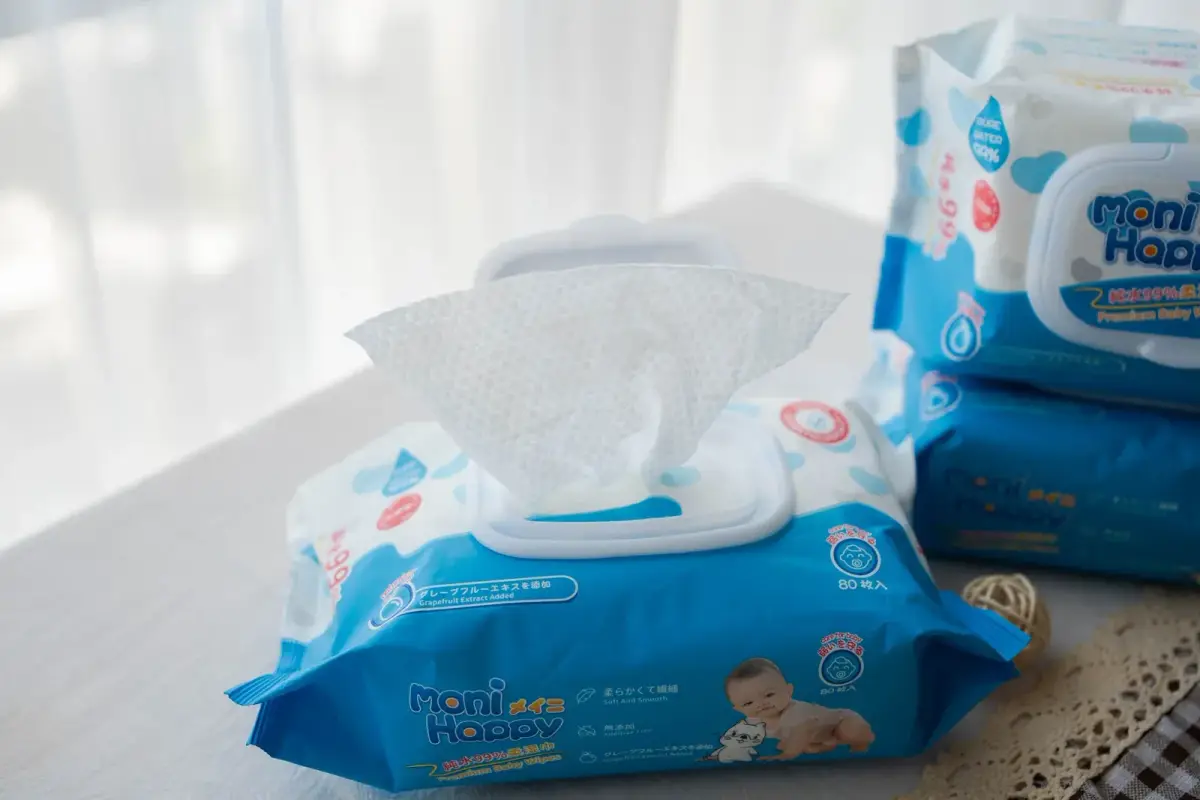
A preservative-free claim on a wet wipes pack is not a formulation choice, it is a file of evidence. It needs three things: water purified to a controlled bioburden, a finished-product test to ISO 11930 or a documented low-risk assessment under ISO 29621, and a pack that holds its seal for the whole shelf life. Without all three, the claim is a printing decision that a regulator can unpick in an afternoon.
Wet wipes are a high-water product. A pack at 80 sheets holds roughly 40 to 45 grams of liquid per 100 grams of product, and that liquid is an environment where bacteria and mould grow if nothing stops them. A preserved formula stops them with a chemical. A preservative-free formula has to stop them with process, packaging and formulation discipline instead.
What does preservative-free actually exclude?
It excludes the substances on the permitted preservative list, which is a shorter list than most buyers expect.
Under the EU cosmetics regulation and the ASEAN Cosmetic Directive that mirrors its annexes, a finite set of substances may be used as preservatives, each with a maximum concentration. Phenoxyethanol at 1 percent, benzoic acid and its sodium salt at 0.5 percent as acid, sorbic acid and potassium sorbate at 0.6 percent as acid, benzyl alcohol at 1 percent, and a handful of others. A claim of preservative-free means none of them appears above the trace level that comes from raw materials, and the trace level itself has to be declared in the product information file.
That is where the first argument usually starts. A supplier reformulates by removing phenoxyethanol, keeps the same water and the same nonwoven, and prints the claim. The pack passes the first month. Then a container sits in a warehouse in Ho Chi Minh City through a hot wet season, and the sheets at the bottom of the pack develop a smell that no one can attribute to anything. A wipes wholesale buyer who has not read the microbiological data will discover the problem from a retailer's complaint, not from a lab report.
Which test actually supports the claim?
Two documents do the work, and they do different jobs.
The first is a preservative efficacy test to ISO 11930. It inoculates the finished product with named organisms, including Staphylococcus aureus, Pseudomonas aeruginosa, Candida albicans and Aspergillus brasiliensis, then counts survivors at 7, 14 and 28 days. A preserved product has to show a defined log reduction. A preservative-free product cannot pass that test by definition, which is why the second document exists.
The second is a microbiological risk assessment under ISO 29621, which sets out the conditions under which a product can be judged low risk and tested differently. Low water activity, an extreme pH, a self-preserving formulation or a single-use format can qualify. For a wet wipe at neutral pH and high water content the case has to be built on process control: purified water, filtration, a controlled filling environment, and a validated hold time for the wet substrate before it goes into the pack.
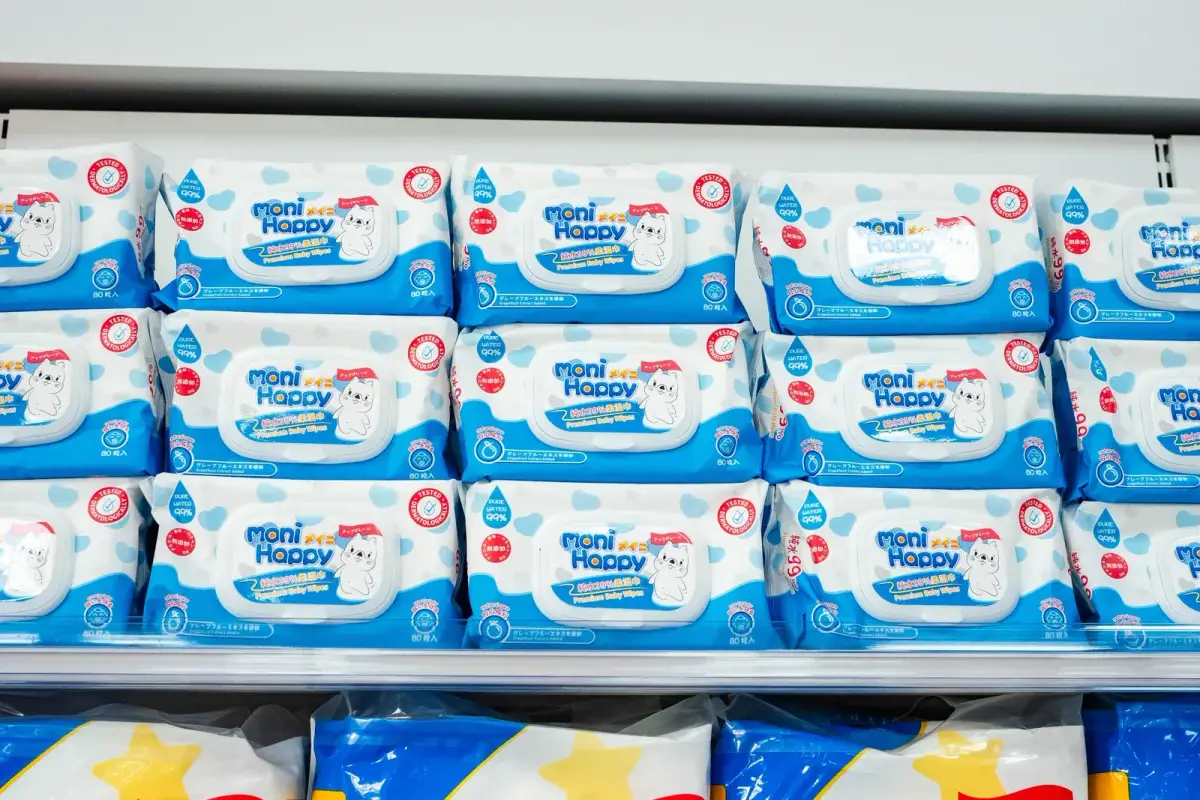
Why does the pack matter as much as the formula?
Because the claim is true in a sealed pack and starts to decay the moment the seal is opened.
A pack that loses 3 grams of water a month through a weak seal does two things at once. It dries at the top, which customers notice, and it changes the water activity of the remaining sheets, which the microbiology does not forgive. The variables that matter are the film structure, the lid gasket, and the force needed to reclose. A common structure for this category is a laminated film with a metallised or aluminium-bearing layer, 90 to 110 microns thick, with a recloseable lid of 1.5 to 2.5 N opening force. Cheaper mono-layer film passes the drop test and fails the twelve-month storage test.
For a wipes wholesale buyer the practical question is not the film spec but the evidence. Ask for the water loss data from a stability trial, ask at what temperature it was run, and ask whether the trial used the production pack or a laboratory pouch. A trial on a lab pouch tells you about the formula. A trial on the production pack tells you what the retailer will receive.
How does the claim interact with cosmetic regulation in the region?
It turns a bulk product into a labelled cosmetic, and that is a different compliance track.
Baby wipes sold as a cosmetic in the ASEAN markets need a notification or registration depending on the country, a product information file held by the responsible party, and labelling that lists ingredients by INCI name. In Vietnam the publication number is issued through the health authority, in Thailand the notification goes through the FDA, in Malaysia through NPRA, and in Singapore the cosmetic notification sits with HSA. The claim itself is treated as a marketing statement that must be verifiable, and a claim in a language the local authority cannot read is a claim that will be questioned at import.
Wipes that are sold for a medical or disinfecting purpose follow a different track entirely, with a different set of permitted claims. A supplier that markets one product under two claims across two channels is creating a file that contradicts itself, and a distributor inherits the problem when the first shipment is held.
What should a buyer ask for before signing off the artwork?
Five documents, in this order, and none of them is a substitute for another.
- The formulation sheet, listing every ingredient with its function, so the absence of a preservative can be checked against the annex rather than taken on trust.
- The microbiological report, either a challenge test to ISO 11930 or a low-risk assessment to ISO 29621, with sample dates, organisms and results.
- The stability data, at least one trial at 40 degrees Celsius for three months and one at ambient for the claimed shelf life, run on the production pack.
- The pack specification, film structure, thickness, lid gasket material and water loss per pack per month.
- The claim wording in each target language, agreed before printing, because relabelling a container at the destination costs more than the entire print run.
Two of these are also the documents a retailer's quality team will ask for when the line is presented for listing. Having them ready shortens the listing conversation by weeks, and it is the difference between a distributor who is trusted with a category and one who is asked to resupply a single SKU.
Where does the claim fit on a shelf in this region?
It fits where a shopper is already worried about what touches newborn skin, which is a narrower space than the whole category.
In Singapore and Malaysia the claim sells against a shelf of imported Japanese and Korean packs at a premium. In Vietnam and Thailand it sells at the mid tier, where the price gap to a preserved pack is 10 to 20 percent and the shopper reads the front panel twice. In all four markets the same rule applies: the claim has to be visible on the front, the ingredient list has to agree with the test file, and the pack has to keep its promise for the whole shelf life, not just the first month. A wipes wholesale buyer who has read the file can price the claim; one who has not is selling a sentence.
Our own wipes line is made on a 99 percent water base with the formulation and stability file kept by SKU, and it is available for private label in the pack formats the region buys. Request pricing and free samples, or start from the wipes range to see the pack formats already in production.
Frequently asked questions
Can a wet wipes pack be preservative-free and still have a 36-month shelf life?
Yes, if the water is purified to a low bioburden, the pH is controlled, the pack barrier is intact and the product has passed a microbiological stability test at the claimed storage temperature. What makes the shelf life defensible is the test data, not the absence of preservative, and a supplier who cannot produce the report has no shelf life to claim.
Is preservative-free the same as alcohol-free?
No, and buyers confuse the two constantly. Alcohol-free means no ethanol or isopropanol is added. Preservative-free means none of the substances on the permitted preservative list is present, and those lists differ between the EU cosmetics annex and the ASEAN Cosmetic Directive. A pack can be alcohol-free and still carry phenoxyethanol.
Does the claim need to appear on the label in every market?
Only if you want to use it commercially. The claim is voluntary, but once printed it becomes a labelling statement a regulator can test, and the product file must support it in the market where it is sold. Printing it in one language for a five-country shipment is how importers end up relabelling at the border.
What test proves the claim?
A preservative efficacy test run to ISO 11930 on the finished product, or a documented low-risk assessment under ISO 29621 that justifies skipping it. Both are laboratory documents with sample dates and organisms named, and both are worth reading in full rather than accepting a certificate of compliance.
Sources and further reading
- ISO 11930:2019, Cosmetics, Microbiology, Evaluation of the antimicrobial protection of a cosmetic product.
- ISO 29621:2017, Guidelines for the risk assessment and identification of microbiologically low-risk products.
- Regulation (EC) No 1223/2009, the EU cosmetics regulation whose annexes the ASEAN Cosmetic Directive follows.
- ASEAN Cosmetic Directive, harmonised requirements for notification, labelling and product information files.
Bottom line. A preservative-free claim is a claim about process, packaging and microbiology, not a phrase a supplier can add to artwork. The buyer who asks for the formulation sheet, the test report and the pack stability data before printing gets a defensible product. The buyer who accepts a certificate of compliance gets a claim that survives until the first hot season in a warehouse.
A wet wipes line is only as good as the file behind it, and we keep that file by SKU so a distributor can hand it to a retailer's quality team on request. Talk to us about a private label run, or read the onboarding guide for the documents a first order needs.
Frequently Asked Questions
Can a wet wipes pack be preservative-free and still have a 36-month shelf life?
Yes, if the water is purified to a low bioburden, the pH is controlled, the pack barrier is intact and the product has passed a microbiological stability test at the claimed storage temperature. What makes the shelf life defensible is the test data, not the absence of preservative, and a supplier who cannot produce the report has no shelf life to claim.
Is preservative-free the same as alcohol-free?
No, and buyers confuse the two constantly. Alcohol-free means no ethanol or isopropanol is added. Preservative-free means none of the substances on the permitted preservative list is present, and those lists differ between the EU cosmetics annex and the ASEAN Cosmetic Directive. A pack can be alcohol-free and still carry phenoxyethanol.
Does the claim need to appear on the label in every market?
Only if you want to use it commercially. The claim is voluntary, but once printed it becomes a labelling statement that a regulator can test, and the product file must support it in the market where it is sold. Printing it in one language for a five-country shipment is how importers end up relabelling at the border.
What test proves the claim?
A preservative efficacy test run to ISO 11930 on the finished product, or a documented low-risk assessment under ISO 29621 that justifies skipping it. Both are laboratory documents with sample dates and organisms named, and both are worth reading in full rather than accepting a certificate of compliance.
Distributor resources
If you are evaluating suppliers for your market, these are the pages that answer the commercial questions — in the order buyers usually need them.
