
2026-11-13 · Moni Happy
What weight band should staff use when recommending baby diapers?

Baby diapers are sized by weight, not age. The bands most brands print are newborn up to 5 kg, S from 4 to 8 kg, M from 6 to 11 kg, L from 9 to 14 kg, and XL from 12 to 17 kg. Store staff should start from the baby's weight, then use three signals to confirm the fit, because the printed ranges overlap on purpose and a boundary case needs judgement rather than a rule.
This piece is written for the person standing at the shelf with a parent, not for the parent reading a blog at home. The job is to turn a weight into a pack count, a pack count into days of cover, and a size question into a reorder the store can plan for. Store staff who can run that arithmetic in their head sell the next size up before the parent thinks to ask.
What weight band should staff use when recommending baby diapers?
The printed band on the pack, read from the baby's current weight, with the parent's own observation used to confirm it. Start at the weight and finish at the fit.
- Newborn. Up to 5 kg. Often has a cord cut-out, which matters for the first two weeks.
- S. 4 to 8 kg. The band most first-time parents skip too quickly because the newborn pack runs out.
- M. 6 to 11 kg. The longest-serving size for most babies, and the one worth stocking deepest.
- L. 9 to 14 kg. Where many parents first try a pull up pants.
- XL and above. 12 to 17 kg and up. Thinner demand, so a store should carry one or two articles rather than a full range.
Brands differ by a kilogram at the edges. That is normal, and it is why staff should read the band on the pack in front of them rather than quote a number from memory.
Why do the printed weight bands overlap?
Because body shape varies as much as weight. A baby at 8 kg with a slim waist and a baby at 8 kg with a rounder build do not need the same fit, and the overlap gives the parent room to choose.
The overlap zone is where most sizing mistakes happen, in both directions. A parent who moves up too early gets a gap at the leg cuff and leaks. A parent who stays too long gets red marks and a strap that will not sit flat. Both are fit problems rather than absorbency problems, and both are visible within a day.
Staff should say this out loud, because it removes the fear of getting it wrong. The correct answer in the overlap is usually to stay in the current size until a signal appears, then move up one band rather than two.
What are the three signals that a baby has outgrown a size?
Red marks at the leg cuff, leaks at the two to three hour mark, and gel lumps when the sheet is changed. Any one is a prompt to move up; two together is a clear answer.
- Red marks at the leg cuff. The elastic is pressing because the leg has grown past the cuff's range. Marks that fade within 20 minutes are pressure; marks that persist are a size problem.
- Leaks at two to three hours. A diaper that used to hold four hours and now fails at two is at its capacity for that baby's output, which rises before weight catches up.
- Gel lumps. Superabsorbent polymer that has swollen and clumped shows the core is saturated in one area, usually because the fit is channelling liquid to a single point.
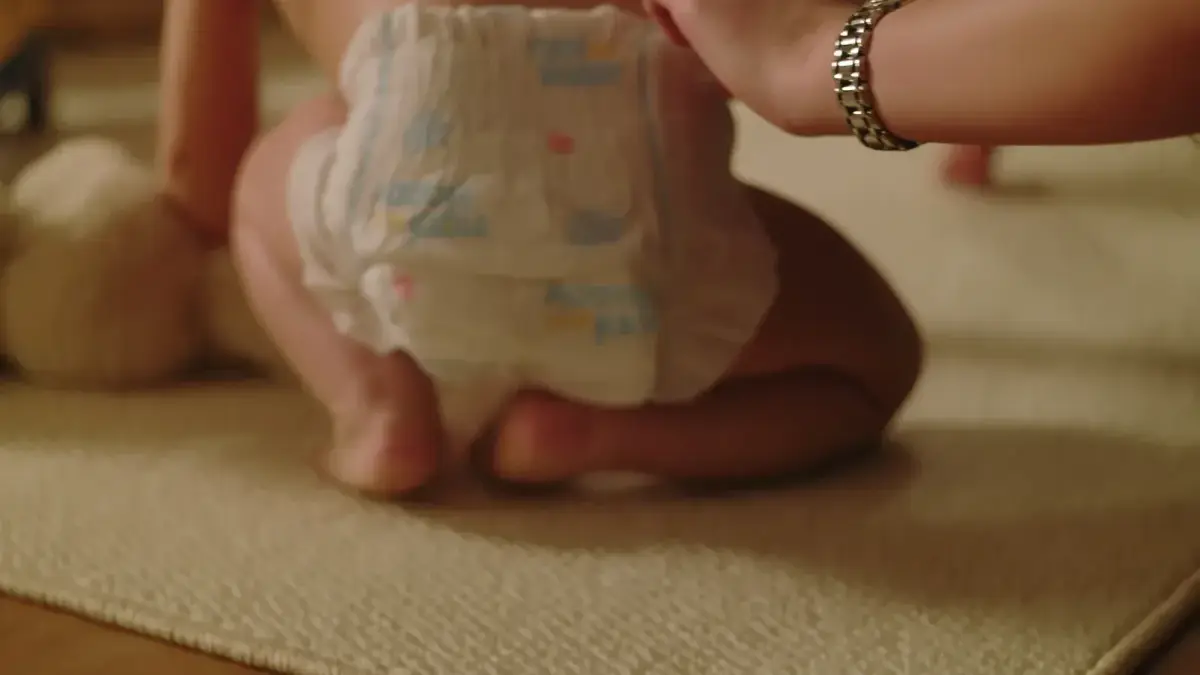
Note what is not on the list: the baby's age, and the number on the pack. Both are proxies. The signals are the evidence.
How many changes a day should staff quote?
Eight to ten in the first weeks, five to six from around six months, and four to five by the time a child is walking. That range is what converts a pack size into days of cover.
Run the arithmetic at the shelf, because it is the calculation that closes a sale. A pack of 60 pieces at six changes a day is 10 days of cover. A pack of 44 at eight changes a day is five and a half days, which is why a parent buying the smaller pack comes back twice as often and often feels the brand runs out too fast.
For a store, this is a stocking insight rather than a script. If the local customer base is mostly newborns, the smaller packs turn faster and the shelf should be deeper on them. If it is mostly toddlers, the opposite. The pack count per size is the same merchandising decision as the size mix, and it should be reviewed with the same cadence.
When should staff suggest pull up pants instead of tape diapers?
From around 9 kg, or as soon as the baby stands and resists lying down. Below that, a pull up pants costs more per piece and is harder to put on a baby who is lying still.
Tape diapers are faster on a lying baby and easier to adjust at the waist. Pull up pants win once the change becomes a wrestling match, and once the child is standing, because they go on like underwear. The crossover is behavioural, not weight-based, and staff should describe it that way: the weight is a rough guide and the behaviour is the trigger.
Price per piece matters here too. A pull up pants uses more material in the waistband and the side seams, so the piece price sits above the tape diaper of the same size. A parent who buys pants too early pays more for a product that is harder to use, which is the one combination that produces a complaint at the counter.
What should staff never promise at the shelf?
Three things: that a diaper will not leak, that it will cure a rash, and that one brand fits every baby. All three are outside the product's control and all three come back as a complaint.
Rash is the sensitive one. Staff can explain fit, absorbency and change frequency, and can point out that a wet or soiled diaper left on skin is the most common cause of irritation. They should not present any diaper as preventing or treating it. Where a parent describes broken skin, persistent redness or a rash that has lasted more than a few days, the answer is a clinician, not an aisle.
For stores that want this as a printed card, keep it to the size table, the three signals and the changes-per-day arithmetic. A laminated card at the shelf does more for reorder rate than a poster, because it answers the question the parent is actually asking. Our pull up pants range and tape diaper range list the size bands and pack counts staff can quote from, and retailers who want shelf support under a partner account can request it here.
Frequently asked questions
Should staff recommend by age or by weight?
By weight, always. Age is a conversation starter. Two babies of the same age can differ by 3 kg, which is a full size band, and the pack prints weight for exactly that reason.
What if the baby sits exactly on the boundary between two sizes?
Move up if the baby is at the top of the range and sleeping through the night, because night volume is higher. Stay in the smaller size if the fit is snug with no marks and no leaks, since a larger size gaps at the cuff.
How many diaper changes a day should staff mention?
Eight to ten in the first weeks, settling to five to six by six months. That number turns a pack count into days of cover, which is the figure a parent actually needs at the shelf.
When should staff suggest pull up pants instead of tape diapers?
From around 9 kg, or as soon as the baby stands and resists lying down. Below that, pants cost more per piece and are harder to put on a lying baby for no benefit.
Sources and further reading
- HealthyChildren.org (American Academy of Pediatrics, current): guidance on diaper changing frequency and newborn skin care for parents.
- World Health Organization (current): child growth standards, including the weight-for-age reference charts that size bands are set against.
- ISO/TC 6 (International Organization for Standardization): test methods for absorbent hygiene products behind the fit and absorbency claims printed on packs.
Bottom line
Size by weight, confirm by signal, and convert the pack into days of cover so the parent knows when to come back. Red marks, early leaks and gel lumps are the three signals worth teaching. Nothing at the shelf should promise a leak-free night or a rash-free baby, because neither is within the product's control.
Frequently Asked Questions
Should staff recommend by age or by weight?
By weight, always. Age is only useful as a conversation starter. Two babies of the same age can differ by 3 kg, which is a full size band, and the pack prints weight for exactly that reason.
What if the baby sits exactly on the boundary between two sizes?
Move up if the baby is at the top of the range and sleeping through the night, because night volume is higher and a bigger core holds it. Stay in the smaller size if the fit is snug at the leg but there are no marks and no leaks, since a larger size gaps at the cuff.
How many diaper changes a day should staff mention?
Eight to ten in the first weeks, settling to five to six by six months. That number is what turns a pack count into a days-of-cover figure, and it is the calculation a parent actually needs at the shelf.
When should staff suggest pull up pants instead of tape diapers?
From around 9 kg, or as soon as the baby stands and resists lying down for a change. Below that, a pull up pants is harder to get on a lying baby and costs more per piece for no benefit.
