
2026-09-08 · Moni Happy Mom
Baby Nasal Congestion: Safe Ways to Clear a Stuffy Nose — A Mom's Guide

There's nothing quite like the sound of a congested baby struggling to breathe through a stuffy nose at 2 a.m. My first baby got her first cold at 3 months, and I was completely unprepared for how helpless I'd feel — she couldn't breathe through her nose, she couldn't nurse properly, and she was miserable. I spent that first night Googling "how to clear baby nose" at 3 a.m., and by morning I had a whole arsenal of tools and techniques. Over three kids and countless colds, I've learned what actually works for clearing a baby's stuffy nose safely — and what to avoid. Here's my practical guide to baby nasal congestion, from a mom who's been there (many, many times).
Why Do Babies Get Stuffy Noses?
Nasal congestion in babies is extremely common, especially in the first year of life. Babies are obligate nose breathers — they primarily breathe through their noses, especially during feeding — so even mild congestion can be more bothersome for them than for older children or adults. Common causes include:
- Common cold viruses: The most common cause of nasal congestion in babies. There are over 200 viruses that can cause the common cold, and babies are exposed to them frequently, especially if they're in daycare or have older siblings. Most babies get 6-8 colds in their first year.
- Dry air: Dry air (from air conditioning, heating, or dry climates) can irritate the delicate nasal passages and cause the mucus to thicken, leading to congestion. This is especially common during winter months when indoor heating dries out the air.
- Allergies: While less common in babies under 6 months, allergies to dust mites, pet dander, mold, or pollen can cause nasal congestion. If congestion is persistent (lasting more than 2-3 weeks) and not accompanied by other cold symptoms, allergies may be the cause.
- Irritants: Smoke, strong odors, perfume, dust, and air pollution can irritate a baby's nasal passages and cause congestion. Secondhand smoke is particularly harmful and should be avoided entirely.
- Normal newborn congestion: Many newborns have mild nasal congestion in the first few weeks of life, sometimes called "newborn rhinitis." This is usually due to the baby's nasal passages being very small and still adjusting to breathing air, and it typically resolves on its own within a few weeks.
- Teething: Some babies experience mild nasal congestion or a runny nose during teething, though the connection isn't fully understood. The congestion from teething is usually mild and not accompanied by other cold symptoms.
Safe Ways to Clear Your Baby's Stuffy Nose
Babies can't blow their own noses, so they need our help to clear congestion. Here are the safe, effective methods that our pediatrician recommended and that worked for us:
1. Saline Spray or Drops
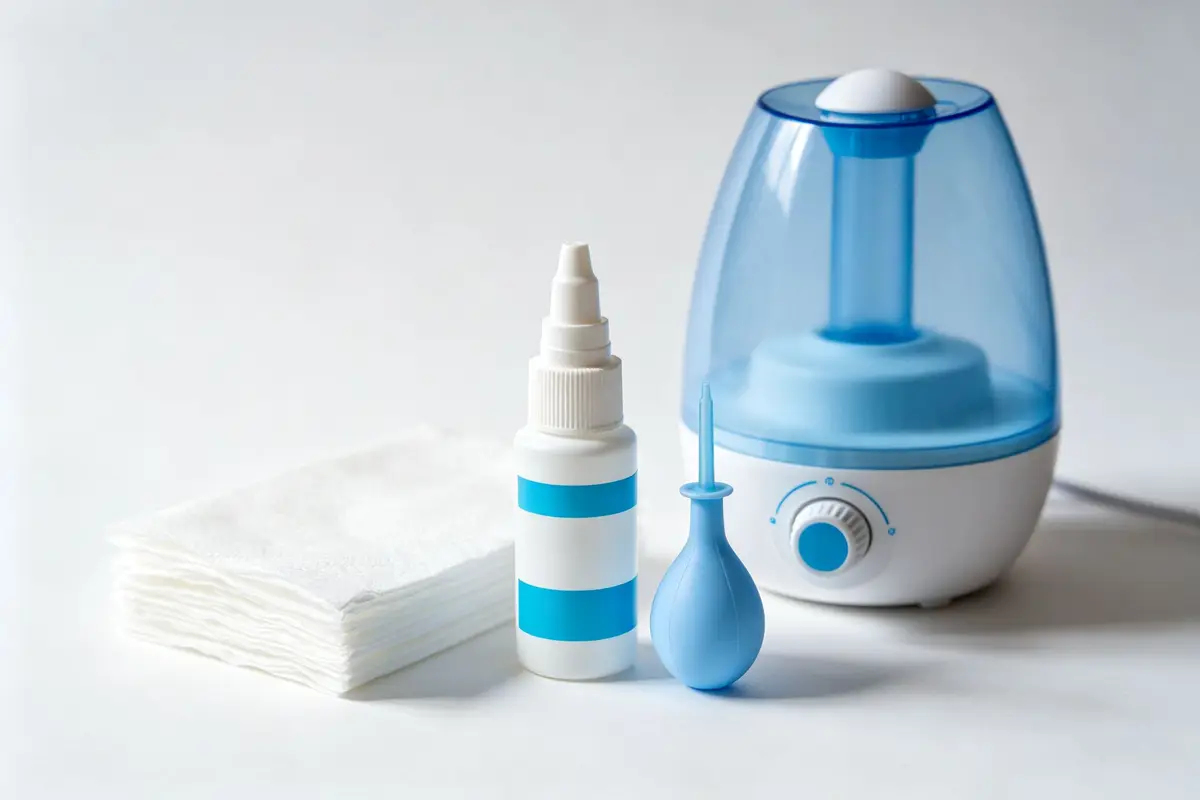
Saline (salt water) spray or drops are the first line of defense for baby nasal congestion. They work by thinning and loosening the mucus, making it easier to remove — either with a bulb syringe or by the baby sneezing it out. Saline is safe for babies of all ages, including newborns, and has no side effects. To use: lay your baby on their back, put 2-3 drops of saline in each nostril, wait 30-60 seconds for the mucus to loosen, then remove the mucus with a bulb syringe (or let the baby sneeze it out). We did this before every feeding and before bedtime, because a clear nose makes feeding and sleeping much easier. We kept a small bottle of saline spray in the diaper bag, the nursery, and the living room — you'll use it more than you think.
2. Bulb Syringe (Aspirator)
A bulb syringe is a rubber bulb with a thin plastic tip that you use to suction mucus out of your baby's nose. It's the classic tool that comes in most baby healthcare kits, and it works well when used correctly. To use: squeeze the air out of the bulb first (before putting it in the nose), gently insert the tip into one nostril (don't go too deep — just past the opening), slowly release the bulb to suction out the mucus, remove the tip, and squeeze the bulb into a tissue to expel the mucus. Repeat on the other nostril. It's best to use saline drops first to loosen the mucus, which makes suctioning more effective and less irritating. Clean the bulb syringe after each use by drawing up warm soapy water and rinsing it thoroughly. We found that doing this after saline drops, before feeds and bedtime, made a noticeable difference in our baby's comfort. Some parents prefer nasal aspirators with a mouth tube (like the NoseFrida), which some find more effective and easier to control — both work, it's a matter of personal preference.
3. Humidifier
A cool-mist humidifier in your baby's room adds moisture to the air, which can help soothe irritated nasal passages and thin mucus, making congestion more comfortable. Cool-mist humidifiers are recommended over warm-mist (steam) humidifiers for babies because there's no risk of burns from hot steam. Use distilled or demineralized water (not tap water, which can contain minerals that get released into the air as white dust) and clean the humidifier daily according to the manufacturer's instructions to prevent mold and bacteria growth. We ran the humidifier in our baby's room every night during cold season, and it seemed to help her breathe more comfortably. We also found that a steamy bathroom — running a hot shower and sitting in the bathroom with the baby for 10-15 minutes — could provide temporary relief, especially before bedtime.
4. Elevate the Head of the Crib
Elevating the head of your baby's crib slightly can help mucus drain and reduce congestion while sleeping. The safest way to do this is to place a rolled-up towel or blanket under the mattress (not under the baby, and not using a pillow) at the head end of the crib, creating a slight incline. Make sure the incline is gentle — no more than 15 degrees — and that the mattress is flat and secure. Never use pillows, wedges, or positioners in the crib, as these increase the risk of SIDS and suffocation. We tried this with our first baby and it seemed to help slightly, though the effect was modest. It's worth trying as part of a comprehensive approach, but don't expect it to be a magic solution.
5. Keep Your Baby Hydrated
Staying hydrated helps thin mucus and keeps the nasal passages moist. For breastfed and formula-fed babies under 6 months, continue offering breast milk or formula frequently — they get all the hydration they need from milk. For babies over 6 months, you can also offer small amounts of water in a sippy cup. If your baby is congested and having trouble feeding (because they can't breathe through their nose while nursing or bottle-feeding), try clearing their nose with saline and suction right before a feed, and offer smaller, more frequent feeds to compensate. We found that clearing the nose right before feeding made a huge difference in how much our baby could eat without getting frustrated.
What NOT to Do
- Do not use over-the-counter cold or cough medications for babies under 4 years old — the FDA and pediatricians strongly advise against them, as they can have serious side effects and have not been shown to be effective in young children.
- Do not use medicated nasal sprays (like decongestant sprays) for babies — these can cause rebound congestion and other side effects. Only use plain saline spray.
- Do not put anything larger than a bulb syringe or saline drops in your baby's nose — no cotton swabs, no fingers, no tweezers. You can damage the delicate nasal lining or push mucus deeper.
- Do not use a warm-mist (steam) humidifier in a baby's room — risk of burns. Use a cool-mist humidifier instead.
- Do not use Vicks VapoRub or similar mentholated rubs on babies under 2 years old — they can irritate the airways and cause breathing problems. For babies over 2, use only the baby-specific formulation and apply it to the chest (not the face or nose), as directed.
- Do not give honey to babies under 1 year old — risk of botulism. (This is a general baby safety rule, but worth repeating since some home remedies for congestion involve honey.)
When Should I Call the Pediatrician?
Most cases of baby nasal congestion are caused by the common cold and resolve on their own within 7-10 days. However, you should contact your pediatrician if:
- Your baby is under 3 months old and has congestion or any signs of illness (babies this young are at higher risk for complications, and any illness should be evaluated)
- Congestion lasts more than 10-14 days without improvement (could be allergies, a sinus infection, or another condition)
- Your baby has a fever (100.4°F / 38°C or higher for babies under 3 months, or 102°F / 39°C or higher for babies 3-6 months)
- Your baby is having difficulty breathing — signs include flaring nostrils, pulling in at the chest or ribs with each breath, rapid breathing, grunting, or a bluish tint around the lips or fingernails (seek emergency care immediately for these signs)
- Your baby is not eating or drinking, is showing signs of dehydration (fewer wet diapers, dry mouth, no tears, lethargy), or is unusually fussy or difficult to console
- The mucus is thick, yellow or green, and accompanied by fever or facial pain (could indicate a bacterial sinus infection)
- There is blood in the mucus (usually from irritation, but should be evaluated if persistent or significant)
- You suspect the congestion is due to allergies or an irritant, and it's not improving with removal of the suspected trigger
With our second baby, we called the pediatrician when her congestion lasted almost three weeks and was accompanied by a persistent low-grade fever — it turned out to be a sinus infection that required antibiotics. It's always better to have it checked out if something seems off or lasts longer than expected. Trust your instincts as a parent — you know your baby best, and if something doesn't seem right, don't hesitate to call.
Frequently Asked Questions
How can I clear my newborn's stuffy nose safely?
For newborns, the safest and most effective method is saline drops followed by gentle suction with a bulb syringe. Put 2-3 drops of plain saline (not medicated) in each nostril, wait 30 seconds, then use a bulb syringe (squeezed first, then gently inserted just past the nostril opening and slowly released) to suction out the loosened mucus. Do this before feeds and bedtime. A cool-mist humidifier in the room can also help. Never use over-the-counter cold meds, medicated nasal sprays, or cotton swabs in a newborn's nose. If your newborn is under 3 months and has congestion, contact your pediatrician — young infants should be evaluated for any illness.
How often can I use saline spray on my baby?
Saline spray is safe to use as often as needed — there's no risk of side effects or rebound congestion with plain saline. Most parents use it 3-4 times a day (before feeds and bedtime), but you can use it more frequently if your baby is very congested. The key is to use it before suctioning, because it loosens the mucus and makes suctioning more effective and less irritating. If your baby's nasal passages become irritated or dry from frequent suctioning, you can reduce the frequency of suctioning while continuing to use saline, which helps keep the passages moist.
Is a NoseFrida or bulb syringe better for baby congestion?
Both the NoseFrida (a mouth-powered nasal aspirator) and the traditional bulb syringe are effective for clearing baby nasal congestion, and which one is "better" is largely a matter of personal preference. The NoseFrida is popular because many parents find it more effective (you control the suction with your mouth), easier to clean, and less likely to irritate the baby's nose. The bulb syringe is simpler, more portable, and doesn't require mouth contact. Some parents find the idea of the NoseFrida off-putting (though it has a filter that prevents mucus from reaching your mouth), while others swear by it. We used both — the bulb syringe for quick, on-the-go use and the NoseFrida for more thorough clearing at home. Both work well when used correctly with saline drops first.
Can a stuffy nose cause my baby to stop breathing?
A stuffy nose alone does not cause a baby to stop breathing, but it can make breathing more difficult, especially during feeding and sleeping, because babies are primarily nose breathers. In rare cases, severe congestion can interfere with breathing, especially in very young infants or babies with underlying respiratory conditions. Signs that your baby is having difficulty breathing include: flaring nostrils, pulling in at the chest or ribs with each breath (retractions), rapid breathing (more than 60 breaths per minute for a newborn), grunting with each breath, or a bluish tint around the lips or fingernails. If you see any of these signs, seek emergency care immediately. For most babies, congestion is uncomfortable but not dangerous, and can be managed with saline, suction, humidification, and time.
Article Summary
Baby nasal congestion is extremely common, especially in the first year, and is most often caused by common cold viruses, dry air, or irritants. Since babies are obligate nose breathers, congestion can interfere with feeding and sleeping, making it distressing for both baby and parents. Safe, effective remedies include saline spray or drops (to loosen mucus), bulb syringe or NoseFrida suction (to remove mucus), a cool-mist humidifier (to add moisture to the air), gentle elevation of the crib mattress, and keeping the baby hydrated. Over-the-counter cold medications, medicated nasal sprays, cotton swabs, warm-mist humidifiers, and mentholated rubs should be avoided in babies. Contact your pediatrician for congestion in babies under 3 months, congestion lasting more than 10-14 days, fever, difficulty breathing, poor feeding, dehydration, or other concerning symptoms. With patience, gentle care, and the right tools, most babies recover from congestion within a week or two.