
2026-09-07 · Moni Happy Mom
Baby Sign Language: Teaching First Signs & Communication Guide

I'll never forget the day my 9-month-old looked at me, made the sign for "more," and then pointed at the banana on her tray. I was blown away — she couldn't talk yet, but she could tell me exactly what she wanted. That was my introduction to baby sign language, and it completely changed how I communicated with my babies. If you've ever felt frustrated trying to figure out what your crying baby wants, baby sign language might be the game-changer you're looking for. Here's what I've learned from teaching all three of my babies basic signs.
What Is Baby Sign Language?
Baby sign language is the practice of teaching pre-verbal babies and toddlers simple hand gestures (usually adapted from American Sign Language, or ASL) to communicate their needs and wants before they can speak. It's important to note that baby sign language is not the same as full ASL — you're teaching a handful of useful, everyday signs, not a complete language. The goal is to bridge the communication gap between when babies understand language (around 6-8 months) and when they can produce spoken words (usually 12-18 months).
Research has shown that babies who learn sign language often: communicate earlier and with less frustration, have stronger parent-child bonding, develop spoken language at the same time or slightly earlier than non-signing babies, and may even have a slight advantage in cognitive development. A 2000 study by researchers at UC Davis found that babies who were taught sign language had higher verbal scores at age 3 than their non-signing peers. But honestly, the biggest benefit for me was simpler: fewer tantrums because my baby could tell me what she wanted instead of crying in frustration.
When Should I Start Teaching Signs?
You can start modeling signs for your baby as early as 6-8 months, but most babies won't be able to produce signs themselves until around 8-12 months. Every baby is different — my first baby started signing "more" at 9 months, my second at 11 months, and my third didn't really get into it until 13 months. The key is to start early, be consistent, and not get discouraged if your baby doesn't sign back right away. They're absorbing everything even if they're not producing signs yet.
A good timeline to keep in mind:
- 6-8 months: Start modeling 3-5 basic signs during daily routines. Your baby will watch and absorb but probably won't sign back yet.
- 8-12 months: Many babies start producing their first signs around this age, especially "more," "milk," and "all done."
- 12-18 months: As your baby's fine motor skills develop, they'll be able to produce more signs. This is also when spoken words start to emerge, and many babies will use signs and words together.
- 18-24 months: As spoken language becomes more dominant, many babies naturally drop signs as they learn to say the words. This is normal and expected — the signs have served their purpose.
Which Signs Should I Start With?
Start with just 3-5 signs that are relevant to your baby's daily life. Trying to teach too many signs at once can be overwhelming for both you and your baby. Here are the signs I found most useful with all three of my babies:
- Milk: Make a fist with one hand, then open and close it (like squeezing a cow's udder). This is usually one of the first signs babies learn because it's associated with something they want frequently.
- More: Touch the tips of your fingers together on both hands, then bring them apart and together again (like clapping with flat hands). This is probably the most useful sign — babies use it for more food, more play, more of anything they enjoy.
- All done / finished: Hold both hands up, palms facing out, and twist them back and forth (like you're waving both hands). This sign is incredibly helpful for knowing when your baby is finished eating, so you don't have to guess whether they're full or just taking a break.
- Eat / food: Bring your fingertips to your mouth (like you're putting food in your mouth). This is useful for communicating hunger or asking if they want a snack.
- Water: Make a "W" shape with three fingers and tap it to your chin. This is useful once your baby starts drinking water.
- Help: Place one open hand on the palm of the other hand and lift both up. This is great for when your baby wants help reaching a toy or getting into a chair.
- Hurt / pain: Point to the area that hurts with both index fingers. This is incredibly useful once your baby is mobile and can get bumps and bruises — they can tell you where it hurts instead of just crying.
- Please / thank you: "Please" is a flat hand on the chest moving in a circle; "thank you" is a flat hand touching the chin and moving forward. These are nice to model early for manners, though they may not be produced until later.
I recommend starting with "milk," "more," and "all done" — these three signs alone will dramatically reduce frustration at mealtime. Once your baby masters those, you can gradually add more signs based on what's relevant to your daily routine.
How Do I Teach My Baby Signs?
Teaching baby sign language is simpler than you might think — it's really about consistency and repetition. Here's what worked for me:
- Model the sign every time you say the word. Whenever you say "milk," make the sign for milk. Whenever you say "more," make the sign for more. Consistency is key — your baby needs to see the sign paired with the word many times before they'll make the connection.
- Use signs during daily routines. The best time to teach signs is during natural, repeated activities — feeding, bath time, diaper changes, playtime. For example, make the "milk" sign every time you offer the breast or bottle, make the "bath" sign before getting in the tub, and make the "all done" sign when you finish a meal or activity.
- Get down to your baby's level. Make sure your baby can see your hands when you're signing. Sit facing them, hold your hands at chest level, and make the signs clearly and slowly.
- Respond immediately when your baby signs. When your baby makes a sign (even an approximation), respond right away — if they sign "more," give them more; if they sign "all done," end the activity. This positive reinforcement teaches them that signing is an effective way to communicate, which encourages them to keep signing.
- Don't correct or force. When your baby first starts signing, their signs will be rough approximations — don't worry about perfect form. Acknowledge and respond to any attempt. You can model the correct sign gently, but don't make it a lesson or correct them in a way that discourages them.
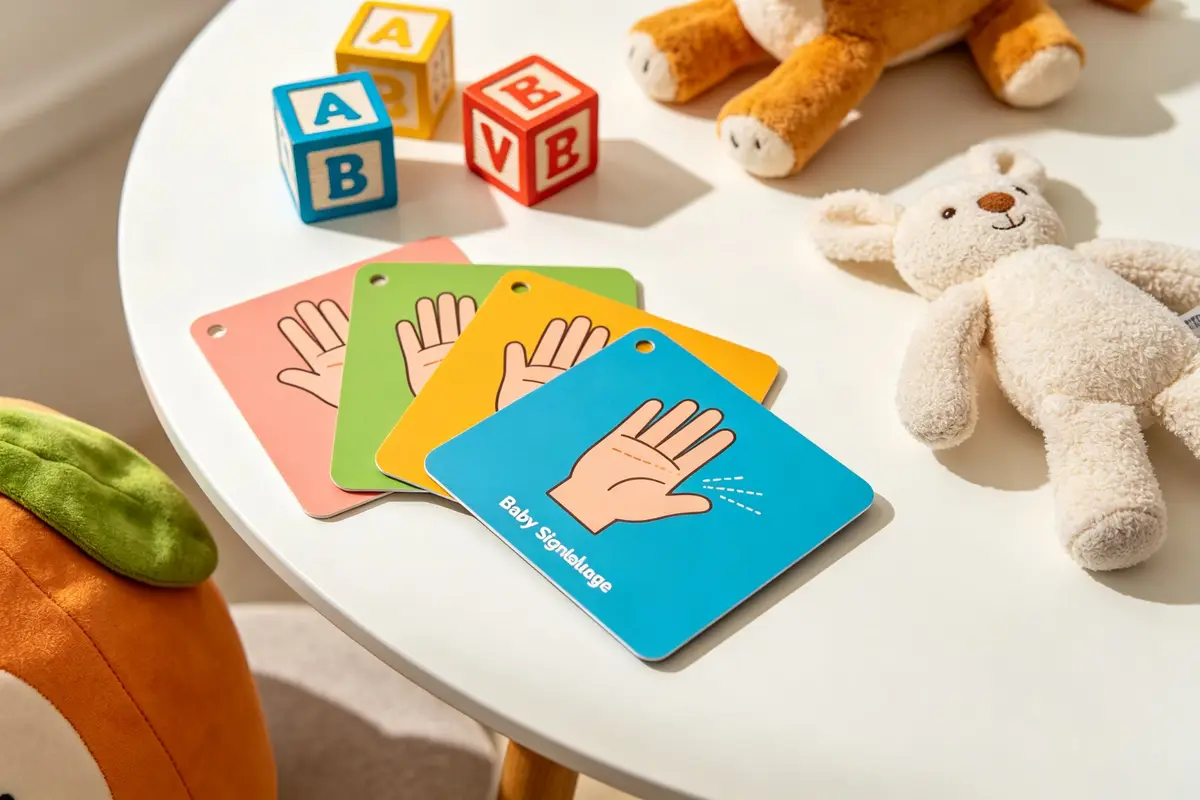
- Involve the whole family. Make sure partners, siblings, grandparents, and caregivers know the signs and use them consistently. The more people who sign with your baby, the faster they'll learn. We kept a small set of sign language flashcards on the fridge so everyone could reference them.
Common Concerns About Baby Sign Language
As a mom, I had my share of concerns before I started teaching signs. Here are the most common ones I hear from other parents, and what I've learned:
- "Will signing delay my baby's speech?" This is the most common concern, and the research consistently says no — babies who learn sign language typically start speaking at the same time or slightly earlier than non-signing babies. Signing actually encourages language development because it gives babies a way to communicate, which motivates them to keep trying. As spoken words emerge, most babies naturally transition to words and drop the signs.
- "My baby isn't signing back — am I doing something wrong?" Probably not. Every baby learns at their own pace, and it can take weeks or even months of consistent modeling before a baby produces their first sign. Keep modeling consistently, and don't give up. My third baby took almost three months of modeling before she signed back, and then suddenly she was signing five different signs in one week.
- "Do I need to learn full ASL?" No. Baby sign language uses a small subset of ASL signs for everyday communication. You don't need to learn grammar, sentence structure, or hundreds of signs — just the 10-20 signs that are relevant to your baby's daily life. There are many great books, apps, and online videos that teach the basic baby signs.
- "Is baby sign language only for hearing babies?" Baby sign language is beneficial for all babies, including hearing babies, hard-of-hearing babies, and babies with communication delays. For hearing babies, it's a temporary communication bridge; for deaf or hard-of-hearing babies, sign language is a primary language. If you have concerns about your baby's hearing or development, talk to your pediatrician.
Frequently Asked Questions
What age should I start baby sign language?
You can start modeling signs for your baby as early as 6-8 months, though most babies won't produce signs themselves until 8-12 months. Start with just 3-5 basic signs (milk, more, all done) during daily routines like feeding. Be consistent and patient — it can take weeks or months of modeling before your baby signs back. The earlier you start, the earlier they'll typically begin signing, but it's never too late to start — even toddlers can benefit from learning signs.
Does baby sign language delay speech?
No, research consistently shows that baby sign language does not delay speech development. In fact, babies who learn sign language often develop spoken language at the same time or slightly earlier than non-signing babies, and may have slightly larger vocabularies. Signing gives babies a way to communicate before they can speak, which reduces frustration and motivates them to keep communicating. As spoken words emerge, most babies naturally transition to words and drop the signs.
What are the most useful first signs to teach?
Start with 3-5 signs that are relevant to daily routines: "milk" (open and close a fist), "more" (touch fingertips together and apart), "all done" (hold hands up and twist), "eat/food" (bring fingertips to mouth), and "water" (tap a W-shape to the chin). "More" and "all done" are particularly useful at mealtime — they dramatically reduce frustration because your baby can tell you whether they want more food or are finished. Once your baby masters these, gradually add signs like "help," "hurt," "please," and "thank you."
How long does it take for a baby to learn signs?
Every baby is different, but most babies take 2-8 weeks of consistent modeling before they produce their first sign. Some babies pick it up faster, others take longer — my first baby signed at 9 months, my second at 11 months, and my third at 13 months. The key is consistency: model the sign every time you say the word, during daily routines, and respond immediately when your baby attempts a sign. Don't get discouraged if it takes time — they're absorbing everything even if they're not signing back yet.
Article Summary
Baby sign language is a simple, effective way to communicate with pre-verbal babies, reducing frustration and strengthening the parent-child bond. Start modeling 3-5 basic signs (milk, more, all done) around 6-8 months during daily routines, and most babies will begin signing back between 8-12 months. Teaching is straightforward: model consistently, get down to baby's level, respond immediately to signing attempts, and involve the whole family. Research shows signing does not delay speech — in fact, it may support language development. As spoken words emerge, most babies naturally transition to words, making sign language a temporary but valuable communication bridge.